

Canada and India at a crossroads
Advertisement
Read this article for free:
or
Already have an account? Log in here »
To continue reading, please subscribe:

Digital Subscription
One year of digital access for only $205*
- Enjoy unlimited reading on winnipegfreepress.com
- Read the E-Edition, our digital replica newspaper
- Access News Break, our award-winning app
- Play interactive puzzles
*First annual payment billed as $205.00 + GST for one year. This annual subscription will automatically renew at $233.00 + GST every 52 weeks (10% off the regular annual price of $259.35). Offer available to new and qualified returning subscribers only. Cancel any time.
To continue reading, please subscribe:
Add Free Press access to your Brandon Sun subscription for only an additional
$1 for the first 4 weeks*
- Enjoy unlimited reading on winnipegfreepress.com
- Read the E-Edition, our digital replica newspaper
- Access News Break, our award-winning app
- Play interactive puzzles
*Your next Brandon Sun subscription payment will increase by $1.00 and you will be charged $17.95 plus GST for four weeks. After four weeks, your payment will increase to $24.95 plus GST every four weeks.
Read unlimited articles for free today:
or
Already have an account? Log in here »
Hey there, time traveller!
This article was published 04/10/2023 (1075 days ago), so information in it may no longer be current.
The last time Canadian diplomacy made world headlines, Lester Pearson cooled the hot war at the Suez Canal in 1957 and earned the Nobel Peace Prize.
Sure, there were spats with the Soviet Union during the Cold War, leading to the occasional removal of diplomats over spying allegations, but these disputes were usually swept under the diplomatic carpet with rare moments of government efficiency.
Those days of quiet Canadian diplomacy are over, owing to the June 18 slaying of Hardeep Singh Nijjar, a 45-year-old Sikh-Canadian. Video shows he had been gunned down in his truck outside a gurdwara, a place of worship, by a group of masked people in Surrey, B.C.
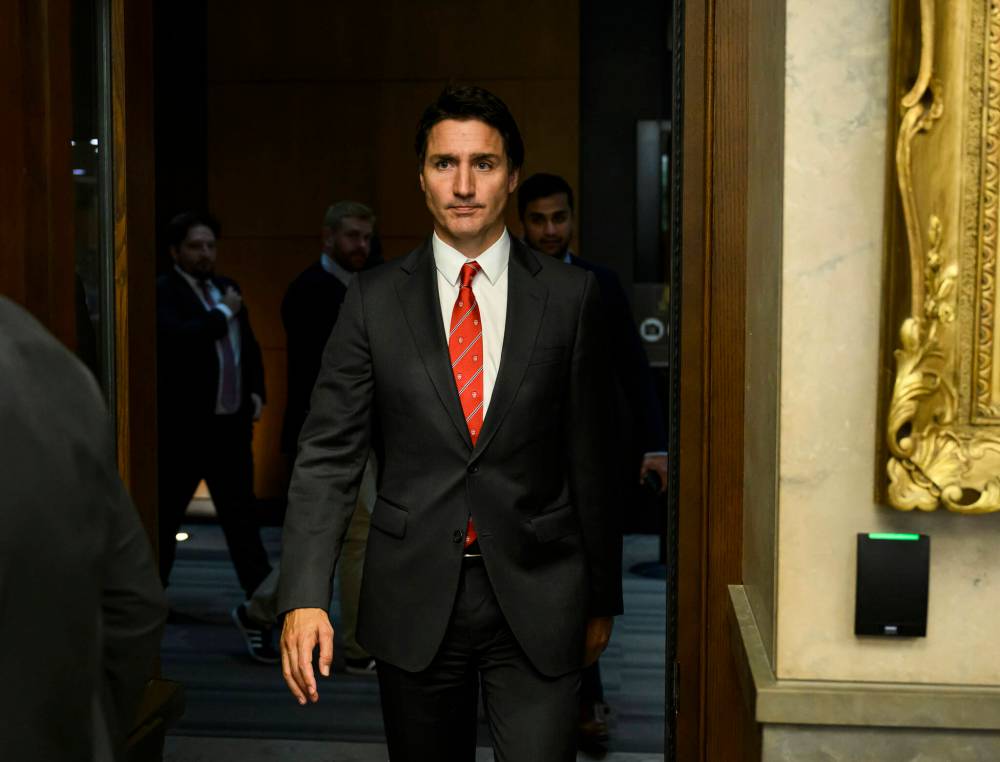
Justin Tang / Canadian Press files
Prime Minister Justin Trudeau leaves the House of Commons on Parliament Hill in Ottawa, after making a statement that Canadian authorities had intelligence that India was responsible for the June fatal shooting of a prominent Sikh leader in Surrey, B.C.
Prime Minister Justin Trudeau basically accused India being behind Nijjar’s killing in Parliament Sept. 18, saying Canadian agencies were “pursuing credible allegations of a potential link between agents of the government of India and the killing of a Canadian citizen.”
The Indian government, which had issued an arrest warrant against Nijjar for advocating for a separate Sikh state, Khalistan, in India’s Punjab region, called Trudeau’s accusations “absurd” and politically motivated.
India also accused Canada of harbouring Khalistani terrorists and extremists who threaten its sovereignty.
Trudeau had raised the matter with Indian Prime Minister Narendra Modi Sept. 10 at the G20 summit in New Delhi, and a government release stated Trudeau “raised the importance of respecting the rule of law, democratic principles and national sovereignty.”
Canada also expelled the head of India’s foreign intelligence service in Canada, and in a tit-for-tat move, India has told a Canadian diplomat to pack his bags and leave. Tuesday, India told the Canadian government that 41 of its 62 remaining diplomats had to leave.
Nijjar was the president of the gurdwara where he was killed, and many of his fellow followers believe foreign interference was involved because of his efforts on behalf of the Khalistan movement, which is outlawed in India.
The worsening relations between the two democratic, Commonwealth countries has left countries allied with both Canada and India in an uncomfortable position.
India has 1.4 billion people, making it a focus for countries’ exports, including goods from Canada, and as a bulwark against China’s growing influence in the Asia-Pacific region.
India has built up relations with the United States, and in June they formed a new partnership that will deepen economic and defence ties.
The U.S. expressed concern about Nijjar’s slaying after Trudeau’s speech in Parliament and asked the Indian government to co-operate with Canada’s investigation.
Diplomacy is a trickier endeavour than it was during the Cold War, when foreign relations with allies and belligerents was easier to understand for those not privy to back-channel negotiations and global power politics.

India is not just an important trade partner, it is the homeland for about two million Indo-Canadians, including about 770,000 Sikhs.
India has suspended the issuance of visas to Canadian travellers and Ottawa has warned Canadians about travel to India, especially to Punjab, where the Golden Temple of Amritsar, one of Sikhism’s most sacred gurdwaras, is located.
Trudeau has many detractors within Canada, judging by his latest approval ratings, but his relations with other countries, most notably China, have also become more rocky since he took over as prime minister in 2015
Trudeau was correct to mention Nijjar’s killing and to defend Canada’s sovereignty when speaking with Modi.
He must also carefully weigh his diplomatic tone because Canada can rarely, if ever, use the second half of the famous foreign-policy advice — “Speak softly and carry a big stick.” — Theodore Roosevelt created for the U.S. in the early 1900s.