

BoC should consider who inflation hurts most
Advertisement
Read this article for free:
or
Already have an account? Log in here »
To continue reading, please subscribe:

Digital Subscription
One year of digital access for only $205*
- Enjoy unlimited reading on winnipegfreepress.com
- Read the E-Edition, our digital replica newspaper
- Access News Break, our award-winning app
- Play interactive puzzles
*First annual payment billed as $205.00 + GST for one year. This annual subscription will automatically renew at $233.00 + GST every 52 weeks (10% off the regular annual price of $259.35). Offer available to new and qualified returning subscribers only. Cancel any time.
To continue reading, please subscribe:
Add Free Press access to your Brandon Sun subscription for only an additional
$1 for the first 4 weeks*
- Enjoy unlimited reading on winnipegfreepress.com
- Read the E-Edition, our digital replica newspaper
- Access News Break, our award-winning app
- Play interactive puzzles
*Your next Brandon Sun subscription payment will increase by $1.00 and you will be charged $17.95 plus GST for four weeks. After four weeks, your payment will increase to $24.95 plus GST every four weeks.
Read unlimited articles for free today:
or
Already have an account? Log in here »
Hey there, time traveller!
This article was published 21/12/2023 (960 days ago), so information in it may no longer be current.
Canada’s inflation rate remained steady in November. It is now very close to the Bank of Canada’s target range of one to three per cent. However, Canadians should not expect interest rates to come down any time soon in response to easing prices.
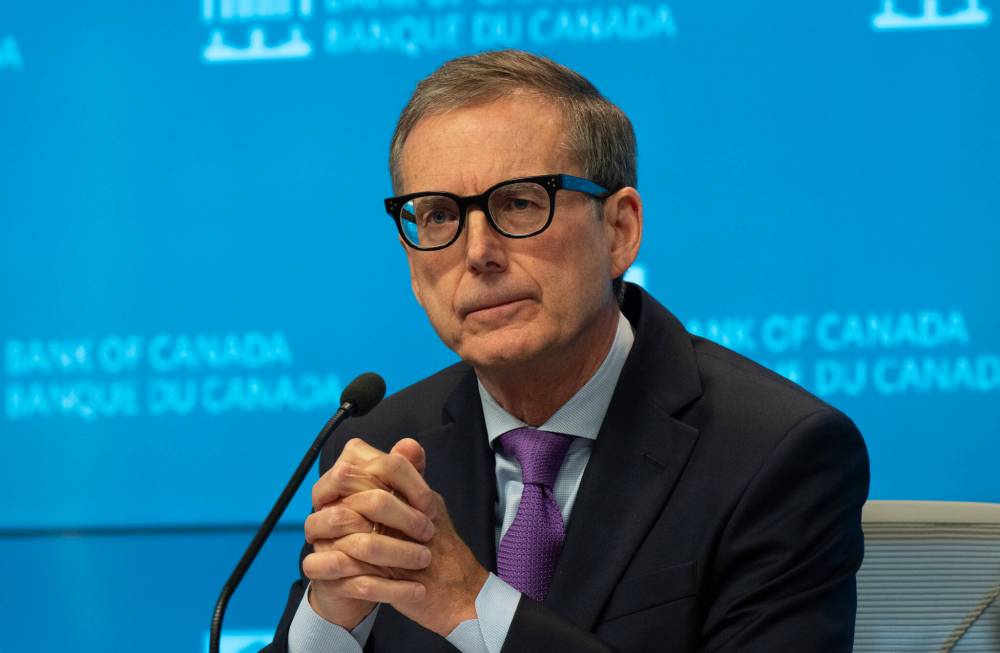
Bank of Canada Governor Tiff Macklem poured cold water last week on any hope of lower rates in early 2024, saying it would be premature to declare victory against price inflation.
“I know it’s tempting to rush ahead to that discussion,” Mr. Macklem said last week during his final public speech of 2023. “But it’s still too early to consider cutting our policy rate.”
According to Statistics Canada, the consumer price index remained at 3.1 per cent in November, unchanged from October. Analysts expected CPI to edge down slightly last month to just under three per cent. But higher-than-expected travel tour costs kept overall prices elevated. Mortgage and interest costs also rose by almost 30 per cent last month year-over-year and rent increased by 7.4 per cent.
Still, grocery prices continued to grow at a slower pace in November for the fifth consecutive month. Energy prices fell 5.7 per cent in November, led by lower fuel costs, which saw a decline of 23.6 per cent. And cellular phone services were down nearly 23 per cent in November year-over-year.
The Bank of Canada has held its key interest rate at a 22-year high of five per cent through its last three rate decisions. But now that inflation is almost within the central bank’s target range of one to three per cent (two per cent being the key benchmark), some analysts are predicting rates could fall as early as the summer of 2024.
That would offer much-needed relief to Canadians struggling with high borrowing costs. The central bank has kept interest rates high to slow economic growth, reduce demand for goods and services and ultimately bring down consumer prices. It is a blunt but effective instrument used by central banks throughout the world to control inflation.
However, the downside is it disproportionately harms lower-income Canadians. High interest rates drive up unemployment and make it more expensive to borrow money, including for mortgages and lines of credit. Lower income people have less financial flexibility, or none at all, to absorb those costs. They bear the greatest brunt of the central bank’s monetary policy.
It is something the Bank of Canada should give greater weight to when deciding when to start cutting interest rates.

The macro-economic theory behind monetary policy to control price inflation is not in question. It works, although even Mr. Macklem acknowledged in his speech there are other supply-side factors the bank must examine more closely in the future when deciding how to control inflation.
What is often overlooked, or minimized, is the impact high interest rates have on lower-income Canadians.
High inflation also disproportionately impacts the least wealthy. Soaring prices for non-discretionary items such as food and shelter have left many Canadians struggling to survive. The question is not whether the central bank should do everything in its power to maintain price stability, but how it can be done to better protect lower-income Canadians.
The Bank of Canada should do a better job of balancing those competing interests.
When it decides in the coming months when, or if, to start cutting interest rates, it should give greater consideration to the proportion of society that has been paying the highest price to control inflation.
History
Updated on Thursday, December 21, 2023 6:28 AM CST: Fixes byline