

Planning ahead to prevent collisions
Advertisement
Read this article for free:
or
Already have an account? Log in here »
To continue reading, please subscribe:

Digital Subscription
One year of digital access for only $205*
- Enjoy unlimited reading on winnipegfreepress.com
- Read the E-Edition, our digital replica newspaper
- Access News Break, our award-winning app
- Play interactive puzzles
*First annual payment billed as $205.00 + GST for one year. This annual subscription will automatically renew at $233.00 + GST every 52 weeks (10% off the regular annual price of $259.35). Offer available to new and qualified returning subscribers only. Cancel any time.
To continue reading, please subscribe:
Add Free Press access to your Brandon Sun subscription for only an additional
$1 for the first 4 weeks*
- Enjoy unlimited reading on winnipegfreepress.com
- Read the E-Edition, our digital replica newspaper
- Access News Break, our award-winning app
- Play interactive puzzles
*Your next Brandon Sun subscription payment will increase by $1.00 and you will be charged $17.95 plus GST for four weeks. After four weeks, your payment will increase to $24.95 plus GST every four weeks.
Read unlimited articles for free today:
or
Already have an account? Log in here »
Hey there, time traveller!
This article was published 11/01/2024 (936 days ago), so information in it may no longer be current.
It’s tough to remember the crash at the Carberry exit on the Trans-Canada Highway without remembering the images that come with it.
Shot from above, there’s the great long half-moon scar of burned asphalt as the small passenger bus angled towards the ditch after impact.
The smashed red walker of one of the bus passengers, lying on its side with a fire truck out of focus in the background. The fading flowers of the roadside memorial.
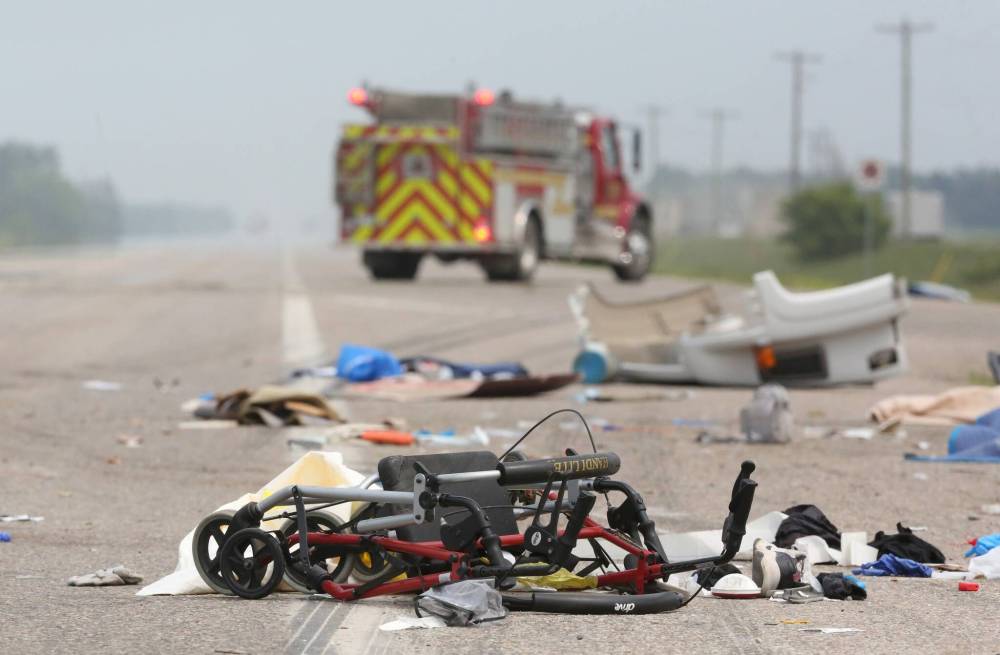
brandon sun Files
The aftermath of a tragic collision near Carberry on June 15, 2023.
Tougher still to drive by that exit without reflexively taking your foot off the accelerator and slowing down. It’s tough to forget that this is a place where danger is always present, however calm it looks now in its anonymous winter whites and beiges.
Because dangerous it is, and dangerous it will remain, at least to some degree.
High speed, driver inattention, and the road design itself are all risk factors that can’t be wished away.
In a way, a report on the Carberry crash prepared for the Manitoba government and released on Monday only confirmed what we already knew: that a right-angle, flat crossing of the Trans-Canada by a secondary highway is inherently dangerous. There have been collisions at the Carberry exit for years, and there have been collisions since the June crash that killed 17 people.
That danger is not restricted to the Carberry exit. Far from it.
Other similar Trans-Canada crossings have similar collision records, albeit not with the terrible toll of the June tragedy.
But there are solutions, at least to a degree.
The best solution for the Carberry exit is years, and millions of dollars, away.
Truth is, this week’s promise of a $100-million cloverleaf overpass 20 to 25 years from now is so far into the future that it isn’t really a promise at all. It’s more like a distant hope. Even if the wheels are set in motion, that solution is several provincial administrations away.
The shorter-term solution is what we should perhaps focus on: a $12-million reconstruction that will start in 2025 and be completed by 2026, a reconstruction that could still take several different forms, but is meant to make the intersection less confusing, complicated and dangerous for drivers trying to calculate the speeds and intentions of drivers coming towards them from several different directions. It will help, but it won’t remove all of the danger.
Danger that is, tragically, well known.
Police forces and other agencies regularly release information about the rates of collisions at particular intersections: some go as far as to make “Top 10” lists of their area’s most dangerous intersections.
Far more important than warning drivers of the mere numbers, though, is an examination of why those particular intersections are so dangerous, and what can be done to reduce the dangers.
That’s why a commitment from the Kinew government to establish a specialized safety unit to review highway safety in the province is such an important step.

Governments tend to be reactive, rather than proactive. Health care is the perfect example: governments spend far more time trying to fix problems in health care than to try to prevent them from occurring. But fixing established problems is really too late: people have already suffered and died.
Having a provincial team to identify dangerous spots in advance — and, more importantly, having a government willing to address those problems before there is a major collision — may not gain politicians even a single vote for its actions.
But it will save lives.
No one wants to see another Carberry. No one wants even one more road death or major injury.
Forewarned is forearmed. Let’s work on that forewarning, so Manitobans don’t find themselves facing forlorn instead.