

Trump’s Iowa win a glimpse into GOP’s intent
Advertisement
Read this article for free:
or
Already have an account? Log in here »
To continue reading, please subscribe:

Digital Subscription
One year of digital access for only $205*
- Enjoy unlimited reading on winnipegfreepress.com
- Read the E-Edition, our digital replica newspaper
- Access News Break, our award-winning app
- Play interactive puzzles
*First annual payment billed as $205.00 + GST for one year. This annual subscription will automatically renew at $233.00 + GST every 52 weeks (10% off the regular annual price of $259.35). Offer available to new and qualified returning subscribers only. Cancel any time.
To continue reading, please subscribe:
Add Free Press access to your Brandon Sun subscription for only an additional
$1 for the first 4 weeks*
- Enjoy unlimited reading on winnipegfreepress.com
- Read the E-Edition, our digital replica newspaper
- Access News Break, our award-winning app
- Play interactive puzzles
*Your next Brandon Sun subscription payment will increase by $1.00 and you will be charged $17.95 plus GST for four weeks. After four weeks, your payment will increase to $24.95 plus GST every four weeks.
Read unlimited articles for free today:
or
Already have an account? Log in here »
Hey there, time traveller!
This article was published 19/01/2024 (933 days ago), so information in it may no longer be current.
With the results of the Iowa caucuses now in hand, it appears the Republican Party’s process for choosing its 2024 presidential nominee is going exactly to plan.
If, that is, the plan involves the ultimate destruction of the Republican Party and, along with it, any lingering notion of traditional conservatism in American politics.
As was predicted by, well, everyone, Donald Trump was the landslide winner of the Iowa caucuses, the first of many steps in the GOP’s process for nominee selection. Trump garnered 51 per cent support among the roughly 100,000 Republicans who braved sub-zero temperatures to participate (compared to a turnout of 187,000 in 2016), far eclipsing the 21 per cent received by Florida Gov. Ron DeSantis and the 19 per cent mustered by former UN ambassador Nikki Haley.
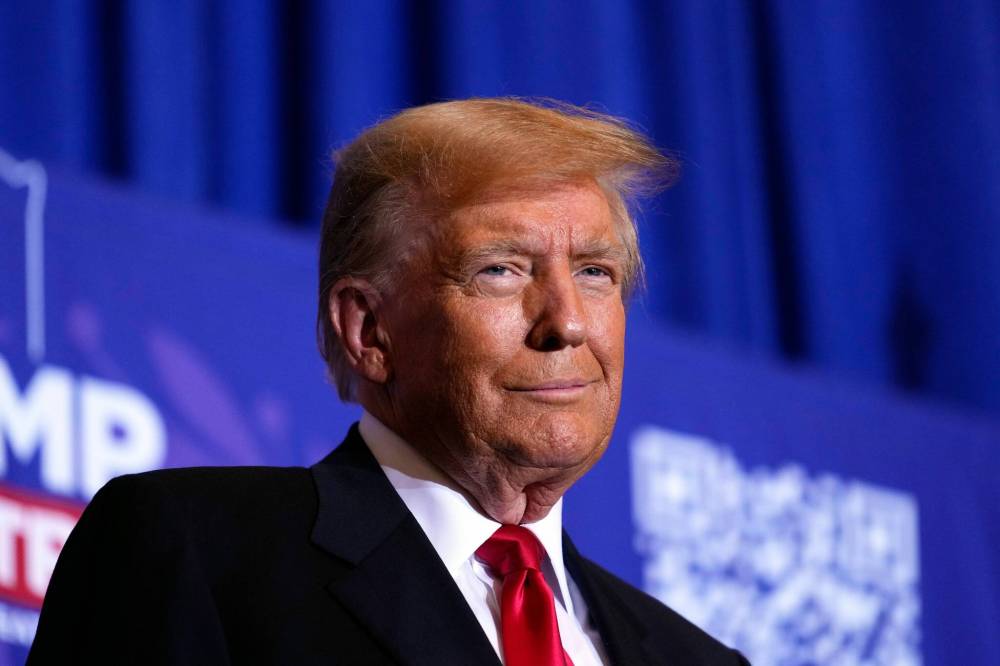
AP Photo/Matt Rourke
Republican presidential candidate former President Donald Trump speaks at a campaign event in Atkinson, N.H., Tuesday, Jan. 16, 2024.
While not a conclusive indicator of how the nationwide process will play out, the Iowa caucuses do offer meaningful insights into the GOP’s functional intentions. Like the Republican Party’s base, Iowa is predominantly rural, white, older and less inclined to be college educated; according to entry polling at caucus locations, fully three-quarters of caucusgoers were seeking to support a candidate who “shares my values” or “fights for people like me.”
For America’s chronically affronted right-of-centre demographic, Trump’s non-stop recitation of grievances, claims of victimhood and promises of post-election retribution against foes real and imagined seem to be hitting the right notes. In an era of online bunker-hunkering in which, for so many, the pursuit of plausible falsehood to reinforce personal resentments has supplanted any remaining desire for useful factual information, it’s hardly surprising that a significant slice of the American electorate favours an outraged narcissist as its preferred leader.
The fact Trump has little apparent interest in discussing actual political or policy issues — and to date has refused to even take part in Republican Party debates (at which the dwindling field of also-rans seems frightened to even mention his name) — appears to be having no impact on his supporters’ view that he is the only choice.
Despite being out of office since January 2021, Trump enjoys the decided advantage of campaigning as an incumbent. His rally-stop rehashing of continuously debunked claims of a stolen 2020 election resonates deeply with his supporters. In Iowa, entry polling suggested 65 per cent of Republican caucusgoers don’t believe President Joe Biden’s 2020 victory was legitimate; to them, Trump is the incumbent.
(This view is not a widely held; a November poll showed 61 per cent of Americans — including 93 per cent of Democrats, 63 per cent of independents and 28 per cent of Republicans — believe Biden fairly won).

Heading toward the Jan. 23 primary stop in New Hampshire, Trump — despite the numerous criminal and civil cases that are proceeding as he continues his quest for a White House return — remains a heavy favourite to carry the GOP standard against Biden this fall.
Which makes this an apt moment to revisit the comments of circa-2016 Lindsey Graham, before the South Carolina senator began his bizarre transformation from moderate conservative to seething Trump lapdog.
Asked, early on, about the erstwhile reality-TV star’s GOP-leadership ambitions, Graham described Trump as “a kook,” “crazy,” “unfit for office” and “a demagogue of the greatest proportion.”
“Donald Trump would be an absolute, utter disaster for the Republican Party, destroy conservatism as we know it,” Graham opined. “It would take generations to overcome a Trump candidacy.”
One can’t help thinking Graham, and other traditional Republicans currently cowering in Trump’s thrall, know deep down inside the observation holds true and the stakes for American democracy are even higher this time around.