

Learning by doing — and taking risks
Advertisement
Read this article for free:
or
Already have an account? Log in here »
To continue reading, please subscribe:
Monthly Digital Subscription
$1 per week for 24 weeks*
- Enjoy unlimited reading on winnipegfreepress.com
- Read the E-Edition, our digital replica newspaper
- Access News Break, our award-winning app
- Play interactive puzzles
*Billed as $4.00 plus GST every four weeks. After 24 weeks, price increases to the regular rate of $19.95 plus GST every four weeks. Offer available to new and qualified returning subscribers only. Cancel any time.
Monthly Digital Subscription
$4.99/week*
- Enjoy unlimited reading on winnipegfreepress.com
- Read the E-Edition, our digital replica newspaper
- Access News Break, our award-winning app
- Play interactive puzzles
*Billed as $19.95 plus GST every four weeks. Cancel any time.
To continue reading, please subscribe:
Add Free Press access to your Brandon Sun subscription for only an additional
$1 for the first 4 weeks*
*Your next subscription payment will increase by $1.00 and you will be charged $16.99 plus GST for four weeks. After four weeks, your payment will increase to $23.99 plus GST every four weeks.
Read unlimited articles for free today:
or
Already have an account? Log in here »
Hey there, time traveller!
This article was published 01/02/2024 (770 days ago), so information in it may no longer be current.
Pretty much everything we attempt in life involves some level of risk. And it’s in taking risks, and dealing with the failures that sometimes result, that we gain the knowledge, experience and confidence that contribute to whatever successes we eventually achieve.
Despite these obvious realities of the human experience, there has developed, in 21st-century society, an aversion to risk that is embodied in a style of parenting to which such descriptives as “helicopter” and “bubble-wrap” are commonly attached. That school of thought decrees little ones should be shielded from risk, protected from danger of any kind and steered instead toward activities that are sanitized, safe and devoid of any potential outcomes other than soft-cushioned shared success.
According to the Canadian Paediatric Society, this trend toward peril-averse parenting is doing a disservice to children, who would be better served by regular exposure to free-range play that involves at least some level of risk.
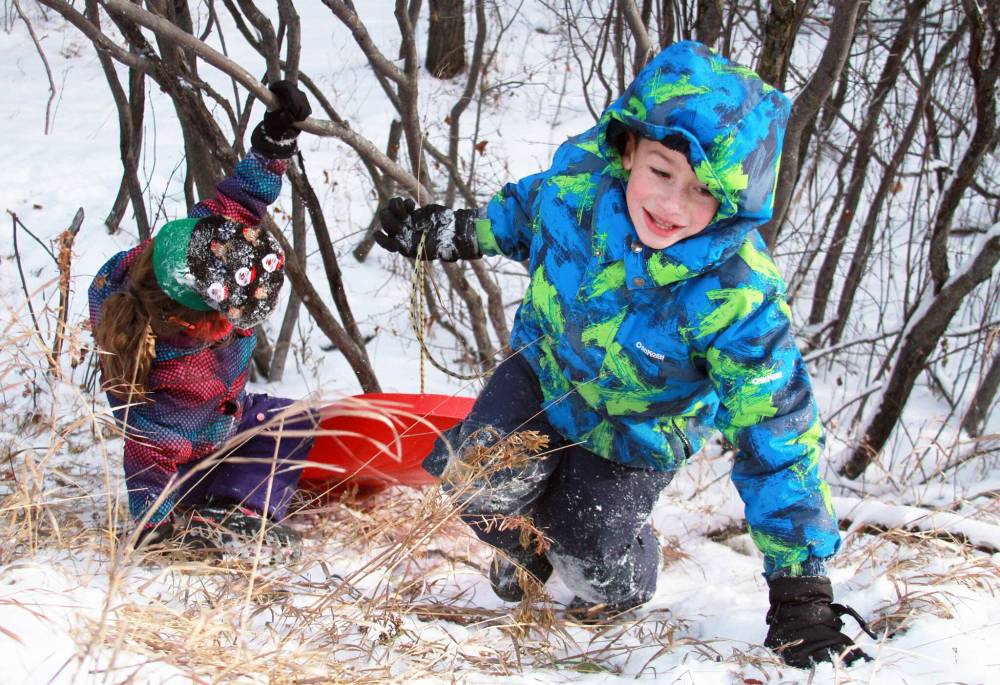
Brandon Sun files
Taking calculated risks has clear benefits for children.
A recently released report from the CPS recommends that kids be encouraged to engage in “unstructured outdoor play” and, in particular, “risky play” that it describes as “thrilling and exciting free play that involves uncertain outcomes and the possibility of physical injury.”
While it isn’t advocating for recklessness or exposing youngsters to unnecessarily hazardous situations, the organization says allowing risk to be present at playtime contributes to the physical, mental and social well-being of children who experience it.
It might cause palpitations in some parenting circles to learn the CPS’s recommended “thrilling” forms of free play fall into such categories as playing at height (climbing, jumping, balancing), playing at speed (fast running, biking, sliding, sledding), play involving tools (supervised use of knives, hammers, saws or ropes), play involving impacts (crashing into things), play involving potentially dangerous elements (in proximity to fire or water) and play (with limited supervision) with risk for disappearing or getting lost.
The argument — presented in apparent response to restrictive safety measures and mandates that have in recent years become commonplace in child-care settings, schools and playgrounds — is that when they’re allowed to play spontaneously in settings such as the ones described above, children might be inclined to push boundaries and test limits in a way that is exciting, challenging and ultimately beneficial.

The CPS does draw an important distinction between risk — situations in which a child can recognize and assess a challenge and decide on a response based on personal preference and perceived skill — and hazard — situations in which the potential for harm is beyond a child’s ability to recognize and appropriately address.
The report also points out what risky play is not: ignoring reasonable safety standards, leaving kids unsupervised in potentially dangerous situations or pushing youngsters to take risks beyond their comfort levels.
What makes the CPS report particularly interesting is that its discussion of the effects of free-range play — the risks, rewards, benefits and potential dangers — arrives at a time when perhaps the most threatening place a young person can be is indoors, seated in front of a computer monitor or gazing unsupervised at a tablet or smartphone screen.
The prospect of a skinned knee, a bloodied chin or even a fracture resulting from a fall pales in comparison to the sorts of peril kids can face from nefarious online actors who, shielded by anonymity and fuelled by malignant intent, seek to reach silently into our homes to deliver indescribable harms to those most in need of protection.
Stacked up against such constantly mutating menaces, what might result from running, tumbling, wielding a sharp tool or crashing into a fixed object doesn’t seem so risky after all. Much better, then, to let ‘em play.