

Choosing a clean water future
Advertisement
Read this article for free:
or
Already have an account? Log in here »
To continue reading, please subscribe:
Digital Subscription
One year of digital access for only $1.44 a week*
- Enjoy unlimited reading on winnipegfreepress.com
- Read the E-Edition, our digital replica newspaper
- Access News Break, our award-winning app
- Play interactive puzzles
*Billed as $5.77 plus GST every four weeks. After 52 weeks, price increases to the regular rate of $19.95 plus GST every four weeks. Offer available to new and qualified returning subscribers only. Cancel any time.
To continue reading, please subscribe:
Add Free Press access to your Brandon Sun subscription for only an additional
$1 for the first 4 weeks*
- Enjoy unlimited reading on winnipegfreepress.com
- Read the E-Edition, our digital replica newspaper
- Access News Break, our award-winning app
- Play interactive puzzles
*Your next Brandon Sun subscription payment will increase by $1.00 and you will be charged $17.95 plus GST for four weeks. After four weeks, your payment will increase to $24.95 plus GST every four weeks.
Read unlimited articles for free today:
or
Already have an account? Log in here »
Hey there, time traveller!
This article was published 22/02/2024 (827 days ago), so information in it may no longer be current.
Fifty or 100 years from now, it probably won’t matter to the residents of southeastern Manitoba whether the provincial government’s recent decision to reject an environmental-licence application for a sand-extraction mining project was based in science and reason or politics and posturing.
If they still have access to clean water, it’s entirely likely they won’t remember the decision at all. How it was made, and when, and why, will be immaterial. It might even strike them as curious that such a public conversation ever took place.
What will matter is the water. That it was ever at risk might seem absurd.
MIKE DEAL / FREE PRESS
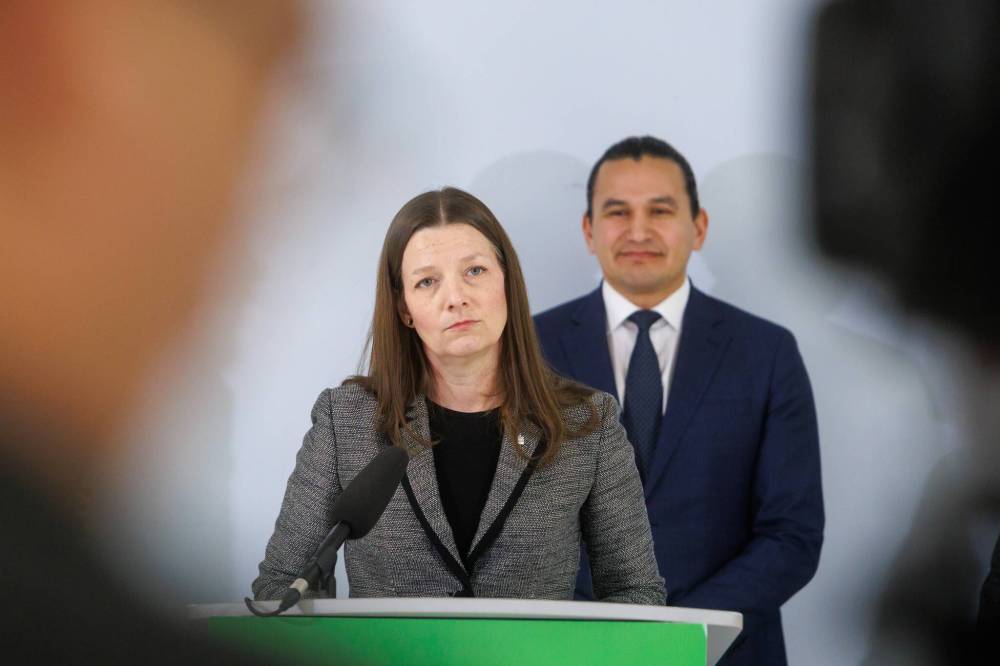
Environment and Climate Change Minister Tracy Schmidt and Premier Wab Kinew
The current reality, however, is that the NDP government’s rejection of the proposed sand-mining project by Alberta-based Sio Silica was anything but a sure thing. In fact, early comments from Premier Wab Kinew after being elected last fall suggested the newly installed government was giving strong consideration to approving the environmental licence, as it eventually did for another sand-mining project near Hollow Water First Nation on the eastern shore of Lake Winnipeg.
In the end, however, Kinew and Environment and Climate Change Minister Tracy Schmidt said no to Sio Silica, citing concerns that the safety of the aquifers in the affected region — home to some 100,000 Manitobans — could not be guaranteed.
Opponents of the project, which would have seen up to 7,200 extraction wells drilled in and around the Rural Municipality of Springfield over the next quarter-century, expressed gratitude that the government had listened to the scientific arguments and arrived at a sensible decision.
Sio Silica, not surprisingly, objected to the decision and claimed it was motivated by politics rather than scientific facts and an understanding of the potential economic benefits of the project.
“Sio remains hopeful that the government will be open to discussing solutions that are grounded in science and do not squander this multi-generational opportunity for the people of Manitoba,” the company said in a released statement.
The company’s response seems to ignore the possibility that the decision to deny an environmental licence could be both practical and political. In fact, the outcome of the Sio Silica saga was only ever going to be a combination of those two motivating forces.
On the practical side, the Clean Environment Commission last year issued a report concluding it could not state with confidence that the project’s potential environmental impacts had been fully considered or that there was an adequate plan to prevent and/or mitigate harm.

That was enough to prompt the previous Progressive Conservative government to hit pause on any licensing decisions regarding the project before last fall’s provincial election. Where politics made an unwelcome — and, some might argue, wholly unnecessary — intrusion into the discussion was after the election, when then-Economic Development Minister Jeff Wharton was accused of pressuring two cabinet colleagues to rush through approval of Sio Silica’s licence before the NDP government was sworn in — an allegation that was confirmed by the two former ministers in question.
Against such backdrop, politics was always going to be an element in whatever decision Kinew and company made regarding the Sio Silica proposal. But such a political inevitability in no way distracts from the fact the final verdict on Sio Silica was the correct one.
The project, which proposed drilling thousands of wells in southeastern Manitoba using techniques and technology frequently described as unproven, simply imposed too much risk on the water supply of a massive region of the province.
And that’s what it comes back to.
Fifty or 100 years from now, the presence or absence of politics in the decision-making won’t matter. The presence or absence of clean water, however, very much will.