

Isn’t nature wonderful — and also horrifying?
Advertisement
Read this article for free:
or
Already have an account? Log in here »
To continue reading, please subscribe:

Digital Subscription
One year of digital access for only $205*
- Enjoy unlimited reading on winnipegfreepress.com
- Read the E-Edition, our digital replica newspaper
- Access News Break, our award-winning app
- Play interactive puzzles
*First annual payment billed as $205.00 + GST for one year. This annual subscription will automatically renew at $233.00 + GST every 52 weeks (10% off the regular annual price of $259.35). Offer available to new and qualified returning subscribers only. Cancel any time.
To continue reading, please subscribe:
Add Free Press access to your Brandon Sun subscription for only an additional
$1 for the first 4 weeks*
- Enjoy unlimited reading on winnipegfreepress.com
- Read the E-Edition, our digital replica newspaper
- Access News Break, our award-winning app
- Play interactive puzzles
*Your next Brandon Sun subscription payment will increase by $1.00 and you will be charged $17.95 plus GST for four weeks. After four weeks, your payment will increase to $24.95 plus GST every four weeks.
Read unlimited articles for free today:
or
Already have an account? Log in here »
Hey there, time traveller!
This article was published 09/04/2024 (865 days ago), so information in it may no longer be current.
The hypersexual zombie cicadas are on the way.
Well, not exactly — they’re only going to arrive in Illinois and Georgia, along with other parts of the southeastern United States.
But it’s a fascinating thing.
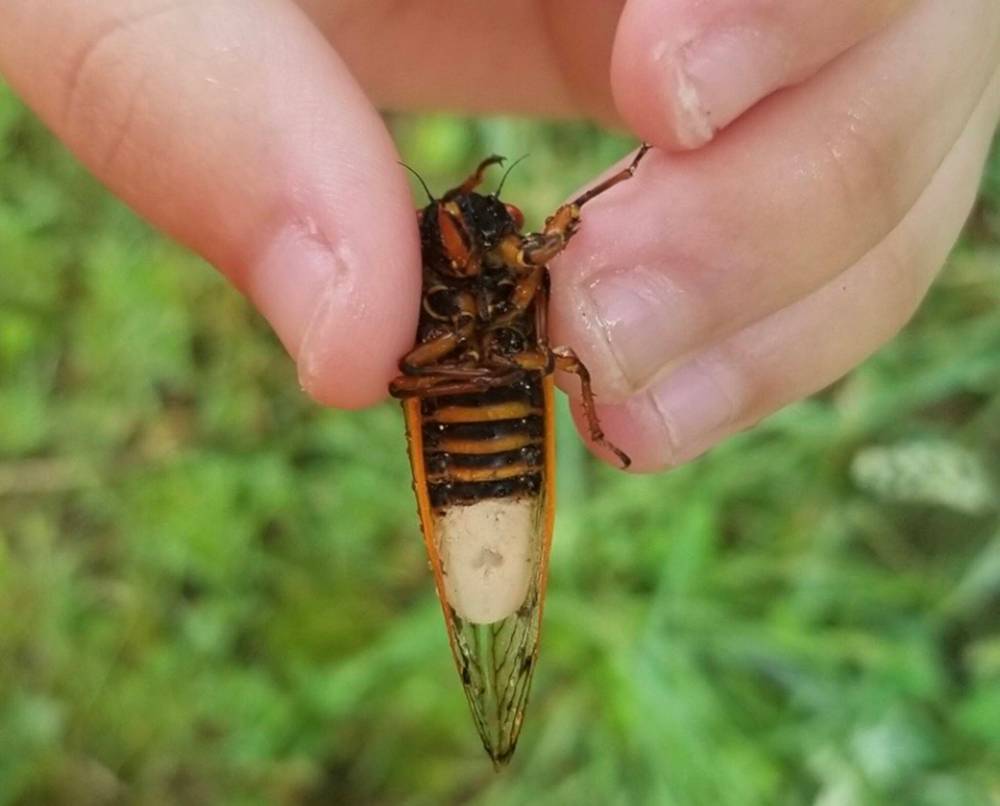
Angie Macias / WVU Photo
Millions of zombie cicadas are expected to invade the southeastern U.S.
Different broods of cicadas spend years underground before emerging and moulting into adults, and this year, Brood XIX, which appears every 13 years, and Brood XIII, which arrives every 17 years, are going to surface for a joint summertime eruption of performative noise leading to procreation.
Having two broods appear simultaneously as the soil warms — specifically to 18 C (64 F) — will mean a plethora of large and noisy bugs.
Concentrations of as much as a million per acre are expected — in all, hundreds of trillions (some scientists suggest quadrillions) of the insects, able to collectively make a sound louder than a jet engine.
With them will come the most curious of fungal predators: five per cent or more of the cicadas, either before or as they emerge, will pick up spores of a fungus called Massospora cicadina.
And then the fungus will take control.
The hows are not for the faint of heart.
The fungal infection replaces internal and sexual organs in the affected cicada with a white plug of fungus. (It actually makes the usual cicada body parts fall off.)
The infection also changes the cicada’s behaviour, making it both hypersexualized and able to attract mates of both sexes.
Apparently, the zombified cicada keeps going without its otherwise necessary parts because the fungus involved is also delivering a healthy dose of fungally manufactured amphetamine.
To recap, stoned hypersexual zombie cicadas.
The whole plan is to spread the fungus spores to even more cicadas as a form of sexually transmitted disease, and get those spores close to the eggs and larvae of the next generation of cicadas.
And, in 13 or 17 years from now, it all happens again.
This is not meant to suggest that we are all now facing an imminent fungal zombiehood of our own.
It’s more to point out that nature finds a way, and when something new and different comes along, humankind is often caught flat-footed.
It’s worth thinking about as scientists grapple with news from south of the border that a potentially serious bird flu, H5N1, has crossed the species barrier and has been found in cattle. The avian flu has already killed millions of birds, but has now infected cattle in 16 herds across six American states. (And not only cattle — one dairy worker as well, who is now recovering.)
Scientists say the risk to humans is currently low, but viruses such as H5N1 mutate quickly (as we’ve learned from multiple COVID mutations over the past few years) and the potential for a serious human form of the virus certainly exists.
The bottom line?

In the natural world, things change, sometimes quickly, and science can have a hard time keeping up.
It has an even harder time keeping up when it’s also trying to deal with the current western worldview where a good portion of the population seems to have decided to denigrate science, and virtually all other sorts of long-term expertise, in favour of internet information that, frankly, often runs no deeper than the latest gossip.
It’s almost certain that as the cicadas emerge from the ground, if they can be said to be expecting anything at all, that they’re expecting a short lifetime of calling or performing to find mates, followed by good clean procreatorial fun.
They almost certainly don’t imagine they could become zombie sex slaves for a parasitic fungus. (Nor, of course, do any of the rest of us.)
But they will be.