

The foundation for a future election
Advertisement
Read this article for free:
or
Already have an account? Log in here »
To continue reading, please subscribe:
Digital Subscription
One year of digital access for only $1.44 a week*
- Enjoy unlimited reading on winnipegfreepress.com
- Read the E-Edition, our digital replica newspaper
- Access News Break, our award-winning app
- Play interactive puzzles
*Billed as $5.77 plus GST every four weeks. After 52 weeks, price increases to the regular rate of $19.95 plus GST every four weeks. Offer available to new and qualified returning subscribers only. Cancel any time.
To continue reading, please subscribe:
Add Free Press access to your Brandon Sun subscription for only an additional
$1 for the first 4 weeks*
- Enjoy unlimited reading on winnipegfreepress.com
- Read the E-Edition, our digital replica newspaper
- Access News Break, our award-winning app
- Play interactive puzzles
*Your next Brandon Sun subscription payment will increase by $1.00 and you will be charged $17.95 plus GST for four weeks. After four weeks, your payment will increase to $24.95 plus GST every four weeks.
Read unlimited articles for free today:
or
Already have an account? Log in here »
Hey there, time traveller!
This article was published 18/04/2024 (921 days ago), so information in it may no longer be current.
In many ways, the latest federal budget looks a lot like a flock of chickens begging for any pot they can find to stuff themselves into.
There’s money for pretty much every topic raised and blamed on Prime Minister Justin Trudeau and his Liberal government of late, from housing shortages to bank fees to fighting car thefts and even the theft of catalytic converters.
And, as usual, the federal opposition parties oppose the spending and the size of this year’s federal deficit. Oppositions, well, oppose. Heaven forbid anything a government could suggest might actually be a solution for an existing problem.
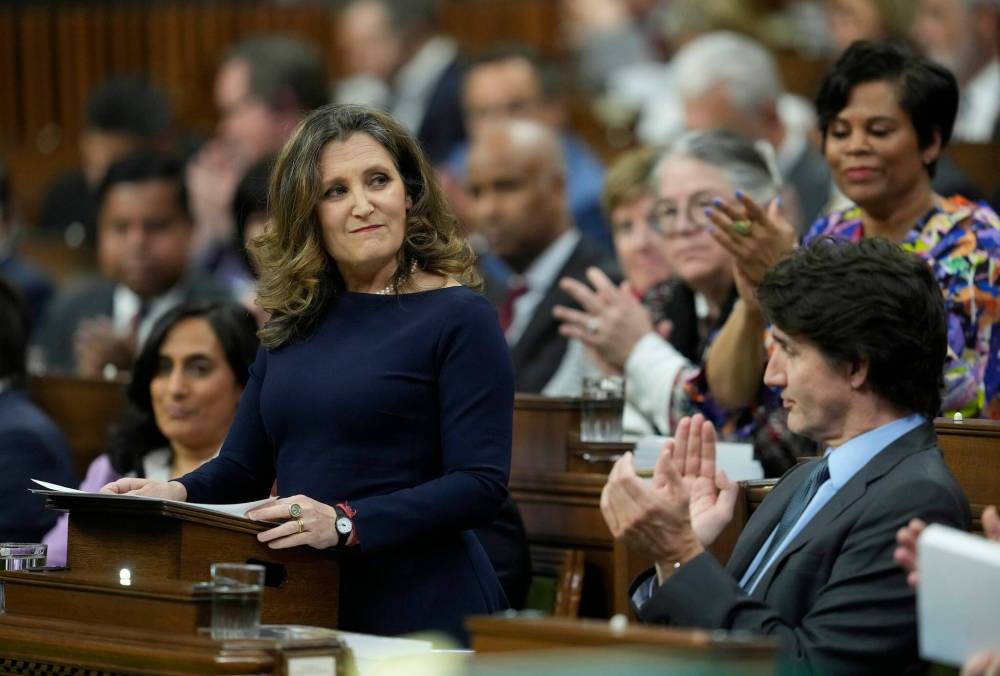
Adrian Wyld / THE CANADIAN PRESS FILES
Federal Finance Minister Chrystia Freeland
But back to chickens and pots.
The money to pay for all those chickens comes from a large deficit — $39.8 billion — and, significantly, a change to Canada’s capital gains tax, which is expected to raise $19 billion in the next five years.
Basically, the Liberals are changing a tax regime that allows 50 per cent of capital gains by corporations or trusts to be taxed as income, with the change meaning that 66 per cent of capital gains will be included as taxable income instead. For individuals, the capital gain has to be more than $250,000 before the new percentage kicks in.
The Liberals maintain that the new tax measures will affect just 0.13 per cent of Canadians, primarily those with an average annual income of $1.4 million or more. Here’s how it’s described in the budget documents: “Next year, 28.5 million Canadians are not expected to have any capital gains income, and three million are expected to earn capital gains below the $250,000 annual threshold … As a result of this, for 99.87 per cent of Canadians, personal income taxes on capital gains will not increase.”
The tax doesn’t include the capital gains from the appreciation of a primary home, gains in Tax-Free Savings Accounts, or Registered Retirement Savings Plans.
It’s hard to imagine that there will be much sympathy for the hard-done-by in that income range.
(One social media offering suggested how cruel the budget would be for parents wanting to hand their $800,000 summer cottage over to their children, who would then have to pay $277,000 of capital gains taxes. The numbers may or may not be right, but the quest for broad-based sympathy among average Canadians for that scenario is unlikely to gain much traction.)
The other part, one that may have federal Liberals giggling behind closed doors, is the question about how Pierre Poilievre’s Conservatives will stickhandle around trying to be the “common sense,” “common Canadian” party and not support taxing the wealthiest of Canadians.
If this was a decision being made by a publicly traded business, it’s the kind of trap that might be called a poison pill.

You can almost see the Liberal campaign ads coming, claiming the Conservatives want to keep money in the hands of Canada’s Weston grocery family.
The question is the degree to which the all-issues money-dumping and the strategic taxation of a segment of society many envy — or downright hate — will work.
Like many modern budgets, this year’s spending stretches far off into the future: many commitments include spending for five years down the road, which, in practical terms, is close to political fiction: the Trudeau administration has to call an election well before that.
And this budget? It might not be an election budget, per se.
But whether the Trudeau Liberals admit it or not, this budget is pretty clearly the foundation that an election campaign is about to be built on.