Poilievre’s pledge to scrap proposed act premature
Advertisement
Read this article for free:
or
Already have an account? Log in here »
To continue reading, please subscribe:

Digital Subscription
One year of digital access for only $205*
- Enjoy unlimited reading on winnipegfreepress.com
- Read the E-Edition, our digital replica newspaper
- Access News Break, our award-winning app
- Play interactive puzzles
*First annual payment billed as $205.00 + GST for one year. This annual subscription will automatically renew at $233.00 + GST every 52 weeks (10% off the regular annual price of $259.35). Offer available to new and qualified returning subscribers only. Cancel any time.
To continue reading, please subscribe:
Add Free Press access to your Brandon Sun subscription for only an additional
$1 for the first 4 weeks*
- Enjoy unlimited reading on winnipegfreepress.com
- Read the E-Edition, our digital replica newspaper
- Access News Break, our award-winning app
- Play interactive puzzles
*Your next Brandon Sun subscription payment will increase by $1.00 and you will be charged $17.95 plus GST for four weeks. After four weeks, your payment will increase to $24.95 plus GST every four weeks.
Read unlimited articles for free today:
or
Already have an account? Log in here »
Hey there, time traveller!
This article was published 10/07/2024 (824 days ago), so information in it may no longer be current.
Last week, Conservative Party Leader Pierre Poilievre vowed that should the Liberals’ proposed Online Harms Act pass into law, and should Canadians elect his party to form government, he would repeal the act.
There is nothing unusual with a new government looking over the plans of its predecessor and making cuts or even repealing laws (or trying to do so). However, should the Online Harms Act pass, getting rid of it would be short-sighted.
Put succinctly, the act aims to take stronger action against what has become an increasingly dangerous and vitriolic online world, particularly for minors. Passage of the bill would lead to a new regulatory framework tackling content which sexually victimizes children, or intimate content which is posted without consent, as well as measures to tackle and punish online hate. It would also establish an ombudsperson tasked with advocating for the public interest on the subject of online safety.
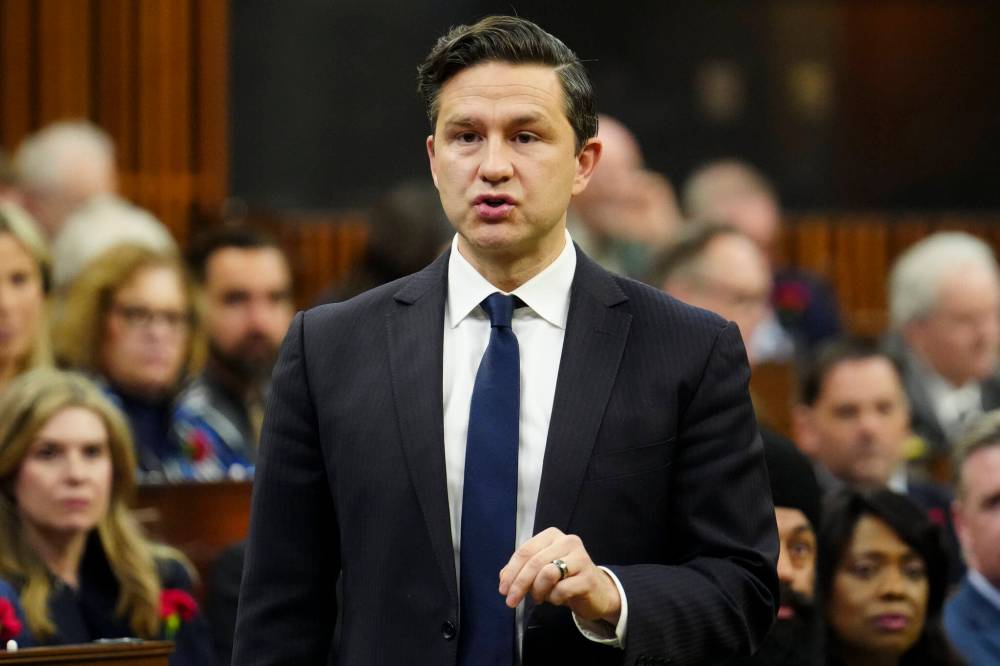
Sean Kilpatrick / Canadian Press Files
Conservative Leader Pierre Poilievre
Poilievre and other Conservative MPs point to the expense and the added bureaucracy as points against the act. (They have also suggested the act is part of a broader censorship scheme, but let us focus on the fiscal element.) On the same day he vowed to repeal, according to the Canadian Press, the parliamentary budget officer pegged the cost of setting up the new regulators at $200 million over five years. Eliminating bureaucracy in the name of cost savings and smaller government is well within the austere wheelhouse of any conservative leader, so Poilievre’s reaction is to be expected.
However, he might do well to resist that impulse.
Many of the issues the act seeks to address have been problems for the entire history of the internet as a public realm. But while the act isn’t exactly ahead of the curve, it is pretty well-timed for the internet as it currently exists — in the time of social media, the noxious element which has always been part of the internet is growing and rising to the surface ever more quickly. Children, who typically spend a great deal of time online, are arguably at greater risk than ever before of sexual exploitation, cyberbullying and online hate. Something has to be done, and the act takes aim at dealing with the most urgent issues.
In the current era of partisan politics, Poilievre and others should recognize it is important to recognize a good idea when it comes along, whoever might pitch it.
And this is still just an idea — the act has not passed and the regulators have not been established. Given its unrealized state, Poilievre’s dismissal is premature.

A spokesman for Poilievre said a “common sense Conservative government” would repeal the act. Well, let’s take a look at the situation, and determine the good sense of such a pledge.
According to Statistics Canada, between 2014 and 2022 there were 15,630 incidents of police-reported online sexual offences against children, and 45,816 online incidents of child pornography. The overall rate of police-reported online child sexual exploitation incidents in Canada has risen to 160 incidents per 100,000 children between 2014 and 2022 — a 217 per cent increase.
There were 219 reported online hate crime incidents in 2022, up from 92 four years prior. Of those cyber-related hate crimes, 82 per cent were violent.
These are growing problems that are too big for individual services that have so far failed somewhat spectacularly to self-monitor. Mitigating these harms will take a comprehensive, countrywide effort, with legitimate power to enforce. The proposed online harms act pledges to offer just that.
It seems like common sense to give it a chance to succeed.