

Looking to the courts for climate help
Advertisement
Read this article for free:
or
Already have an account? Log in here »
To continue reading, please subscribe:

Digital Subscription
One year of digital access for only $205*
- Enjoy unlimited reading on winnipegfreepress.com
- Read the E-Edition, our digital replica newspaper
- Access News Break, our award-winning app
- Play interactive puzzles
*First annual payment billed as $205.00 + GST for one year. This annual subscription will automatically renew at $233.00 + GST every 52 weeks (10% off the regular annual price of $259.35). Offer available to new and qualified returning subscribers only. Cancel any time.
To continue reading, please subscribe:
Add Free Press access to your Brandon Sun subscription for only an additional
$1 for the first 4 weeks*
- Enjoy unlimited reading on winnipegfreepress.com
- Read the E-Edition, our digital replica newspaper
- Access News Break, our award-winning app
- Play interactive puzzles
*Your next Brandon Sun subscription payment will increase by $1.00 and you will be charged $17.95 plus GST for four weeks. After four weeks, your payment will increase to $24.95 plus GST every four weeks.
Read unlimited articles for free today:
or
Already have an account? Log in here »
Hey there, time traveller!
This article was published 26/09/2024 (676 days ago), so information in it may no longer be current.
Seeing limited success elsewhere, advocates for better climate policy are turning to the courts.
Last week, the Manitoba Southern Chiefs’ Organization filed suit in Court of King’s Bench to have Lake Winnipeg declared a person with constitutional rights, just as a human being would have.
The statement of claim points to many of the vast lake’s woes: declining populations of fish, birds and other wildlife; increasing difficulty in sourcing traditional foods and medicines around the lake; and the arrival of invasive species such as zebra mussels.
The Canadian Press
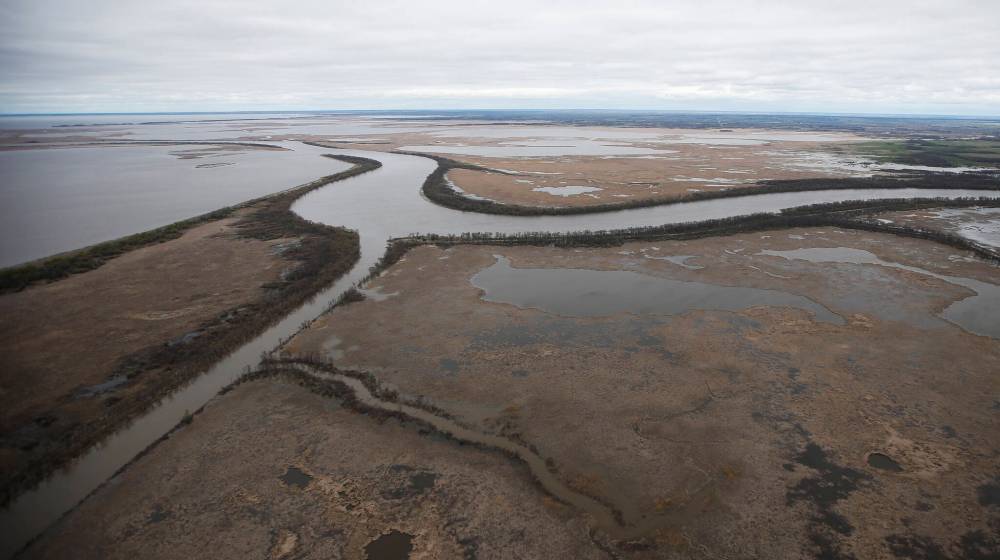
Netley Creek and the Red River enter Lake Winnipeg just north of Winnipeg.
The lawsuit refers to Anishinaabemowin terms used for the lake in 2024: moowaakamiim (“the water is full of feces”), for example.
Not a great descriptor for one of the world’s largest lakes, and one of such importance to Manitoba.
The lawsuit isn’t entirely without merit. Corporations, which are considerably less alive than a lake teeming with everything from fish to micro-organisms, are recognized as persons by the courts.
There have been other cases. Personhood has been claimed for two rivers in Canada. But beyond even the issue of personhood for bodies of water, it’s not the first time the courts have been used to make a point about governments’ need to take decisive action on climate change and its effects on our environment.
In April, a group of elderly Swiss women won a major victory at the European Court of Human Rights, to which they launched a case claiming that the Swiss government’s failures to combat global warming jeopardized their human rights. In 2019, Sophia Mathur, then only 12 years old, sued the Ontario government for weakening the province’s climate targets.
Writing for the Ecojustice environmental law charity backing her and other youths, Mathur voiced her frustrations with having to be as active on the climate front as she had been.
“I shouldn’t have had to become Canada’s first youth climate striker because in a rich country like Canada, with all our technological capability and access to the best science, governments should be doing much more than they are to lower emissions,” she wrote. “And I shouldn’t have to take our own government to court to defend our right to a safe and healthy climate environment.”
Quite right. But Mathur’s fight goes on: while in her decision Justice Marie-Andrée Vermette agreed with some of the claims in the suit, it was ultimately dismissed in April 2023. Mathur and her representatives filed an appeal, which was heard in January.

From the young to the old, it is becoming increasingly clear just how much we are all affected by an increasingly volatile, harsh climate.
For those who question that, this past summer wracked up $7 billion in insured losses from severe weather events, the highest ever and 10 times the average losses between 2001 and 2010.
Whether it be concerns that our dotage will be hard to suffer under increasing heat and wildfire risk, or that our adulthoods will be marred in myriad ways, we all stand to lose out if serious action is not taken immediately. One would think this would be equally clear to governing politicians, who also live on this planet, and yet it continues to be a struggle to get everyone on the same page.
So it falls to people, or advocacy groups, or even government bodies such as the Southern Chiefs’ Organization, to put the matter before a judge, in hopes of a ruling that the people setting our climate policy are, in fact, dropping the ball.
And further still, in the hopes that the consequences of those rulings might actually force some meaningful change in how those leaders care for our environment going forward.
Advertisement Advertise With Us
Advertisement Advertise With Us