

Pope Francis — a consistent voice for the poor
Advertisement
Read this article for free:
or
Already have an account? Log in here »
To continue reading, please subscribe:

Digital Subscription
One year of digital access for only $205*
- Enjoy unlimited reading on winnipegfreepress.com
- Read the E-Edition, our digital replica newspaper
- Access News Break, our award-winning app
- Play interactive puzzles
*First annual payment billed as $205.00 + GST for one year. This annual subscription will automatically renew at $233.00 + GST every 52 weeks (10% off the regular annual price of $259.35). Offer available to new and qualified returning subscribers only. Cancel any time.
To continue reading, please subscribe:
Add Free Press access to your Brandon Sun subscription for only an additional
$1 for the first 4 weeks*
- Enjoy unlimited reading on winnipegfreepress.com
- Read the E-Edition, our digital replica newspaper
- Access News Break, our award-winning app
- Play interactive puzzles
*Your next Brandon Sun subscription payment will increase by $1.00 and you will be charged $17.95 plus GST for four weeks. After four weeks, your payment will increase to $24.95 plus GST every four weeks.
Read unlimited articles for free today:
or
Already have an account? Log in here »
Hey there, time traveller!
This article was published 22/04/2025 (488 days ago), so information in it may no longer be current.
With the death of Pope Francis, we have all lost a strong and dependable voice for the poor and disadvantaged, a man willing to voice disapproval of the actions of the most powerful nations in the world, and a church leader who managed to maintain humility even as he rose to the highest ranks of church office.
The first Pope to come from Latin America, Jorge Mario Bergoglio came from humble beginnings in Argentina, becoming a modernizing force in the Roman Catholic Church and someone who was unafraid to speak his truth to power.
At a time when even members of U.S. President Donald Trump’s own party seem terrified to criticize their president, the Pope showed no such compunctions: in February, Pope Francis wrote to American Catholics, decrying the Trump administration’s policies on mass deportation.
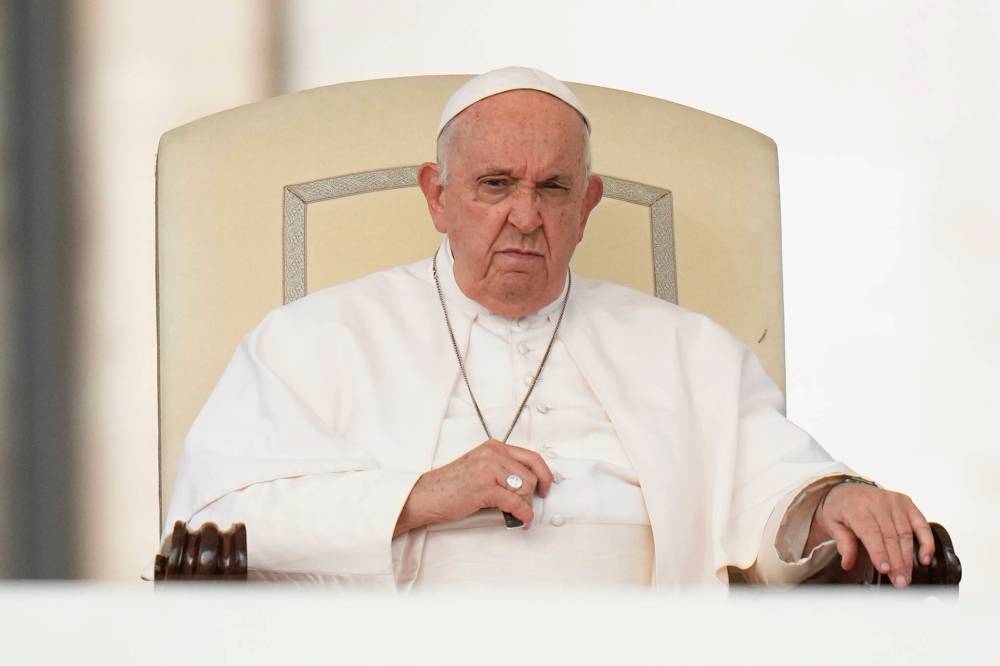
The Associated Press
Pope Francis at The Vatican in 2023
“I exhort all the faithful of the Catholic Church … not to give in to narratives that discriminate against and cause unnecessary suffering to our migrant and refugee brothers and sisters,” the Pope wrote. “What is built on the basis of force, and not on the truth about the equal dignity of every human being, begins badly and will end badly.”
Pope Francis spoke out against violence in South Sudan and in Ukraine, and on the day before his death, released a statement saying “I express my closeness to the sufferings … of all the Israeli people and the Palestinian people … I appeal to the warring parties: call a ceasefire, release the hostages and come to the aid of a starving people that aspires to a future of peace.”
During his 12 years as pope, Pope Francis fought to change a deeply conservative Catholic Church from within, wresting control from clergy who wanted to keep the direction of the church firmly in the hands of the Vatican. He brought more progressive clergy into the management of the church, strove for outreach to those most in need and deliberately moved away from the pomp, circumstance and ostentation of the Vatican. (Members of his staff said he hated going to the Vatican for precisely that reason)
In some ways, he was an object lesson for a church that professed to care about the poor, but also seemed to be in love with the trappings of its own riches.
Sometimes, that came with the simplest of examples: he paid his own hotel bill at the meeting of cardinals that selected him as pope, rode around Vatican City in a Ford Focus, and stayed in a guest house instead of the papal apartments. He even chose his name to recognize the church’s need to serve the poor, picking the name Francis after St. Francis of Assisi, who ministered to the poor and was described as having been chosen by God to rebuild the church.

Did Pope Francis go far enough to drag the church into a position as a meaningful and current guide for moral behaviour?
Perhaps not in all eyes.
But he made crucial steps to answer for wrongs by Catholic clergy against a broad range of victims, including an apology to the Indigenous community for the abuse of Indigenous children in residential schools by clergy.
He will be remembered as a pope who shook up the status quo in the Vatican, and hopefully as one who began a modernization of the church that future popes will continue.
Perhaps the clearest articulation of his message came in 2015, and is one that people of all faiths should consider: “Without a solution to the problems of the poor, we cannot resolve the problems of the world.”