

Exceptions, rules and looking at the big picture
Advertisement
Read this article for free:
or
Already have an account? Log in here »
To continue reading, please subscribe:

Digital Subscription
One year of digital access for only $205*
- Enjoy unlimited reading on winnipegfreepress.com
- Read the E-Edition, our digital replica newspaper
- Access News Break, our award-winning app
- Play interactive puzzles
*First annual payment billed as $205.00 + GST for one year. This annual subscription will automatically renew at $233.00 + GST every 52 weeks (10% off the regular annual price of $259.35). Offer available to new and qualified returning subscribers only. Cancel any time.
To continue reading, please subscribe:
Add Free Press access to your Brandon Sun subscription for only an additional
$1 for the first 4 weeks*
- Enjoy unlimited reading on winnipegfreepress.com
- Read the E-Edition, our digital replica newspaper
- Access News Break, our award-winning app
- Play interactive puzzles
*Your next Brandon Sun subscription payment will increase by $1.00 and you will be charged $17.95 plus GST for four weeks. After four weeks, your payment will increase to $24.95 plus GST every four weeks.
Read unlimited articles for free today:
or
Already have an account? Log in here »
Hey there, time traveller!
This article was published 11/08/2025 (360 days ago), so information in it may no longer be current.
‘But we’ve always had smoky days…”
We certainly have. But this year has been the smokiest year since smoke records for Winnipeg started being kept and we’ve still got to the end of October to see those smoke numbers rise even higher.
That doesn’t seem to be an anomaly, either.
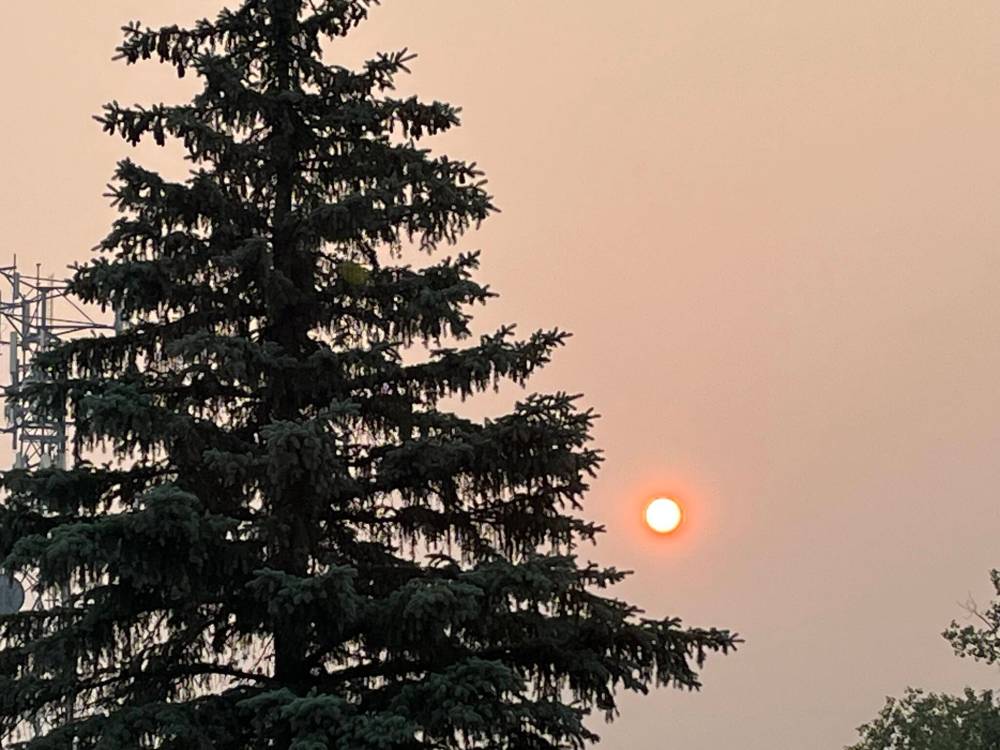
Russell Wangersky/Free Press
Forest fire smoke over Winnipeg, July 11
Four of the five smokiest years in Winnipeg have been in the last five years: 2021, 2023, 2024 and 2025.
More smoke, because there are more large wildland fires.
“But we’ve always had forest fires…”
Yes. We’re in early August, not even nearly at the end of the forest fire season. As of July 30th in Canada, there have been 3,582 forest fires, which puts us slightly below the 10-year average (to date) of 3,931 fires — across the country, that number puts this year at about 91 per cent of the 10-year average.
But consider the amount of land burned — as of July 30, 6,260,975 hectares, compared to the 10-year average of 2,704,359 hectares. In other words, 232 per cent more land burned, according to Natural Resources Canada’s National Wildland Fire Situation Report.
There were also big fire years nationally in 2014, 2017, 2018, 2021 and 2023.
Why? Not because fire crews aren’t doing the work. It’s primarily because we’re building closer and closer into the area between urban and forest land and primarily because it’s hotter and drier.
“But it’s been hot and dry before…”
The global average temperature for July was the third-highest on record. The second-highest was July 2023, the highest, July 2024. The ten most recent years are the warmest years on record.
And with that hotter comes dryer — and most of Canada is abnormally dry.
Here’s how it looked on Agriculture Canada’s Canadian Drought Monitor, as of the end of June: “Precipitation was below normal for much of British Columbia, northwestern and southeastern Alberta, southern and eastern Saskatchewan, all of Manitoba, southeastern Ontario and much of Atlantic Canada. Drought conditions expanded across British Columbia, the southern Prairies, southeastern Ontario and the Atlantic Region. … At the end of the month, 62 per cent of the country was classified as Abnormally Dry or Moderate to Extreme Drought, including 66 per cent of the country’s agricultural landscape.”
Look, if you don’t want to believe unusual things are happening with the climate, you don’t have to — but picking a single example at random to try and support your case is a mug’s game.
For years, everyone had at least one friend who hated seatbelts and would spout that they had heard some apocryphal tale about a driver who rolled their car and “would have been strangled” if they’d been wearing a seatbelt. Could that happen? Theoretically, yes.

Never mind that the science is abundantly clear that you’re far safer wearing a seatbelt in a crash, especially from the often-fatal result of being ejected from the car during the crash.
There are true stories about babies surviving being snatched into the air by tornadoes — but that doesn’t mean you should feel perfectly safe standing in the middle of a Manitoba farmer’s field as the funnel cloud approaches, chewing up the turf as it gets ever-closer.
Or being told “you can die of electrocution if a plugged-in hair dryer falls into a full bathtub with you already in the tub,” and you answering “But hair dryers have fallen into full bathtubs for years, and some people have been just fine…”
You don’t want to be saying that as the hair dryer slips out of your hands.
The results tend to be more decisive and not in a good way.