

Lessons from an airline strike
Advertisement
Read this article for free:
or
Already have an account? Log in here »
To continue reading, please subscribe:
Monthly Digital Subscription
$1 per week for 24 weeks*
- Enjoy unlimited reading on winnipegfreepress.com
- Read the E-Edition, our digital replica newspaper
- Access News Break, our award-winning app
- Play interactive puzzles
*Billed as $4.00 plus GST every four weeks. After 24 weeks, price increases to the regular rate of $19.95 plus GST every four weeks. Offer available to new and qualified returning subscribers only. Cancel any time.
Monthly Digital Subscription
$4.99/week*
- Enjoy unlimited reading on winnipegfreepress.com
- Read the E-Edition, our digital replica newspaper
- Access News Break, our award-winning app
- Play interactive puzzles
*Billed as $19.95 plus GST every four weeks. Cancel any time.
To continue reading, please subscribe:
Add Free Press access to your Brandon Sun subscription for only an additional
$1 for the first 4 weeks*
*Your next subscription payment will increase by $1.00 and you will be charged $16.99 plus GST for four weeks. After four weeks, your payment will increase to $23.99 plus GST every four weeks.
Read unlimited articles for free today:
or
Already have an account? Log in here »
Hey there, time traveller!
This article was published 21/08/2025 (247 days ago), so information in it may no longer be current.
Air Canada’s planes are, slowly, once again taking to the skies, but there’s a whole lot about the way the dispute played out between the airline and its flight attendants that figuratively just won’t fly.
The fact a tentative settlement was reached, with the assistance of a chief mediator appointed by the federal government after nine hours of talks that ended early Tuesday morning essentially confirms the assertion by the Canadian Union of Public Employees (CUPE) that the airline had previously refused to bargain in good faith in an effort to avert and/or end a strike.
CUPE officials argued Air Canada wasn’t interested in doing the hard work of hammering out a deal and was instead banking on federal-government intervention in the form of a back-to-work order that would end the strike and force the dispute to binding arbitration.
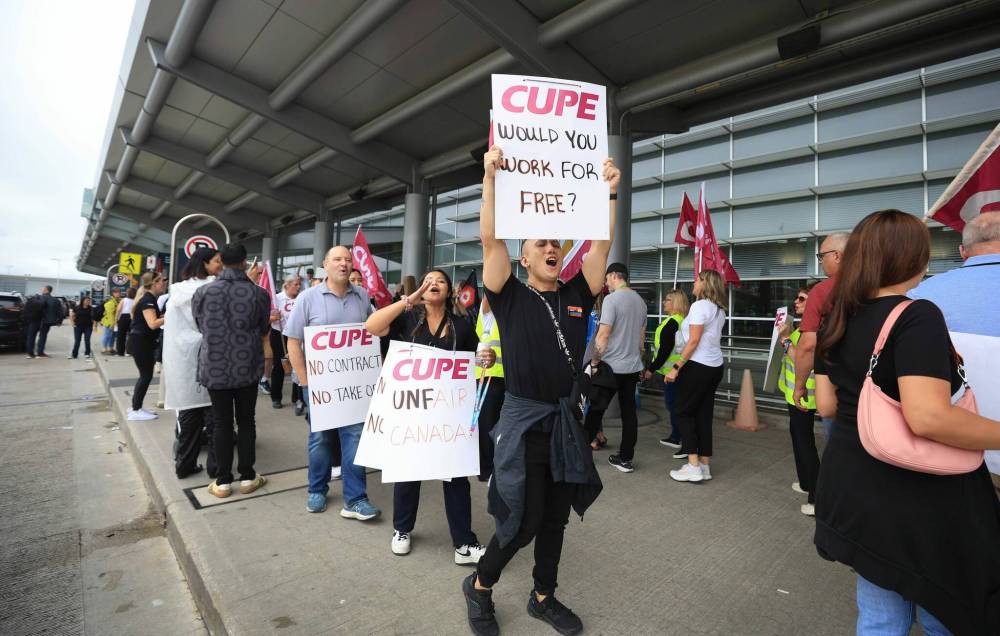
The timeline of events over the past few days certainly seems to support that view. Negotiations hit an impasse, and with 99 per cent of Air Canada’s 10,000 flight attendants having voted in favour of strike action, on Aug. 13 CUPE served the company with a 72-hour strike notice (Air Canada responded with a similarly timed lockout notice).
Anticipating a strike, the airline started cancelling flights the following day; after the union refused the company’s request for binding arbitration, Air Canada followed by asking the federal government to impose it.
Flight attendants walked off the job early Saturday, forcing the cancellation of all Air Canada and Air Canada Rouge flights. With the strike affecting more than 130,000 passengers daily, Jobs and Families Minister Patty Hajdu announced she was exercising her right under the Canada Labour Code to end the strike and force arbitration — clearly the move Air Canada was anticipating and counting on as a mechanism to get its planes back in the air.
What the airline was not banking on, it seems, was CUPE’s response that it would defy the back-to-work demand and order its members to remain on the picket lines, even after a declaration by the Canada Industrial Relations Board that the strike was illegal and must end by noon Monday.
Less than 24 hours later, the tentative agreement was reached.

While the sequence of events certainly seems to support CUPE’s allegation of bad-faith bargaining by Air Canada based on an assumption that government intervention would end the strike, the airline is not the only party that has cause for reflection and a need to do some explaining.
The federal jobs minister and Prime Minister Mark Carney should provide the rationale for its hasty decision to intervene in this dispute — a move that mirrors the Liberal government’s earlier legislative efforts, under prime minister Justin Trudeau, to end rail, port and postal-service disruptions.
It took CUPE’s defiance of the back-to-work order to demonstrate the collective-bargaining process can work if both parties make a good-faith commitment to negotiating a deal and one side isn’t relying on the “crutch” of government intervention to strengthen its position.
By successfully forcing Air Canada to work toward a negotiated settlement, CUPE has no doubt reframed the manner in which future disputes will be handled, by the directly affected parties and also by the government of the day.
It’s incumbent on the Carney government to absorb the events of the past week as a teachable moment in its handling of labour disputes. And now that its planes are (slowly) getting back in the air, it’s the duty of Air Canada to atone for the appalling manner in which it treated its customers before and during this mercifully short but nonetheless painful interruption of service.