

Pierre Poilievre may be his own problem
Advertisement
Read this article for free:
or
Already have an account? Log in here »
To continue reading, please subscribe:

Digital Subscription
One year of digital access for only $205*
- Enjoy unlimited reading on winnipegfreepress.com
- Read the E-Edition, our digital replica newspaper
- Access News Break, our award-winning app
- Play interactive puzzles
*First annual payment billed as $205.00 + GST for one year. This annual subscription will automatically renew at $233.00 + GST every 52 weeks (10% off the regular annual price of $259.35). Offer available to new and qualified returning subscribers only. Cancel any time.
To continue reading, please subscribe:
Add Free Press access to your Brandon Sun subscription for only an additional
$1 for the first 4 weeks*
- Enjoy unlimited reading on winnipegfreepress.com
- Read the E-Edition, our digital replica newspaper
- Access News Break, our award-winning app
- Play interactive puzzles
*Your next Brandon Sun subscription payment will increase by $1.00 and you will be charged $17.95 plus GST for four weeks. After four weeks, your payment will increase to $24.95 plus GST every four weeks.
Read unlimited articles for free today:
or
Already have an account? Log in here »
Hey there, time traveller!
This article was published 18/12/2025 (286 days ago), so information in it may no longer be current.
It’s often said the first step toward finding a solution is admitting there’s a problem.
Pierre Poilievre has a problem. What seems to be making it difficult for the Conservative party leader to fix is his inability to recognize — or, at least, publicly acknowledge — that Pierre Poilievre, in large part, is the problem.
In the wake of recently having three Conservative MPs exit his caucus — two crossing the floor to join the ruling Liberal party and a third declaring he intends to leave office early next year — Poilievre continues to reject any suggestion his leadership style is a factor in those departures or the other concerning trends that find the party he leads losing strength and influence less than 12 months after seemingly being headed toward a massive majority victory.
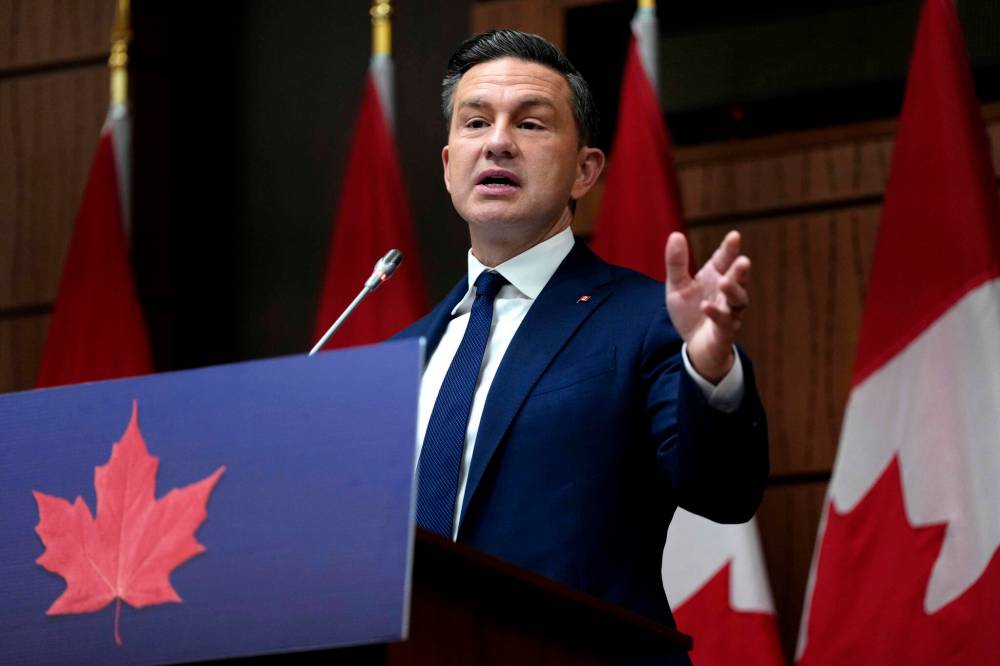
Justin Tang / the canadian press files
Federal Conservative Leader Pierre Poilievre
When Acadie-Annapolis MP Chris d’Entremont defected in November, he cited Poilievre’s combative/divisive style as a factor in his decision. “It’s just looking at leadership styles and whether we are doing the right thing for Canada or we’re doing the right thing for ourselves, and I would rather be on the side of Canadians,” he said, adding other Conservatives should consider whether they’re “trying to build for the world… rather than knocking people down.”
When Markham-Unionville MP Michael Ma followed suit last week, he said his choice to join the Liberals followed listening to his constituents and reflecting on the direction in which both his party and the country are headed. “This is a time for unity and decisive action for Canada’s future,” he explained. “I entered public service to help people — to focus on solutions, not division.”
The addition of the two former Conservatives raises the Liberals’ seat total to 171, just one seat shy of a parliamentary majority. Meanwhile, Edmonton MP Matt Jeneroux — after reportedly considering crossing the floor — declared in November he will step down as early as next spring, and has not appeared in the House of Commons or participated in votes since his announcement.
And yet, when asked in the aftermath of his former colleagues’ exits whether he bears some responsibility for their decisions, Poilievre adopted a familiar tone. “No, it’s a problem of Mark Carney’s leadership,” he countered when CBC’s Rosemary Barton posed the inevitable question. “He is trying to manipulate his way, through backroom deals, to get (a) majority.”

It would, he insisted in Poilievre-speak, be a “costly majority” that would “enrich Liberal elites,” achieved “not through democratic means.”
Unfortunately for the Conservative leader, the option of crossing the floor to join another party is very much part of this country’s entrenched democratic traditions, and while he might insist Carney somehow seduced his erstwhile caucus members to switch allegiances, there’s no denying they must have cultivated sufficient reason to leave before deciding where to go.
It isn’t surprising that Poilievre would refuse to entertain the notion he’s on the wrong side of this discussion; his has been a never-step-back approach to politicking since his early emergence as one of prime minister Stephen Harper’s most effective attack dogs. As Conservative leader, he has consistently demonstrated a willingness to favour inflammatory rhetoric, name-calling and confrontational catchphrases over measured political debate. Facts have frequently been a casualty in his over-zealous pursuit of political advantage.
Is his leadership part of the problem? One of the hallmarks of that style, and of Poilievre’s political personality, is that he would never concede such a thing.
But when the Conservative party gathers in Calgary next month for its leadership review, the one thing that most certainly won’t be up for discussion is Carney’s leadership style.
Related Articles
Poilievre's communications director Katy Merrifield resigns
Advertisement Advertise With Us
Advertisement Advertise With Us