

Creating financial distance from Donald Trump
Advertisement
Read this article for free:
or
Already have an account? Log in here »
To continue reading, please subscribe:

Digital Subscription
One year of digital access for only $205*
- Enjoy unlimited reading on winnipegfreepress.com
- Read the E-Edition, our digital replica newspaper
- Access News Break, our award-winning app
- Play interactive puzzles
*First annual payment billed as $205.00 + GST for one year. This annual subscription will automatically renew at $233.00 + GST every 52 weeks (10% off the regular annual price of $259.35). Offer available to new and qualified returning subscribers only. Cancel any time.
To continue reading, please subscribe:
Add Free Press access to your Brandon Sun subscription for only an additional
$1 for the first 4 weeks*
- Enjoy unlimited reading on winnipegfreepress.com
- Read the E-Edition, our digital replica newspaper
- Access News Break, our award-winning app
- Play interactive puzzles
*Your next Brandon Sun subscription payment will increase by $1.00 and you will be charged $17.95 plus GST for four weeks. After four weeks, your payment will increase to $24.95 plus GST every four weeks.
Read unlimited articles for free today:
or
Already have an account? Log in here »
Hey there, time traveller!
This article was published 02/01/2026 (249 days ago), so information in it may no longer be current.
Maybe it’s a form of Trumpic Karma for U.S. President Donald Trump’s “America First” economic policy.
Or maybe an example of the biblical saying, “As ye sow, so shall ye reap.” Or maybe, just maybe, yet another example of what happens when a former ally is no longer considered stable or trustworthy — and countries decide it’s time to distance themselves.
It is also perhaps one of the most interesting potential decouplings to come out of Trump’s tariff and trade blackmail. And it will be interesting to see just how a set of major U.S. corporations react to a move that could hit them hard on the revenue side — especially because no one in the United States has Trump’s ear quite the way billion-dollar business owners do.
mark schiefelbein / the associated press FILE
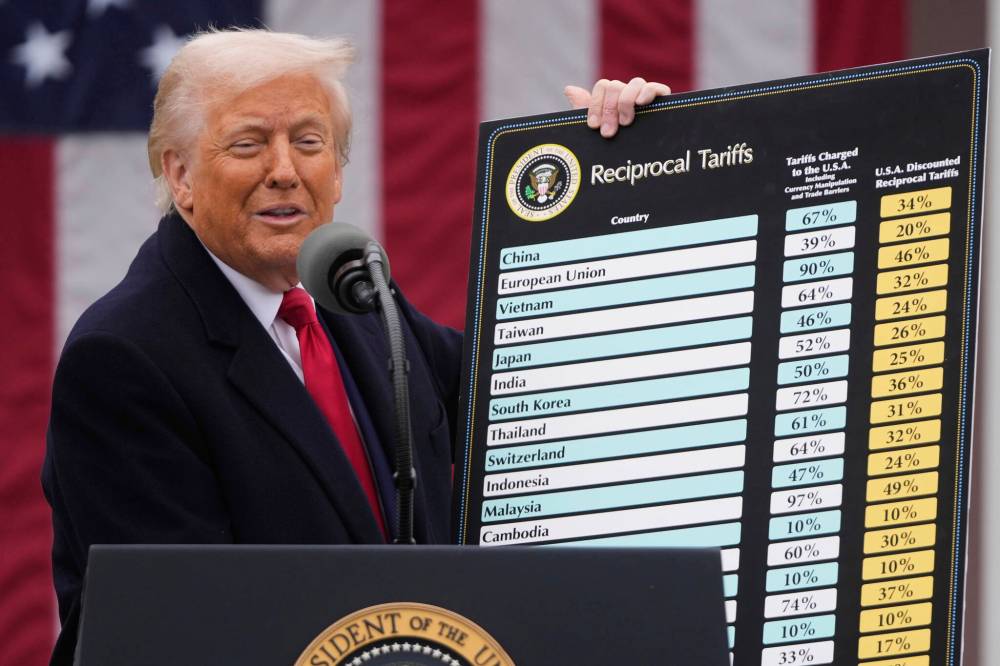
U.S. President Donald Trump
After determining that U.S. monetary policy and regulation is, under Trump, a risky world, the European Union is moving ahead with establishing a fees-free point-of-sale system that would free customers and businesses inside the EU from paying fees to U.S. businesses such as Apple Pay, Google Pay, Mastercard and VISA.
It’s an effort that will take a revenue bite out of those companies, but will also give the EU better control over its own financial future. (Worldwide, Apple Pay was expected to collect US$4 billion in transaction fees in 2025 alone.)
The EU has rightly decided that having financial transfers operate from companies in the U.S. creates a clear risk to European companies and customers — let alone the fact that commission to the service providers siphons European money to the U.S.
It’s a reasonable decision when you look at it through the lens of last week’s decision by the U.S. to take action against EU officials for the offence of not allowing U.S. standards of allowable internet speech to trump European legislative requirements. (In other words, the U.S. took action to sanction Europeans who argued that American social media giants had to abide by the anti-hate laws of European countries where those social media firms were operating — the clear and unacceptable message being that U.S. law has primacy over all else, even on foreign soil.)
There are cautions, of course: opponents of the payment plan question whether an EU-run system can be put in place without bureaucratic costs and delays, and others claim it’s governmental overreach that will be used to restrict public choice.
Frankly, governments often underperform their promises and radically underestimate their costs, and starting an EU-wide payment system has more than its fair share of threats and challenges.
But that doesn’t mean it shouldn’t be attempted, because it’s abundantly clear that lying down and rolling over to the presidential menace is not any form of solution.

At the core of the decision is something that Trump and the U.S. federal administration have failed to appreciate.
As it continues its bull-in-a-China-shop approach to international politics, there may be other countries that want to keep doing business with America. Other countries, for a time, may need to do business with the U.S.
But the more unreasonable the United States becomes, the more likely it will be seen as a threat, and the more likely it will be that countries find other partners and other ways to do business.
Pragmatically, stepping away from the United States and American companies is the right thing to do for many former close partners, even if the process is difficult, expensive and may take years to bring to fruition.
The alternative is the same as deciding to pay someone who is blackmailing you: once their first demand is satisfied, you can count on them coming back again, and again, and again.