Talking the talk — now it’s time for the walk
Advertisement
Read this article for free:
or
Already have an account? Log in here »
To continue reading, please subscribe:

Digital Subscription
One year of digital access for only $205*
- Enjoy unlimited reading on winnipegfreepress.com
- Read the E-Edition, our digital replica newspaper
- Access News Break, our award-winning app
- Play interactive puzzles
*First annual payment billed as $205.00 + GST for one year. This annual subscription will automatically renew at $233.00 + GST every 52 weeks (10% off the regular annual price of $259.35). Offer available to new and qualified returning subscribers only. Cancel any time.
To continue reading, please subscribe:
Add Free Press access to your Brandon Sun subscription for only an additional
$1 for the first 4 weeks*
- Enjoy unlimited reading on winnipegfreepress.com
- Read the E-Edition, our digital replica newspaper
- Access News Break, our award-winning app
- Play interactive puzzles
*Your next Brandon Sun subscription payment will increase by $1.00 and you will be charged $17.95 plus GST for four weeks. After four weeks, your payment will increase to $24.95 plus GST every four weeks.
Read unlimited articles for free today:
or
Already have an account? Log in here »
Hey there, time traveller!
This article was published 05/03/2026 (213 days ago), so information in it may no longer be current.
“What’s going to be different?”
That key question was left hanging in the air after last week’s announcement of a new multi-agency task force to combat drug trafficking in this province.
The task force, as described by Justice Minister Matt Wiebe with support from senior officials in justice, law enforcement and border security, is far-reaching in its scope and ambitious in its intentions. It creates opportunities for pooling resources and sharing expertise in order to confront a crisis Wiebe admits “has strained our medical system and has created crime in our streets.”
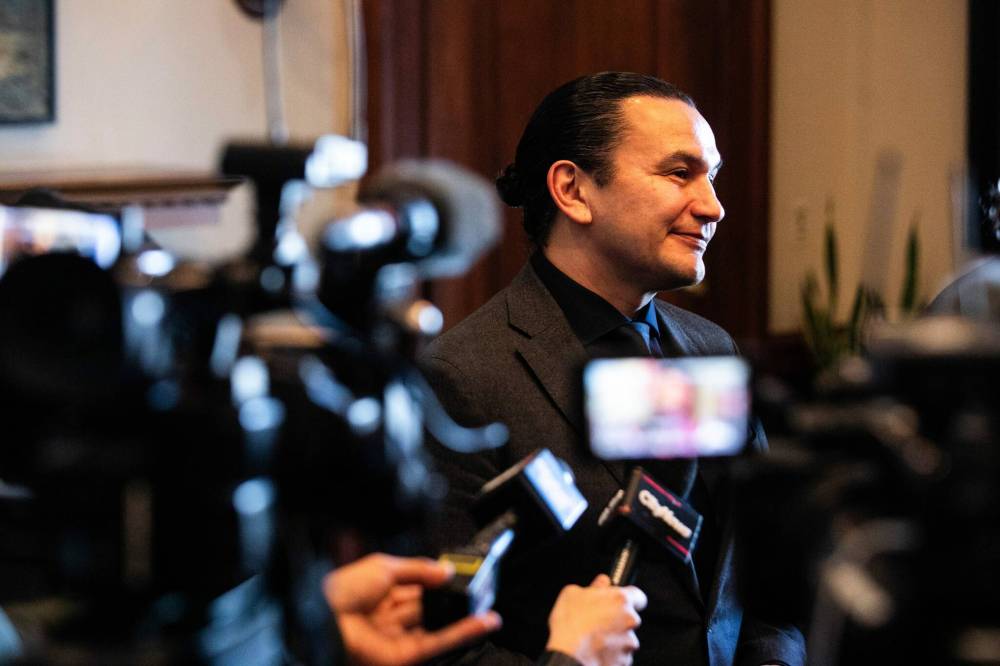
MIKAELA MACKENZIE / FREE PRESS
Manitoba Premier Wab Kinew
But it’s not the first time a government has declared the situation critical and unveiled an aggressive effort to interrupt the flow of illicit drugs into our communities. And despite the best intentions of those behind such initiatives, little progress — if any — has been made.
Which prompted drug-awareness advocate Joseph Fourre, who lost a son to fentanyl poisoning in 2023, to pose the key question noted above. What makes this time different from the other times?
Referring to a task force announced in 2018 by the Progressive Conservatives under then-premier Brian Pallister (and dismissed by then-Opposition leader Wab Kinew as an “illusion of action”), Fourre described this effort as “almost déjà vu” and noted governments often talk tough about drugs but seldom follow those words with meaningful and productive actions.
“More often than not, they have a hard time getting up the very first rung of the ladder,” he said.
Last week’s announcement certainly was a show of co-ordinated force — in addition to officials from the provincial justice department, RCMP, Canada Border Services Agency, Manitoba Criminal Intelligence Centre, Manitoba First Nations Police Service and police services in Winnipeg, Brandon, Altona, Winkler and Morden, Wiebe was also flanked by federal “fentanyl czar” Kevin Brousseau, who will serve as an adviser to the task force.
Brousseau, a former RCMP member whose service included a lengthy posting in Manitoba, rightly noted no individual law enforcement agency can hope to take on the complexities and broadening scope of the modern-day trafficking of synthetic drugs that are cheap, easy to manufacture, extremely potent and too often lethal.

What’s required, he said, is a response that is “equally sophisticated, co-ordinated and united.”
The plan, according to Wiebe, is for the task force — which held its initial meeting on Feb. 25 and will reconvene later this month — is for the agencies involved to share knowledge, set priorities and prepare a provincewide strategy aimed at disrupting supply chains. Among the proposed actions is a “targeted meth sweep” that will focus on producers and distributors of that drug and other narcotics.
As was the case when the Pallister government made its 2018 announcement, last week’s unveiling was discounted by the opposition as mere political posturing. And what’s required now is for this government to prove that it’s the one — unlike all the previous ones that have made similar-sounding pledges — that has finally come up with a plan that will deliver the necessary combination of co-operation, co-ordination, analysis and action to make an actual, measurable difference on the streets of Winnipeg and in communities throughout Manitoba in which the distribution and consumption of deadly drugs continues to be a scourge.
All the right people showed up for last week’s announcement, and all the right things were said.
Now comes the harder part, which has confounded governments here and elsewhere for as long as drugs and addiction have been a major contributor to society’s woes: turning words into deeds, and then having those deeds produce actual results.