

Reading the tea leaves of trash
Advertisement
Read this article for free:
or
Already have an account? Log in here »
To continue reading, please subscribe:
Digital Subscription
One year of digital access for only $1.44 a week*
- Enjoy unlimited reading on winnipegfreepress.com
- Read the E-Edition, our digital replica newspaper
- Access News Break, our award-winning app
- Play interactive puzzles
*Billed as $5.77 plus GST every four weeks. After 52 weeks, price increases to the regular rate of $19.95 plus GST every four weeks. Offer available to new and qualified returning subscribers only. Cancel any time.
To continue reading, please subscribe:
Add Free Press access to your Brandon Sun subscription for only an additional
$1 for the first 4 weeks*
- Enjoy unlimited reading on winnipegfreepress.com
- Read the E-Edition, our digital replica newspaper
- Access News Break, our award-winning app
- Play interactive puzzles
*Your next Brandon Sun subscription payment will increase by $1.00 and you will be charged $17.95 plus GST for four weeks. After four weeks, your payment will increase to $24.95 plus GST every four weeks.
Read unlimited articles for free today:
or
Already have an account? Log in here »
On McPhillips as on many Winnipeg streets, the spring study begins.
In many archeological digs, you have to remove the topsoil — sometimes, even dig deep into the soil in search of artifacts. Here, you just have to wait for the snow to melt.
It is a rite of spring: the thrill of the discovery of the remains of a near-past civilization, one that dates well back in time, perhaps even to 2025.
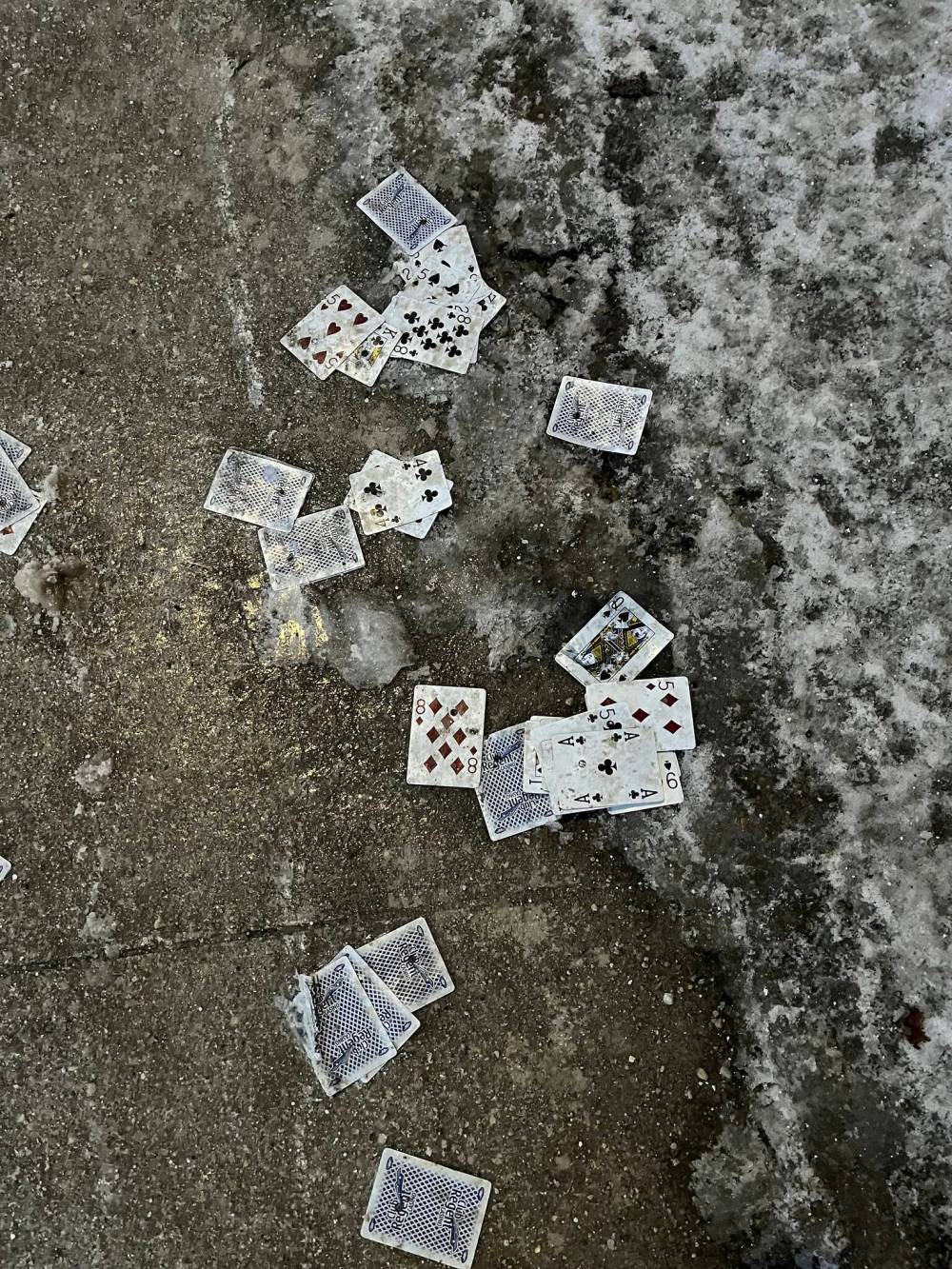
Russell Wangersky/Free Press
A deck of discarded playing cards near College Avenue
The pieces are a puzzle, but as they fit together, you begin to think you can see part of the full puzzle.
They liked coffee. Plastic lids and paper cups are a constant; they are found in varying states of physical decomposition, crushed and torn by car tires and snowplows, lids with imprinted logos from Tim Hortons, McDonald’s cups with their “Caution — Contents Hot” legal warning. Liking coffee apparently does not include properly disposing of the cups.
This past civilization had its share of bad or unlucky drivers. At many intersections, almost-thawed-out snowbanks reveal jigsaw piles of what is almost certainly the most expensive plastic you can break: bumpers and headlight surrounds and plastic grills.
Some also failed to understand the basics of car maintenance. A library of lug nuts, five or six per block, suggest cars being driven with their wheels only precariously attached: large springs and important-looking bolts, U-shaped fasteners and even windshield wipers lie in the grit and debris that remains when the gutters dry.
Many of these inhabitants were smokers. Cigarette packages are a regular discovery, flat on their backs, mouths open after giving out that last cigarette. Cigarette butts are everywhere, sometimes in piles where they’ve been emptied from cars, but also individually, in all stages of deconstruction at the hands of the elements.
Fast-food bags and packaging are frequently found in our samples as well, or are at least sighted from a distance as they kite their way across the pavement in the spring winds.
This civilization had dogs. Some walk those dogs and let the snow hide the canine waste until it surfaces in the thaw; others meticulously collect that waste in plastic bags, and then leave them tightly tied in out-of-the-way nooks and crannies for some sort of expected future analysis.
There are oddities that defy explanation, and others that fire the imagination.
Old clothes twine in the gutter, their contortions as expressive as the fixed-ash body-casts of Pompeii — a sweatshirt raises its inside-out arms in surrender, a pair of trousers rests precisely as if they were urgently stepped out of at the foot of a bed.
Behind the bus shelter at McPhillips and Selkirk, a small suitcase stands alone on the grass — it had been set on fire, leaving a stub of a statue in a medium of melted and burned black plastic.

On Banning, a treasure cache: 66 cents in well-weathered American coins, none valued at more than a dime, uniformly grey with road dust. You can but wonder how those 14 coins got there, and why … but archeology is not about guessing.
Near College and McPhillips, a deck of playing cards, half face up and half face down, is dealt across the sidewalk.
The strata is not necessarily that old, but it is deep and revealing and often confusing.
You can’t tell which individual part of this past civilization is directly responsible, but you can say one thing from the study: most of all, that many of those who inhabited that particular period of Winnipeg life cared little for their surroundings or their fellow citizens.
The world may not have been their oyster: it was certainly their garbage dump.