

Banning five words won’t clean up the legislature
Advertisement
Read this article for free:
or
Already have an account? Log in here »
To continue reading, please subscribe:

Digital Subscription
One year of digital access for only $205*
- Enjoy unlimited reading on winnipegfreepress.com
- Read the E-Edition, our digital replica newspaper
- Access News Break, our award-winning app
- Play interactive puzzles
*First annual payment billed as $205.00 + GST for one year. This annual subscription will automatically renew at $233.00 + GST every 52 weeks (10% off the regular annual price of $259.35). Offer available to new and qualified returning subscribers only. Cancel any time.
To continue reading, please subscribe:
Add Free Press access to your Brandon Sun subscription for only an additional
$1 for the first 4 weeks*
- Enjoy unlimited reading on winnipegfreepress.com
- Read the E-Edition, our digital replica newspaper
- Access News Break, our award-winning app
- Play interactive puzzles
*Your next Brandon Sun subscription payment will increase by $1.00 and you will be charged $17.95 plus GST for four weeks. After four weeks, your payment will increase to $24.95 plus GST every four weeks.
Read unlimited articles for free today:
or
Already have an account? Log in here »
Back in the 1960s, legendary counterculture comedian George Carlin gained notoriety — and sparked no small measure of controversy — with a standup bit in which he described the seven words that can never be said on television.
The monologue was, in keeping with Carlin’s body of work during a politically charged career that spanned more than five decades, insightfully hilarious with a clear intention to provoke. A brilliant rumination on the power of speech, it cleverly dissected the profane nature of the seven words while also stripping them of their impact by repeating them out loud for comic effect.
The question of whether certain words should or shouldn’t be said was front and centre this week — albeit in a decidedly less chucklesome context — in the Manitoba legislature with the declaration by Speaker Tom Lindsey that five specific words are heretofore considered unparliamentary and banned from use in legislative proceedings.
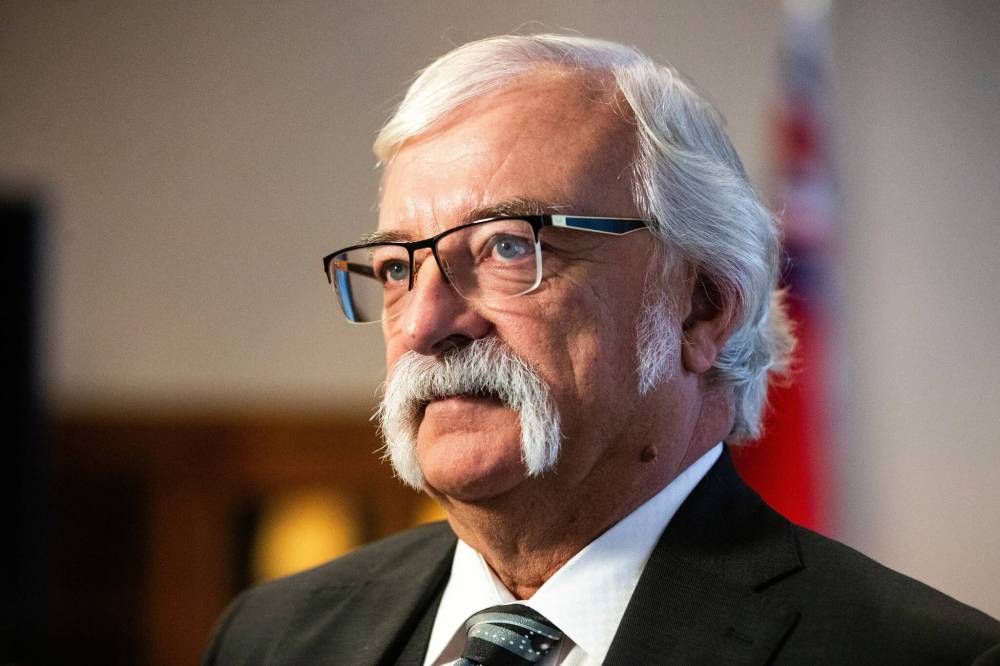
MIKAELA MACKENZIE / FREE PRESS Files
House Speaker Tom Lindsey
In an ongoing — and, by all appearances, generally futile — effort to re-inject a measure of decorum to a chamber in which debate and discourse have grown more fractious, coarse and belligerent over time, Lindsey ruled MLAs can no longer call one another any of these: “bigot,” “homophobe,” “racist,” “misogynist” or “transphobe.”
In defending his decision, Lindsey explained that “setting this new standard for our legislature is necessary to ensure that the people’s business is conducted in a civil, orderly manner consistent with the practices of the federal parliament and every other jurisdiction in Canada.”
Ironically, the Speaker made the declaration on the same day he expelled an Opposition member for refusing to apologize for a remark Lindsey judged to be racist. Progressive Conservative MLA Wayne Ewasko was offered three opportunities to apologize for having heckled Premier Wab Kinew with “Hey, quit drinking” — a comment Lindsey later described as disparaging and amounting to anti-Indigenous racism.
Upon Ewasko’s ejection from the chamber, Lindsey turned to remaining MLAs and observed, “I would like to congratulate us on meeting a new low.”
While it’s difficult to assess whether a new vernacular depth had been plumbed in an assembly in which behavioural highs seem increasingly difficult to find, what can be said about the Speaker’s ruling is it did not sit well with everyone in the legislature.
Government house leader Nahanni Fontaine objected on behalf of the ruling NDP and argued her party — whose roster of MLAs includes transgender, queer, gender non-conforming, Indigenous, Black, Sikh and Asian Canadian members — should be protected from discriminatory remarks in the chamber, and the five-word ban strips away the ability to directly call out unacceptable behaviour.
Kinew went further, saying he will continue to call out racism when he sees it.

For their part, the Progressive Conservatives seem satisfied with the removal of the five specified words from the legislative lexicon.
“This language is always hurled from the government to our side. … We’re not the ones using these five words against them,” said PC Leader Obby Khan, who himself was recently rebuked for referring to non-binary Health Minister Uzoma Asagwara as “a terrible person … whatever you are.”
If the Speaker’s stated intent is to elevate the tenor of legislative discourse by limiting attacks on character and therefore shifting the focus to policy-inclined debate, the banning of five words seems a rather meagre half-measure. While his ruling aligns Manitoba’s legislative rulebook with those of other parliamentary bodies, Lindsey still faces the unenviable task of ensuring MLAs here desist from the gutter-level kind of heckling that makes others feel the need to respond with one or more of the now-banned words.
What’s really required is a commitment, from all MLAs, to do better.
Unlike Carlin’s venerable exercise in verbal deconstruction, Manitoba’s current can’t-say-that kerfuffle is neither amusing nor illuminative.
Related Articles
Kinew’s rebuke of Speaker shows he’s lost confidence in him: Khan

Advertisement Advertise With Us
Advertisement Advertise With Us