

Climate science targeted by Trump again
Advertisement
Read this article for free:
or
Already have an account? Log in here »
To continue reading, please subscribe:
Digital Subscription
One year of digital access for only $1.44 a week*
- Enjoy unlimited reading on winnipegfreepress.com
- Read the E-Edition, our digital replica newspaper
- Access News Break, our award-winning app
- Play interactive puzzles
*Billed as $5.77 plus GST every four weeks. After 52 weeks, price increases to the regular rate of $19.95 plus GST every four weeks. Offer available to new and qualified returning subscribers only. Cancel any time.
To continue reading, please subscribe:
Add Free Press access to your Brandon Sun subscription for only an additional
$1 for the first 4 weeks*
- Enjoy unlimited reading on winnipegfreepress.com
- Read the E-Edition, our digital replica newspaper
- Access News Break, our award-winning app
- Play interactive puzzles
*Your next Brandon Sun subscription payment will increase by $1.00 and you will be charged $17.95 plus GST for four weeks. After four weeks, your payment will increase to $24.95 plus GST every four weeks.
Read unlimited articles for free today:
or
Already have an account? Log in here »
It’s scientific vandalism. And it’s not the first time.
The U.S. administration under President Donald Trump wanted to let one of the world’s most successful climate change satellites — the Orbiting Climate Observatory, or OCO2 — simply fall from space and burn up in the atmosphere. It took a court order to stop that same administration from dismantling the National Center for Atmospheric Research and removing its supercomputer system.
Now Trump’s team has a new target. And once again, it’s involved with leading-edge climate research.
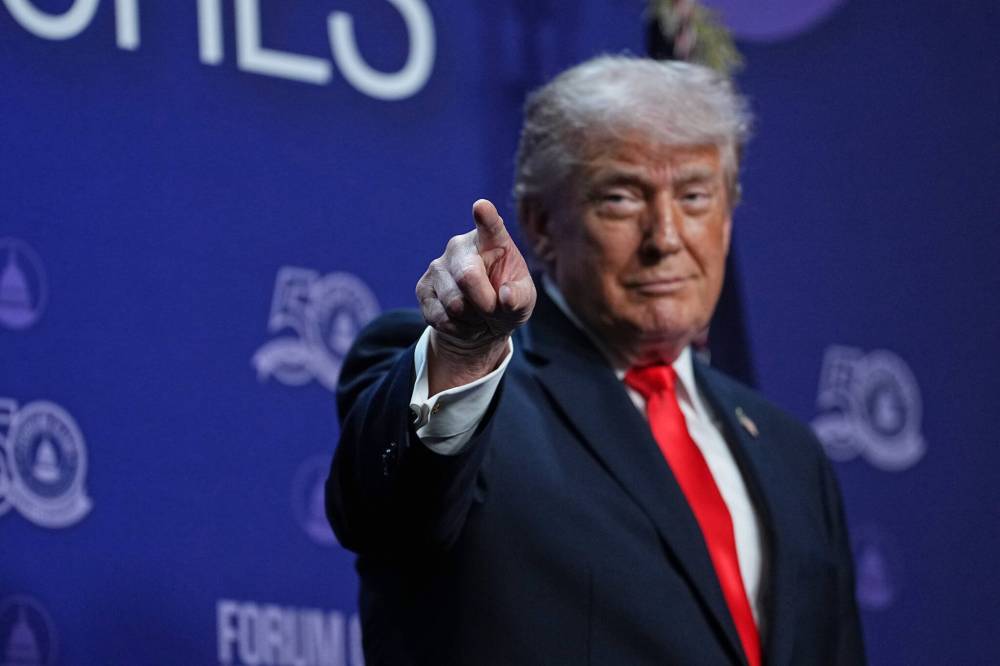
Associated press files
U.S. President Donald Trump
The Trump administration has set its sights on the Ocean Observatory Initiative, a US$368 million system of deep-water ocean-sensing equipment in the Atlantic and Pacific oceans and, as a result, the U.S. National Science Foundation (NSF) is going to start removing over 900 sensors, some as deep as 9,200 feet under the surface.
The sensors have already provided a treasure trove of information for climate and ocean scientists: the moored sensors provide information on currents, temperatures and ocean acidity, along with other chemical and biological information.
A spokesman for the NSF gave the New York Times an epic dose of bafflegab to explain why the sensors were being taken up now, having only been installed in 2016. The system was designed to be operational until 2041.
The NSF’s Michael England said the move “aligns with NSF’s wider strategy to have a nimbler approach to prioritizing support for evolving scientific priorities and emerging technologies as well as a deliberate approach to smart life-cycle management within its portfolio of research infrastructure.”
Honestly, it sounds more like he shook a bunch of buzzwords in an empty baked bean can, emptied them on the table and read them out loud.
Craig McLean, a former acting chief scientist at the National Oceanic and Atmospheric Administration during Trump’s first term, had a clearer explanation.
He told the Times that it was a symptom of the Trump administration’s general disdain for science.
“This reflects the further lack of understanding that the current administration has of scientific value and scientific merit,” McLean told the Times. “By dismantling such a system, we push the United States back yet again into a rear seat in global scientific leadership.”
But maybe going backwards — or at least keeping Americans firmly in the dark — is what the Trump team would prefer. After all, the same administration tried to shut down the Ocean Observatory twice before, in both 2025 and 2026, by cutting its budget by 80 per cent. Both times, the U.S. Congress halted the effort.
It looks like third-time unlucky for scientific research and its uncomfortable analysis of potential threats.
But burying your head in the sand won’t keep you safe from potential threats.
Trump and his team seem to believe that problems can be addressed by simply ignoring that they exist.
After all, he famously told a campaign crowd that the best way to reduce COVID cases was to … not test for the disease.
“When you do testing to that extent, you’re gonna find more people, you’re gonna find more cases. So I said to my people ‘Slow the testing down, please,’” Trump told a campaign rally in Tulsa, Oklahoma in 2020.

His staff said he was “clearly” joking, but Trump subsequently told reporters that he was serious.
Getting rid of climate research certainly has the potential to make Americans less concerned about the Trump government’s efforts to stop or slow renewable energy projects in favour of doubling down on oil — “Drill, baby, drill,” to quote President Trump — and even increasing the use of coal for energy.
Science is clearly in the crosshairs in the U.S. right now.
But changing the narrative, sadly, does not change the facts.
Or the results.