

The Trump tariff policy — Round 3
Advertisement
Read this article for free:
or
Already have an account? Log in here »
To continue reading, please subscribe:
Digital Subscription
One year of digital access for only $1.44 a week*
- Enjoy unlimited reading on winnipegfreepress.com
- Read the E-Edition, our digital replica newspaper
- Access News Break, our award-winning app
- Play interactive puzzles
*Billed as $5.77 plus GST every four weeks. After 52 weeks, price increases to the regular rate of $19.95 plus GST every four weeks. Offer available to new and qualified returning subscribers only. Cancel any time.
To continue reading, please subscribe:
Add Free Press access to your Brandon Sun subscription for only an additional
$1 for the first 4 weeks*
- Enjoy unlimited reading on winnipegfreepress.com
- Read the E-Edition, our digital replica newspaper
- Access News Break, our award-winning app
- Play interactive puzzles
*Your next Brandon Sun subscription payment will increase by $1.00 and you will be charged $17.95 plus GST for four weeks. After four weeks, your payment will increase to $24.95 plus GST every four weeks.
Read unlimited articles for free today:
or
Already have an account? Log in here »
Sometimes, you can only put your head in your hands and wonder when this will all end.
On Wednesday, the office of the U.S. Trade Representative, Jamieson Greer, announced a new round of 10 per cent tariffs against countries the United States feels aren’t doing enough to combat forced labour and 12.5 per cent tariffs against countries which only partially ban, or don’t ban, forced labour.
Canada is one of the countries that would get a 10 per cent tariff, but only on goods not covered by the current Canada-U.S-Mexico trade agreement.
The New York Times files
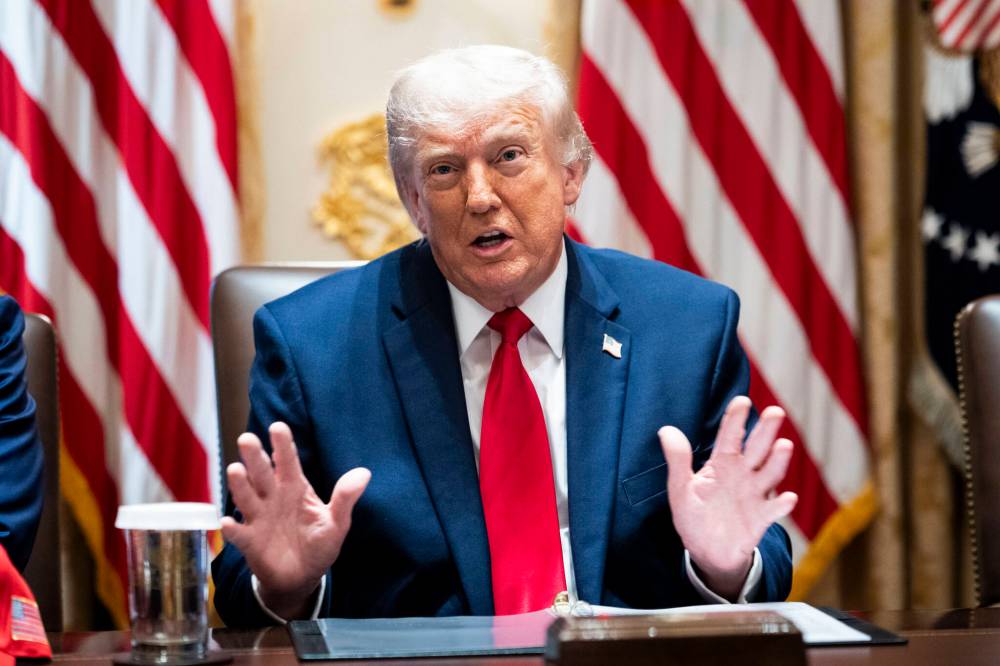
U.S. President Donald Trump
It’s viewed as just another attempt to push forward U.S. President Donald Trump’s tariff agenda after his initial attempts were derailed by the U.S. Supreme Court.
But forced labour is an interesting area for the Trump administration to suddenly develop a concern about.
Why?
Because American governments currently benefit directly from their own forced labour policies.
The American Civil Liberties Union outlined in a 2022 report the way prisoners in the United States are required to work without choice about what they do, without standard labour protections. They are either not paid or paid far less than they would be outside prison walls. Not only that, their pay is reduced even further by some states seizing inmates’ pay for room and board.
“From the moment they enter the prison gates, incarcerated people lose the right to refuse to work. This is because the 13th Amendment to the U.S. Constitution, which protects against slavery and involuntary servitude, explicitly excludes from its reach those held in confinement due to a criminal conviction,” says the ACLU report, Captive Labor: Exploitation of Incarcerated Workers.
“Nearly 800,000 incarcerated workers have (jobs that) look similar to those of millions of people working on the outside. But there are two crucial differences: Incarcerated workers are under the complete control of their employers and they have been stripped of even the most minimal protections against labour exploitation and abuse.”
The report also points out that, every year, inmates produce US$2 billion in goods and provide US$9 billion of prison maintenance services.
Many might argue that making those convicted of crimes work for their keep is a reasonable punishment for their crimes — but if that’s your argument, it’s hard to understand why you would also claim that using forced labour is a justification for imposing tariffs against another country. The argument can’t truly be “it’s good when we do it, but bad if you don’t do enough to stop it.”

Especially because, in Canada’s case, the federal government has laws against forced labour in the supply chain and has pledged to strengthen those rules. (But, as we saw with the round of tariffs connected to trafficking fentanyl, facts don’t particularly matter.)
What’s really taking place is that Donald Trump is deeply in love with his concept of tariffs, and he’ll use any pretext he can find to try to impose them on products from other nations. This means, whether it’s obscure language from old laws or suddenly developing an intense desire to protect those harmed by forced labour, there will only be more attempts to justify tariffing trading partners.
And that means more time, trouble and court battles — and more tariff money collected from American customers for foreign goods — until the next court loss.
Followed almost immediately, no doubt, by some eager White House lawyer finding some other hoary and dated scrap of legislation to start the process all over again.
It’s tiresome, it’s troubling, it’s not neighbourly — and it’s par for the Trump course. The Canadian government can only be consistent, measured and careful. Everything Trump isn’t.