

Carney wise to keep options open
Advertisement
Read this article for free:
or
Already have an account? Log in here »
To continue reading, please subscribe:

Digital Subscription
One year of digital access for only $205*
- Enjoy unlimited reading on winnipegfreepress.com
- Read the E-Edition, our digital replica newspaper
- Access News Break, our award-winning app
- Play interactive puzzles
*First annual payment billed as $205.00 + GST for one year. This annual subscription will automatically renew at $233.00 + GST every 52 weeks (10% off the regular annual price of $259.35). Offer available to new and qualified returning subscribers only. Cancel any time.
To continue reading, please subscribe:
Add Free Press access to your Brandon Sun subscription for only an additional
$1 for the first 4 weeks*
- Enjoy unlimited reading on winnipegfreepress.com
- Read the E-Edition, our digital replica newspaper
- Access News Break, our award-winning app
- Play interactive puzzles
*Your next Brandon Sun subscription payment will increase by $1.00 and you will be charged $17.95 plus GST for four weeks. After four weeks, your payment will increase to $24.95 plus GST every four weeks.
Read unlimited articles for free today:
or
Already have an account? Log in here »
Two news stories showed remarkable overlap in the last few days: one on Prime Minister Mark Carney, talking about what the new world order looks like, the other on AI and the Trump administration’s decision to limit sales of two new AI models.
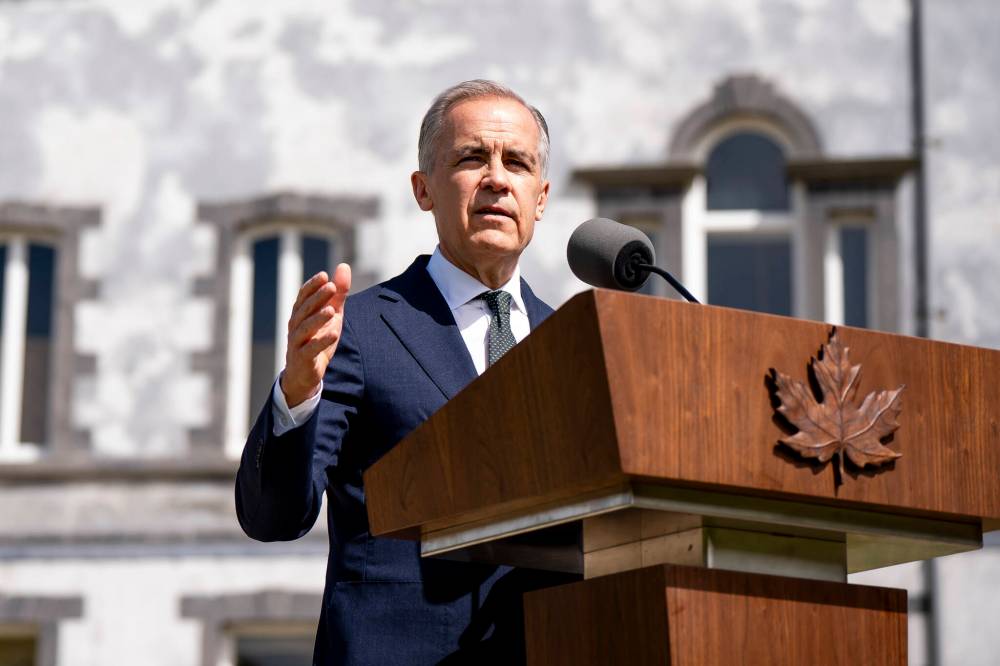
First, here’s Prime Minister Carney in Ireland, on his way to G7 meetings in France: “What one can’t do at this point in a rapidly shifting world order is to rely on one set of institutions, one grouping, one country to provide the answers.”
Isn’t that the truth — reliability and the U.S., for example, are hardly synonymous at the moment.
Couple that with the decision by the U.S. federal government to put export controls on new AI models from Anthropic, saying it had to restrict access to the technology to protect the U.S. from abuse of the AI by foreign nationals.
Now, put the two together: it creates an interesting problem for customers who may be buying U.S. tech.
What if an already erratic U.S. administration decides to turn off the taps on other products at some point? Products that you’ve built into your supply chain or manufacturing process?
You can bet it’s a factor that will be considered more and more when companies outside the U.S. are looking at buying products that depend on proprietary software that happens to be grounded in that country.
It’s an issue that’s already been raised about Canada’s continuing purchases of the F-35 fighter. It’s difficult to depend on technology if it’s integral to a product, especially when parts of that cloud tech are hosted in another country and can theoretically be turned off by that country’s government, rendering things like your aircraft useless.
That’s especially a concern when a foreign country’s president is actively claiming he wants to annex your country.
Asked about the Anthropic decision, by the way, Carney said, “You’ll hear me say this over and over again. It is never a good idea to have one option.”
Many of the efforts at trade restrictions by the Trump administration have fallen afoul of U.S. courts: Trump plainly believes his edicts are above all laws, and he’s frequently brought back to Earth by jurists. And it may well be that the bans on the out-of-country sale of Anthropic’s Fable 5 and Mythos 5 will be overturned somewhere down the road.
But that takes time.
Products don’t just have to be leading-edge to capture a market — they must also be dependable.
It won’t happen immediately. It won’t even happen quickly. But if American products aren’t dependable because their operation depends on technology that can be restricted at the drop of an executive order or a trade ban, customers are bound to eventually go somewhere else instead.

The U.S. administration may view restricting access to commercial products as a way of strengthening American business and keeping development of products at home — making it advantageous for American producers to make their products within the U.S.
But as a marketing tool, it can’t help but hurt sales in the long-term.
It’s a little like selling subscription-based add-ons to your products: adding things like remote start functions and heated seats in cars that can be turned off remotely if the customer doesn’t pay a monthly fee will only work until there’s a credible alternative that doesn’t tap customers for more cash every 30 days.
There’s an old saying about legislation that, when you use it to fence something in, you’re also fencing other things out.
When you build a tariff barrier or a trade ruling barrier to limit foreign companies from selling into your market, you’re also running the risk of them reciprocating, or in this case, being unable to buy your product.