

Time for national trucking regulation
Advertisement
Read this article for free:
or
Already have an account? Log in here »
To continue reading, please subscribe:

Digital Subscription
One year of digital access for only $205*
- Enjoy unlimited reading on winnipegfreepress.com
- Read the E-Edition, our digital replica newspaper
- Access News Break, our award-winning app
- Play interactive puzzles
*First annual payment billed as $205.00 + GST for one year. This annual subscription will automatically renew at $233.00 + GST every 52 weeks (10% off the regular annual price of $259.35). Offer available to new and qualified returning subscribers only. Cancel any time.
To continue reading, please subscribe:
Add Free Press access to your Brandon Sun subscription for only an additional
$1 for the first 4 weeks*
- Enjoy unlimited reading on winnipegfreepress.com
- Read the E-Edition, our digital replica newspaper
- Access News Break, our award-winning app
- Play interactive puzzles
*Your next Brandon Sun subscription payment will increase by $1.00 and you will be charged $17.95 plus GST for four weeks. After four weeks, your payment will increase to $24.95 plus GST every four weeks.
Read unlimited articles for free today:
or
Already have an account? Log in here »
The case of Conquer Transport Inc. is a stark reminder that, when it comes to trucking safety, provincial borders can include dangerous loopholes.
Manitoba pulled the company’s safety certificate in late 2021 after finding it non-compliant with highway safety laws and trucking regulations. Yet the company continued operating in Manitoba after obtaining an Alberta safety certificate and vehicle registrations. It even changed its name to Conquer Transportation Inc. in the process.
Nearly five years after Manitoba shut it down, a truck registered to the company allegedly ran a stop sign near Brandon on May 27 and struck an SUV, killing 49-year-old Xiaoyun Zhang, who had the right of way.
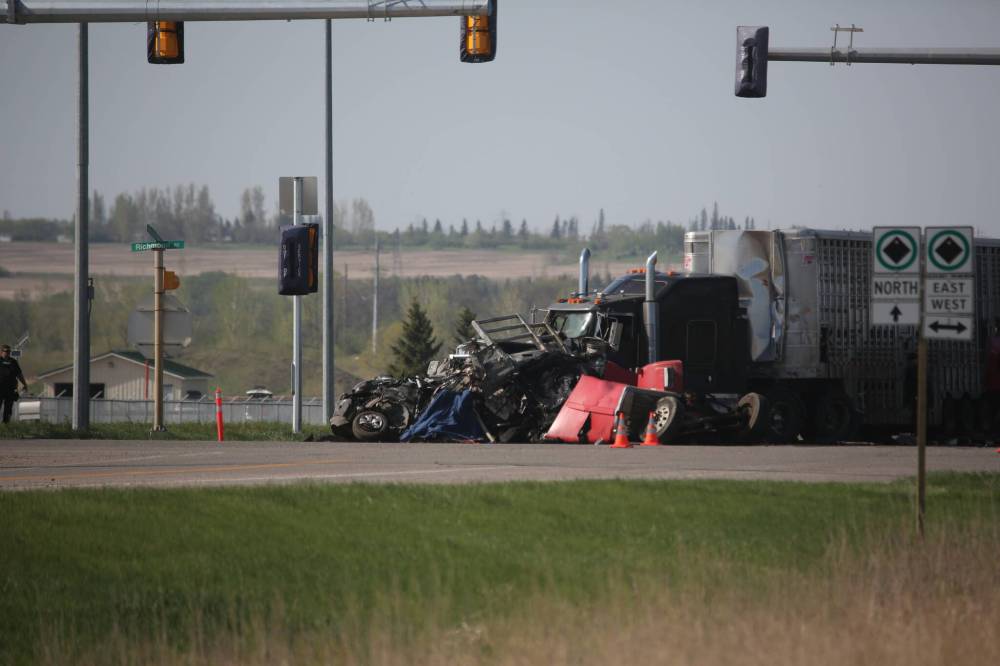
Alex Lambert / Brandon Sun files
The scene of the May 27 crash involving a Conquer Transportation truck that left one man dead.
The Alberta government has now shut the company down after its investigators found numerous safety violations, including problems with driver hours, vehicle maintenance and inspections, and the company’s safety program.
That action is welcome. It is also painfully late.
The federal government needs to get serious about creating a national trucking safety system that prevents precisely this kind of jurisdictional shell game.
Manitoba Transportation Minister Lisa Naylor has been lobbying Ottawa for a public registry that would allow governments and the public to see trucking companies’ safety records, including violations and changes to their safety fitness ratings.
That would be a good start. But Manitoba Trucking Association executive director Aaron Dolyniuk is right that a database alone isn’t enough.
Canada needs a national system with common safety standards for interprovincial carriers. A trucking company that has been deemed too dangerous to operate in one province should not be able to simply cross a provincial boundary, change its name and obtain a new set of credentials elsewhere.
The current system creates precisely the kind of gaps that bad operators can exploit.
Alberta Transport Minister Devin Dreeshen aptly described it as a “whack-a-mole game”: when one province catches a bad operator, it can pop up somewhere else under a different name and structure.
That is not an acceptable safety regime.
There is also an important economic argument for fixing this. Unsafe carriers don’t just put motorists at risk. They undermine legitimate trucking companies that invest in properly maintained vehicles, trained drivers and compliance with safety regulations.
As Dolyniuk noted, bad operators can exploit regulatory grey areas to operate illegally and drive rates down. That puts responsible companies at a competitive disadvantage.
The trucking industry needs consistent rules precisely because trucks don’t stop at provincial borders. Neither should safety records.
This is an area where the federal government should be doing what governments are supposed to do — establishing a common national framework while working with provinces and territories to enforce it.

There is also a constitutional argument to be made: interprovincial trucking is a federal jurisdiction. The key provision is section 92(10)(a) of the Constitution Act, 1867, which gives Parliament jurisdiction over “Lines of Steam or other Ships, Railways, Canals, Telegraphs, and other Works and Undertakings connecting the Province with any other or others of the Provinces.”
Not all trucks cross provincial boundaries, but many do. So, a national safety system would make sense both constitutionally and practically speaking.
Either way, there is no good reason a company deemed an unacceptable risk to public safety should be able to acquire a different provincial credential without the other jurisdiction knowing its history.
And there is no good reason the public should have difficulty determining whether a trucking company has previously been shut down or sanctioned for serious safety violations.
The Alberta government’s decision to shut down Conquer Transportation is a strong and necessary response. But it should not take a fatal crash to expose the weaknesses in Canada’s patchwork trucking-safety system.