

New drug enforcement program a better approach, but not yet enough
Advertisement
Read this article for free:
or
Already have an account? Log in here »
To continue reading, please subscribe:

Digital Subscription
One year of digital access for only $205*
- Enjoy unlimited reading on winnipegfreepress.com
- Read the E-Edition, our digital replica newspaper
- Access News Break, our award-winning app
- Play interactive puzzles
*First annual payment billed as $205.00 + GST for one year. This annual subscription will automatically renew at $233.00 + GST every 52 weeks (10% off the regular annual price of $259.35). Offer available to new and qualified returning subscribers only. Cancel any time.
To continue reading, please subscribe:
Add Free Press access to your Brandon Sun subscription for only an additional
$1 for the first 4 weeks*
- Enjoy unlimited reading on winnipegfreepress.com
- Read the E-Edition, our digital replica newspaper
- Access News Break, our award-winning app
- Play interactive puzzles
*Your next Brandon Sun subscription payment will increase by $1.00 and you will be charged $17.95 plus GST for four weeks. After four weeks, your payment will increase to $24.95 plus GST every four weeks.
Read unlimited articles for free today:
or
Already have an account? Log in here »
In late June, when the Winnipeg Police Service launched a 10-day ‘crackdown’ on open drug use and illegal drug sales in areas in and around downtown, it did so without consulting or informing community outreach and social services agencies working in the targeted areas.
Inevitably, the WPS action drew criticism from several front-line agencies, which issued a collective statement just two days after the police operation began, pointing out that heavy-handed policing would drive vulnerable people away from the help they desperately need.
“Every day we work to build trust with people who have experienced trauma, discrimination, and barriers to care,” Kate Sjoberg, executive director of Resource Assistance for Youth, said at the time. “Actions that create fear around accessing services can undo months or years of relationship-building and place people at greater risk of preventable harm.”
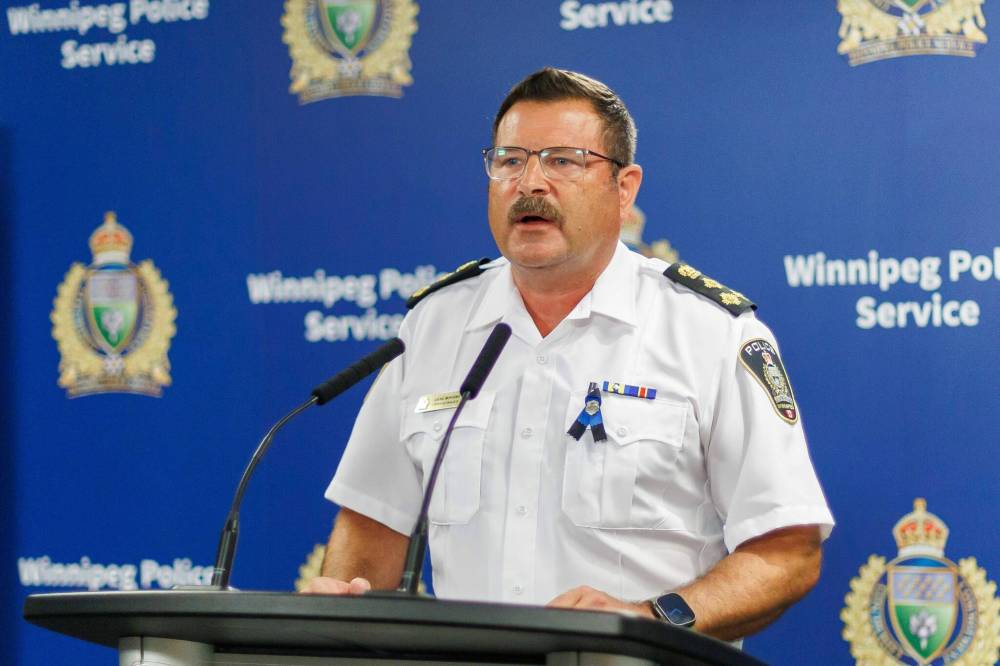
MIKE DEAL / FREE PRESS
Winnipeg Police Chief Gene Bowers
At the time, WPS Chief Gene Bowers held up his hand and said, “That’s on me.”
The chief said police had decided to act after receiving complaints from residents and businesses for months about illegal drug-related activity in several areas of the city, including Main Street, Point Douglas, West Broadway and the West End.
Mayor Scott Gillingham fully supported the crackdown, and a WPS analysis of its results, finally made public in July, noted that reports of violent crime in those areas were down 16.5 per cent from the same period in 2025, while property crime was down 10.5 per cent.
Bowers also promised in June to sit down with front-line agencies and “work towards helping the people who are being devastated by the drugs that are on our streets.”
Those discussions led to the early August announcement of a new, collaborative drug enforcement program, targeting the same areas as the first, which began Friday, Aug. 7 and will continue into November.
During Crackdown 2.0 (our name for it), WPS officers are working with an Indigenous-led coalition of 11 front-line groups, including Ka Ni Kanichihk, which has provided a dedicated co-ordinator to work closely with police.
It’s a wise move, especially in hindsight, but will this attempt to address crime rates, as well as the multi-layered issues of addiction, homelessness, mental health and related traumas, ultimately lead to the ideal result — which is more people seeking treatment, securing housing and receiving the follow-up supports they require?
That’s difficult to say. The ‘enforcement-with-support’ approach now taken by the WPS seems piecemeal while critical elements of a solution — such as funding for treatment programs and beds, and infrastructure such as transitional housing, affordable housing and wraparound supports — are insufficient or missing.
It’s most likely that the conundrum of Manitoba’s most glaring social issue will remain unresolved, especially when you consider the amounts of money and time required to create programs, build infrastructure and train the people required to make a meaningful impact.

In the meantime, useful programs and instruments will continue to pop up in scattershot fashion.
Just last week we learned that emergency responders dealing with drug-related calls will have another tool at their disposal, owing to the Winnipeg Fire and Paramedic Service being granted an exemption to administer buprenorphine, a prescription medication which curbs opioid withdrawal symptoms and cravings for 24 to 36 hours.
In addition, Winnipeg’s controversial and long-awaited supervised drug-consumption site finally opened on Tuesday, Aug. 11.
The space at 366 Henry Ave. gives users of street drugs a place where they can get high with clean needles, thus avoiding contracting HIV or Hepatitis A, while under the supervision of staff trained in overdose treatment and prevention.
Fewer people may overdose or die but, even when considered together, a kinder, gentler drug crackdown and a few new harm-reduction initiatives don’t provide a clear path to recovery.
Related Articles
Long-awaited supervised drug consumption site opens quietly after months of loud opposition



Advertisement Advertise With Us
Advertisement Advertise With Us