

Fully protecting Transit drivers overdue
Advertisement
Read this article for free:
or
Already have an account? Log in here »
To continue reading, please subscribe:

Digital Subscription
One year of digital access for only $205*
- Enjoy unlimited reading on winnipegfreepress.com
- Read the E-Edition, our digital replica newspaper
- Access News Break, our award-winning app
- Play interactive puzzles
*First annual payment billed as $205.00 + GST for one year. This annual subscription will automatically renew at $233.00 + GST every 52 weeks (10% off the regular annual price of $259.35). Offer available to new and qualified returning subscribers only. Cancel any time.
To continue reading, please subscribe:
Add Free Press access to your Brandon Sun subscription for only an additional
$1 for the first 4 weeks*
- Enjoy unlimited reading on winnipegfreepress.com
- Read the E-Edition, our digital replica newspaper
- Access News Break, our award-winning app
- Play interactive puzzles
*Your next Brandon Sun subscription payment will increase by $1.00 and you will be charged $17.95 plus GST for four weeks. After four weeks, your payment will increase to $24.95 plus GST every four weeks.
Read unlimited articles for free today:
or
Already have an account? Log in here »
Doesn’t it seem like “enough is enough” has been said more than enough times?
The union representing Winnipeg Transit drivers declared last week — again — that the service’s buses need to be outfitted with full safety shields, after yet another incident involving an assault on a partially protected transit operator.
The most recent altercation, which Amalgamated Transit Union Local 1505 president James Van Gerwen described as “almost like a hijacking situation,” occurred around 1 a.m. on Aug. 20 at the St. Vital terminal, when a passenger who had repeatedly told the operator to put the bus in motion subsequently produced a hatchet from a bag and threatened the driver from outside the partial Plexiglas protection current equipment affords.
MIKAELA MACKENZIE / FREE PRESs fileS
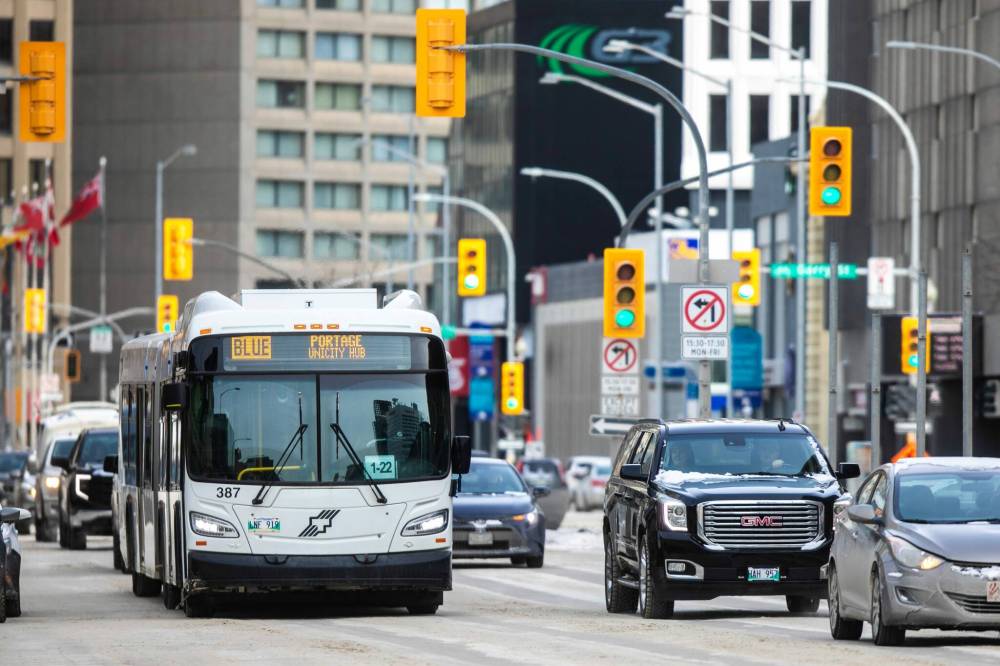
Drivers deserve safety on Winnipeg Transit buses.
Fortunately, the operator was able to flag down a nearby police vehicle before violence could ensue, but the driver, in her first year of service with Winnipeg Transit, is now on leave from her duties. According to the union, she joins more than 60 other drivers who are currently on stress leave owing to trauma and/or psychological injuries suffered on the job.
More than 30,000 days of lost driver time have accumulated as a result of harms suffered on the job, the union reports. That’s a staggering — and costly — number.
“The amount of Workers Compensation Board claims that we must be paying out would pay off the entire shields within two years,” said Van Gerwen. “So every day they’re holding off on putting these shields in, it’s costing Winnipeggers money.”
Two things seem apparent: the frequency with which Winnipeg Transit staff are being assaulted while on duty is increasing — no doubt a byproduct of the addiction and poverty that have also been on the rise in Winnipeg for several years — and the pace with which the transit service and city hall are working to address the issue in no way reflects the urgency of the situation.

The installation of safety shields was first explored in 2017, in response to concerns about the (then-) increasing frequency of abuse of transit drivers. After a six-month pilot project in which two different kinds of shield were tested in a small number of buses, the city announced a full-scale rollout of the selected shield product in 2019. The entire fleet was outfitted with partial shields by mid-2020.
Recent experience and rising violence, however — there were 104 recorded assaults on transit operators last year, and city data show 42 assaults so far this year on uniformed bus drivers — have prompted the union to call for enhanced protection that fully shields drivers from potential attack.
The city set aside $2.7 million in its 2024 capital budget for a pilot project to test the effectiveness of full shields, but to date that study has not been conducted. Cost estimates are reportedly being revised in order for the pilot study to be included in Transit’s 2027 budget submission, but the union has, quite rightly, demanded an accelerated timeline for the installation of full shields.
The current mayor and city council have invested loads of capital — actual, political and intellectual — in improving and expanding Winnipeg’s transit system. But ambitious drawing-board imaginings of expanded rapid-transit corridors and efficiency-minded route reconfigurations are meaningless if the system’s buses can’t be made safe for the individuals tasked with steering them through city streets.
For the sake of those operators whose daily behind-the-wheel duties put them at risk of assault and associated compounding trauma, as well as those future drivers upon whose hiring Transit’s lofty service-enhancement aspirations depend, the city must make the installation of full protective shields a legislative and logistical priority.