

Mars mission part of new space age
Advertisement
Read this article for free:
or
Already have an account? Log in here »
To continue reading, please subscribe:
Monthly Digital Subscription
$1 per week for 24 weeks*
- Enjoy unlimited reading on winnipegfreepress.com
- Read the E-Edition, our digital replica newspaper
- Access News Break, our award-winning app
- Play interactive puzzles
*Billed as $4.00 plus GST every four weeks. After 24 weeks, price increases to the regular rate of $19.95 plus GST every four weeks. Offer available to new and qualified returning subscribers only. Cancel any time.
Monthly Digital Subscription
$4.99/week*
- Enjoy unlimited reading on winnipegfreepress.com
- Read the E-Edition, our digital replica newspaper
- Access News Break, our award-winning app
- Play interactive puzzles
*Billed as $19.95 plus GST every four weeks. Cancel any time.
To continue reading, please subscribe:
Add Free Press access to your Brandon Sun subscription for only an additional
$1 for the first 4 weeks*
*Your next subscription payment will increase by $1.00 and you will be charged $16.99 plus GST for four weeks. After four weeks, your payment will increase to $23.99 plus GST every four weeks.
Read unlimited articles for free today:
or
Already have an account? Log in here »
Hey there, time traveller!
This article was published 10/12/2018 (2655 days ago), so information in it may no longer be current.
The universe is never quite what we thought it was. Different civilizations have studied the heavens, making sense of the movement of the sun, the moon, stars and planets. Every so often, our picture of what’s out there gets a little bit clearer.
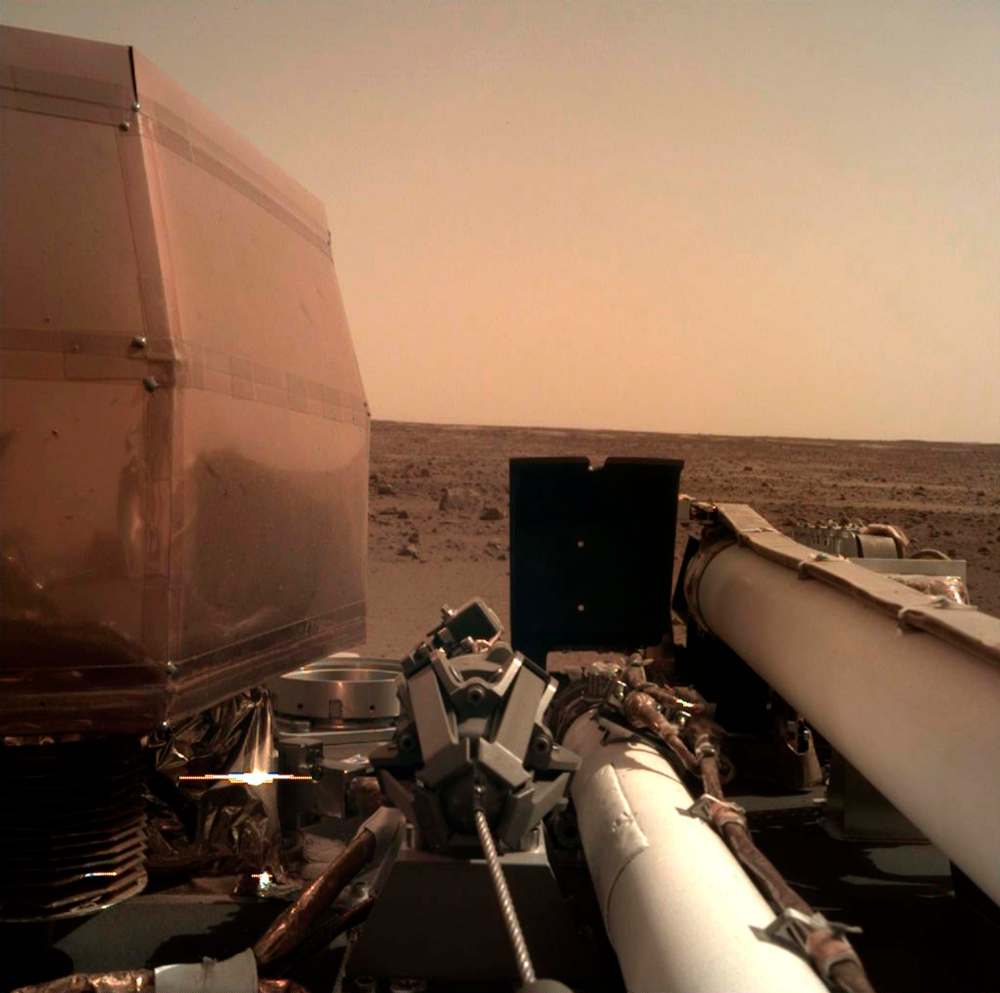
With the touchdown of NASA’s InSight lander on Mars on Nov. 26, that looks likely to happen again.
It’s no easy thing to reach the so-called “red planet.” Since 1960, of all the Soviet/Russian, U.S., European and Japanese attempts to get to Mars, more than 50 per cent have failed. But the future of space exploration looks bright, partly thanks to a recognition that few countries can do it alone.
The Space Race between the United States and former Soviet Union is now more than a half-century old and no longer so much a race as (at times) co-operation. Other space agencies, including Canada’s, have worked together on huge endeavours such as the International Space Station.
And though humans haven’t set foot on the moon since 1972, that may change. NASA has released details in recent weeks that another mission to the moon is in the cards, as a prelude to a manned mission to Mars — both in co-operation with private enterprise. Those future human explorers may depend on what the current robotic explorer on Mars can find out.
Mars has generated a certain fascination over the years. Sci-fi literature has mined the possibilities of contact with the planet for more than a century, with H.G. Wells’ War of the Worlds debuting in 1897, and in the intervening years, works such as Ray Bradbury’s 1950 The Martian Chronicles more recent works such as Kim Stanley Robinson’s Mars trilogy and Andy Weir’s The Martian look at what kind of life could be possible there, either human or non-human.
InSight may shed some light on that.
Following a tense 6½-minute descent, during which the lander slowed from 19,800 km/h to a more gentle 8 km/h, InSight made it safely to the surface at Elysium Planitia and was able to deploy its solar panels. The panels produce about 600-700 W on a clear Martian day — that’s enough to power a kitchen blender, but it will allow InSight to conduct a mission unprecedented in humankind’s study of our closest planetary neighbour.
Previous landers and rovers have studied the surface of Mars, but InSight is the first to attempt to study the planet’s deep interior, and if successful, its long-term mission will tell scientists much more about how the planet developed and how it compares with Earth. In coming weeks, the lander will deploy a seismometer, to measure movements in the ground (“marsquakes”), and a heat probe.

Aside from what scientists hope to learn about Mars’ core, its development and our understanding of such planets, that information can only be helpful to future human-led expeditions.
Entrepreneur Elon Musk has mused openly about the possibility, even necessity, of a human colony there, and NASA is engaging in partnerships with private companies with an eye to getting people to the planet.
Previous human explorers navigating vast stretches of the Pacific, the Atlantic and other oceans didn’t have the advantage of sending unmanned probes ahead to study conditions.
Perhaps, if humankind can keep co-operating, InSight and other robotic explorers will give us insight to get to Mars, and live there, safely.
Who knows just how much clearer our picture of the universe — and ourselves — will become as a result?
History
Updated on Monday, December 10, 2018 9:35 AM CST: Corrects that InSight's panels produce about 600-700 W