

Life in a dead town
Asbestos, Que. -- the name says it all
Advertisement
Read this article for free:
or
Already have an account? Log in here »
To continue reading, please subscribe:
Monthly Digital Subscription
$1 per week for 24 weeks*
- Enjoy unlimited reading on winnipegfreepress.com
- Read the E-Edition, our digital replica newspaper
- Access News Break, our award-winning app
- Play interactive puzzles
*Billed as $4.00 plus GST every four weeks. After 24 weeks, price increases to the regular rate of $19.95 plus GST every four weeks. Offer available to new and qualified returning subscribers only. Cancel any time.
Monthly Digital Subscription
$4.99/week*
- Enjoy unlimited reading on winnipegfreepress.com
- Read the E-Edition, our digital replica newspaper
- Access News Break, our award-winning app
- Play interactive puzzles
*Billed as $19.95 plus GST every four weeks. Cancel any time.
To continue reading, please subscribe:
Add Free Press access to your Brandon Sun subscription for only an additional
$1 for the first 4 weeks*
*Your next subscription payment will increase by $1.00 and you will be charged $16.99 plus GST for four weeks. After four weeks, your payment will increase to $23.99 plus GST every four weeks.
Read unlimited articles for free today:
or
Already have an account? Log in here »
Hey there, time traveller!
This article was published 29/05/2010 (5799 days ago), so information in it may no longer be current.
ASBESTOS, Que.— Both hands on the wheel of his orange Bronco, Claude Lortie bounces down the gravel path carved out of jagged, serpentine rock, into the mouth of the giant pit.
A pool of crystal blue water beckons from the bottom, so blue against the grey rock and the "white gold" of asbestos it looks like it’s been colour-enhanced, like the Technicolor newsreels that once boasted of the magic mineral.
Lortie, the manager of the Jeffrey Mine, who is preparing for his 42nd — and perhaps last — season here, surveys the landscape with a fondness for the rocky hills that contrasts sharply with the tales of stunted lives and painful deaths more often associated with asbestos, first in Quebec and now in the developing world, where it continues to be exported.
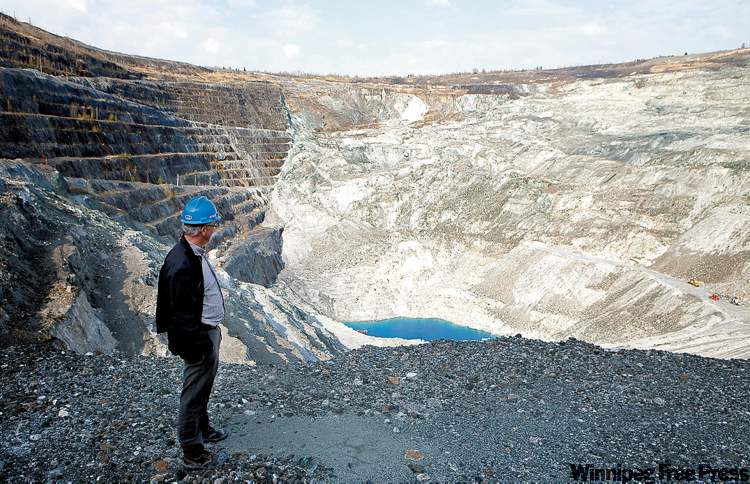
"If I believed what I hear on television every night, I’d have to pinch myself to make sure I am still alive," Lortie says.
He and his crew, most of whom are also in their 60s, are gearing up for what might be the last mining season in Asbestos after 131 turbulent years, nevertheless hoping that "any day now" the Quebec government will come through for them and guarantee a $58-million bank loan to open a new underground mine — under the blue lake.
There is a lot riding on the decision, not least the future of a town that shares its name with the mineral and the disease it engendered, at once the source of its pride and shame.
Asbestos, the mineral, may well be inextinguishable, as the Greek adjective suggests. But is the town of Asbestos?
Named by Jobboom magazine in 2006 as one of the 10 towns in Quebec most likely to disappear, the latest casualty of Asbestos’s slow demise is city hall itself.
On April 21, the people of this Eastern Townships hamlet voted to demolish the imposing edifice rather than pay to maintain it.
Built in 1966, most of the building has been empty for some time, said Mayor Hugues Grimard, and the necessary repairs would cost about $1.5 million, over and above the yearly upkeep.
The town just doesn’t have that kind of cash anymore, said Grimard. After the mine, the largest employer is the hospital. After the hospital, it’s the local grocery store.
Since 2002, the mine has opened only sporadically, however, for three to five months a year in the summer, usually starting in April, when electricity is cheaper. This year it opened May 3. As a result, tax revenues from the mine are also sporadic.
"That’s why we need this new mine," says Grimard, a lifelong resident of Asbestos, who was elected in November on a promise to get the town’s finances in order. Like many of the town’s 7,000 inhabitants, his grandfather and several uncles worked at the mine. "It would mean 450 new jobs. It’s the history, the passion and the future of this town."
Grimard says he doesn’t read any of the negative articles on asbestos that appear daily around the world.
It’s all "disinformation," he says. Looking over the chain-link fence that marks the line where the town ends and the mine begins, he says even NASA needs asbestos, to fireproof its shuttles.
How can it be bad?
It’s a refrain often heard in this town, where the giant pit has never been far out of sight or out of mind.
***
Across the street from city hall, a 1970s-style ice cream parlour appears deserted, leaving visitors to imagine what it must have been like when the vast lot in front swarmed with children, during more prosperous times when the town was booming and young families were settling in to profit from the white-gold rush on which Asbestos was founded.
Early inhabitants had noticed the silky substance that veined the rocks on a hillside known as Webb’s Ledge, named after the farmer who owned the land. But it was a Welsh miner named Evan Williams who, visiting his parents in 1881, was the first to identify the substance as the mineral asbestos, and recognize its commercial value.
Up until the mid 1890s, only about 20 people worked in the Jeffrey Mine, manually packing asbestos fibres into bags for about 10 cents an hour.
But through the next half century, the mine expanded, along with demand for the fire-resistant product, forcing hospitals and churches in town to relocate periodically to make way for the ever-widening pit. (The current owners of the mine have opted to dig underground instead of further expanding the open pit, in part to avoid encroaching on the town again.)
It was the strike by asbestos workers in 1949, however, that cemented the town’s place in Quebec history.
Striking for better pay and better conditions — notably the removal of dust inside and outside the mill — the bitter feud between about 2,400 francophone workers and their English-speaking bosses, which forced at least parts of the Catholic church to split with Premier Maurice Duplessis for the first time, would lay the foundation for the Quebec labour movement and the Quiet Revolution.
It’s a proud history that townsfolk don’t want to let go of, despite the events of the next half century, as the magic mineral became a pariah around the world.
By the time Claude Lortie showed up for his first day on the job as a mechanic in 1968, the Jeffrey Mine had reached its peak. The strike had ended with the union caving in after mass arrests, but conditions slowly improved and the miners prospered.
The Jeffrey Mine once produced about 200,000 tonnes of asbestos per year, to be used in 3,000 different products, from hair dryers and coffee pots, to talcum powder and potting soil, sewage pipes and insulating mattresses, not to mention the more obvious applications: fireproof suits for firefighters, and insulation in millions of homes and schools throughout North America and Europe. Even modelling clay, used in schools, often contained asbestos until the 1970s.
But the world’s love affair with asbestos came to an end as more and more scientists began to draw the link between asbestos and several forms of deadly lung disease showing up in miners and others exposed to the fibres released into the air, including the first documented case of asbestosis (1907), asbestos-related lung cancer (1934) and mesothelioma (1960), whose only known cause is exposure to asbestos.
The latency period for these diseases — the time it takes for the disease to manifest itself — is between 15 and 50 years. The dust that bothered asbestos miners in 1949, was now starting to kill them. Deaths linked to exposure to asbestos still made up 55 per cent of all work-related deaths in Quebec last year.
Meanwhile, it took almost as long for the world to react. All forms of asbestos, including chrysotile asbestos, the kind mined in Quebec, were banned in the United Kingdom in 1999, and in the 27 states of Europe in 2005, as they came to see the carcinogen buried in their walls as a sleeping bear — harmful when disturbed — and very expensive to get rid of.
Asbestos has not been banned in the United States or in Canada, but it is strictly controlled under the Hazardous Products Act.
So as asbestos fibres were being removed from the Parliament buildings in Ottawa, J.M. Asbestos Inc. — as the company has been known since 1983, when it was bought by a group of senior staff — sought out new markets abroad.
In India, Mexico and Indonesia, for example, cement reinforced with asbestos fibres is now used to make pipes, sheets, flooring and other products.
The Quebec and federal governments have attempted to walk a tightrope, promoting public health on the one hand and the asbestos industry on the other. Asbestos today can be used safely, advocates say.
But politicians’ once unswerving support for the industry has begun to wane. Liberal Leader Michael Ignatieff came out against the continued mining and export of asbestos last year. Then two Conservative MPs, Pat Davidson of Ontario and Dona Cadman of British Columbia, followed suit, publicly breaking ranks with their prime minister.
They have joined the International Labour Organization, the Canadian Medical Association, the Canadian Cancer Society, the Canadian Labour Congress, the World Health Organization and the World Federation of Public Health Associations in calling for a ban on the mining, export and use of all forms of asbestos.
And the letters, now directed at Quebec Premier Jean Charest in particular, keep coming. Last week, he received one from a group of workers’ organizations in India.
"When it comes to the asbestos industry, you readily abandon science and put forward the lie that Quebec’s asbestos can be safely used, when even your own government health experts have told you this is not true," said a letter from Mohit Gupta of the Occupational and Environmental Health Network of India.
"Given the public health crisis caused by asbestos in Quebec, we are aware that you are no longer using asbestos," Gupta continued. "We are glad you are not exposing your own citizens to asbestos harm. But do we not count?"
Back in Asbestos the town, however, asbestos is still used — mixed with asphalt — for paving streets. It’s more expensive but it lasts longer, says Mayor Grimard proudly. Its also used elsewhere on Quebec highways, though with less fanfare.
And just as politicians before him have eaten hamburgers to quell fears of E. coli and drunk tap water to dispel concerns of contaminated water, the mayor drives over asbestos, and smiles.
***
In the centre of Asbestos, there is a mall, and in the centre of the mall, there is a diner. Casse-croute le Gourmet, run by Henriette Dubois for the past 22 years, is where some of the retired miners and other townsfolk spend their time.
"We’re an aging population — we’re certainly not dying from asbestos," says Dubois, slinging Salisbury steak and other home-cooking for a lunchtime crowd. "We’ve always lived with it, and why not? My father worked 30 or 40 years in the mine. He started when he was 15, and he died at 90. He didn’t die from asbestos."
Dubois believes all the "disinformation" was spread by the French, who banned the substance to promote their own asbestos-free products.
"Why does NASA need it?" she asked. "It can’t be as bad as all that."
Indeed, as Dubois says, there are many golden agers in Asbestos, who are all the more visible now that school enrolment has dropped precipitously.
But their presence in town may be more a byproduct of demographics and real-estate values than healthy living conditions.
Montrealers, for example, can sell their $300,000 home in the city and buy an equivalent home in Asbestos for $100,000, pocketing the difference. And there is a 24-hour emergency room in the town, and other services to offer retirees, Grimard says.
If the provincial government won’t back funding for the underground mine, Asbestos may avoid becoming a ghost town by becoming a retirement town. What other alternatives are there?
***
Back at the mine, where 200-tonne trucks sit idle, waiting for a decision from the Charest government "any day now," Bernard Coulombe, the majority shareholder of the Jeffrey Mine, also contemplates the alternatives.
A J.M. man from the beginning — he joined Johns-Manville Co., when it owned the mine back in 1969, and now he owns 65 per cent of it — he has come to take the heritage of the mine and the town’s future to heart. He, too, boasts of the role asbestos has played in space exploration, and even talks about how asbestos could have saved lives on 9/11, had it been sprayed all the way to the top of the Twin Towers. It was only sprayed to Floor 71, Coulombe says, that’s why the towers collapsed after only 56 minutes.
He began building the underground mine — with its 800-metre shaft — in 1995, sinking $130 million into it. But after completing 90 per cent of the construction, he ran out of money in 2002.
"I went around the world for two years trying to drum up investment, but I couldn’t find the $35 million to finish the mine," he says.
He attracted Chinese investors, but then they pulled out before even visiting the mine. Ignatieff’s comments may have scared them off, Coulombe believes. Bad publicity — and the fear of litigation mining deep pockets — stop people from investing in a lucrative market, he says.
When he began his career with Johns-Manville, everyone was breathing dust, he said, and most were also smoking — a particularly lethal combination. About six per cent of 11,000 employees got asbestosis, he said. Now all the fibre extraction is carried out under negative pressure to minimize airborne dust.
"Those are the sins of the past, and we’re paying dearly for them."
Coulombe turned to the government as a last resort, hoping it would make a good business decision. As the open-pit mine heads toward depletion, the underground mine would provide $1 billion to the provincial government over the next 20 years in corporate taxes, mining rights and income taxes, he says. Another $1 million a year would go to the municipal government. Enough to cover city hall’s expenses and then some.
But Coulombe is worried those sins, and the onslaught of criticism from all sides — except at home in Asbestos — will stop the Charest government from backing the plan.
Still, today there are safe ways to use asbestos, he says, and J.M. already does an audit of working conditions at each company that imports its product. J.M. will be even more severe, once the mine goes through, he said.
"But it’s harder to break a prejudice than an atom," Coulombe says, quoting Albert Einstein.
And if the new mine doesn’t happen?
There have been many Plan Bs over the years, and Coulombe has had a personal hand in trying to diversify the local economy. But none of them have panned out.
A magnesium smelter built for $1.3 billion to turn mine tailings into magnesium ore closed in 2003 after just three years in operation, when its owners realized they couldn’t compete with Chinese producers, leaving the town bitter, and heavily in debt.
Efforts to generate electricity through wind turbines placed on the edge of the mine didn’t work, either.
Now a plan to bring up to 800,000 tonnes of garbage a year from Montreal to Asbestos, turning some of it into methane gas to power small industries, and landfilling the rest on part of the 2,000-hectare J.M. site, is stalled in court.
According to its promoter Estrie Enviropole, it would create about 225 permanent jobs, more than compensating for the 250 part-time jobs lost if the mine shuts down.
But the town — and the region — is divided over the proposal. The six other municipalities in the region voted against it, enacting legislation to limit the amount of garbage brought in to 50,000 tonnes per year.
Only Asbestos itself, under then mayor Jean-Philippe Bachand, welcomed the plan, by a slim margin of 54 per cent to 46 per cent, according to a survey done in 2008.
Estrie Enviropole has launched a lawsuit against the other six municipalities — and their mayors — for what it says was discriminatory legislation. The case will be heard in Superior Court in the fall. But even if the company wins, it will still have to submit to public consultations through the Bureau des audiences publiques de l’environnement.
Grimard, happy he’s not one of the mayors named in the lawsuit, nevertheless has vowed to hold a referendum on the garbage project if it is approved.
Perhaps the only proposal that wouldn’t raise the hackles of townsfolk would be to turn the vast 2.5-kilometre wide pit into a park for motocross and all-terrain vehicles. But it’s hardly a top choice.
A Facebook page dedicated to the opening of the new mine has 1,166 members. Another for the Jeffrey Mine Quad — or four-wheeler — park has 58 members.
Coulombe says whatever happens, hell keep up the fight to keep the mine and the town alive. He’d rather mothball the project and wait for a more hospitable political climate than see it gone forever.

"If it was just for me, I’m 68," said Coulombe, who is also president and CEO of Niocan, the company behind a proposed niobium mine near Oka. "But I have 450 people waiting for me to give them a job. And my objective is to save the heritage. I’m so convinced that asbestos is so useful and so well used. Why should I abandon it?"
Claude Lortie, for his part, will just work at another mine if J.M. closes. "Not a week goes by without headhunters calling," he says.
As for NASA, it will surely find another supplier.
— Montreal Gazette