

Inside the Cirque
The spectacle begins in the Montreal creative laboratory
Advertisement
Read this article for free:
or
Already have an account? Log in here »
To continue reading, please subscribe:
Monthly Digital Subscription
$1 per week for 24 weeks*
- Enjoy unlimited reading on winnipegfreepress.com
- Read the E-Edition, our digital replica newspaper
- Access News Break, our award-winning app
- Play interactive puzzles
*Billed as $4.00 plus GST every four weeks. After 24 weeks, price increases to the regular rate of $19.95 plus GST every four weeks. Offer available to new and qualified returning subscribers only. Cancel any time.
Monthly Digital Subscription
$4.99/week*
- Enjoy unlimited reading on winnipegfreepress.com
- Read the E-Edition, our digital replica newspaper
- Access News Break, our award-winning app
- Play interactive puzzles
*Billed as $19.95 plus GST every four weeks. Cancel any time.
To continue reading, please subscribe:
Add Free Press access to your Brandon Sun subscription for only an additional
$1 for the first 4 weeks*
*Your next subscription payment will increase by $1.00 and you will be charged $16.99 plus GST for four weeks. After four weeks, your payment will increase to $23.99 plus GST every four weeks.
Read unlimited articles for free today:
or
Already have an account? Log in here »
Hey there, time traveller!
This article was published 18/09/2010 (5677 days ago), so information in it may no longer be current.
Even in the defiantly strange world of Cirque du Soleil, Madame Zazou has an odd job.
Not that she has time to explain it to me. As part of a small group of western Canadian journalists on a tour of Cirque’s international headquarters in Montreal, I’m being whisked from interview to interview with impressive efficiency when we are suddenly intercepted by a diminutive woman sporting heavy makeup. She exits a small room while loudly and tunelessly braying the words to the Bee Gees’ Staying Alive.
Spotting the group, she immediately takes exception to a journalist’s tie and promptly removes it, cheerfully tells him that it is inappropriate, stuffs it into his shirt pocket and then moonwalks away.
That’s Madame Zazou, says tour guide and Cirque spokeswoman Tania Ormejuste. Being crazy, it seems, is part of her daily job.
Madame Zazou writes blogs, organizes talent shows for the non-performers on staff and oversees other employee contests, Ormejuste explains. But, generally, her main duty is to dole out daily helpings of zaniness whenever possible, which is surely one of the more unusual occupations to be found in the headquarters of an organization that reportedly generates $810 million in revenue every year.
A former street performer who used to pal around with Cirque founder and one-time fire-eater Guy Laliberté, Zazou is a direct link to the humble busker origins of one of North America’s greatest and most bizarre success stories.
She’s very unpredictable, says a clearly delighted Ormejuste, somewhat unnecessarily, as we watch Zazou disappear down the hall.
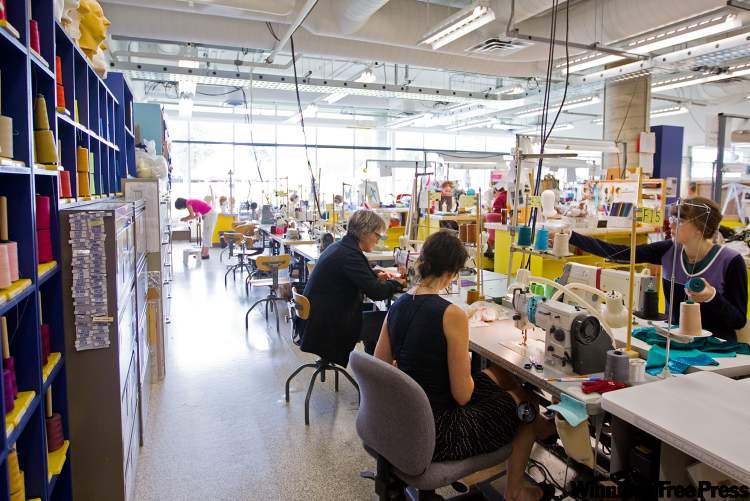
It’s a reminder for those of us on the tour of Cirque’s big-top esthetic and its general strangeness. The multimillion-dollar juggernaut may be a business success, but the first flickers of creativity that give rise to the surreal, carnival-like and lucrative creations happen here in what Cirque dubs its creative laboratory. This is where the clowns practise without makeup. This is where the elaborate sets are designed. This is where acrobats fly off trapezes and Russian swings and Chinese poles. This is where 400 costume-makers turn 130,000 kilometres of fabric into 25,000 costumes every year. This is where shows like the ones that will be seen by 15 million people in 2010 are plotted, planned and practised.
There are 21 separate shows under the Cirque banner that are either touring the world or taking up residences in places such as Las Vegas, China, Japan and Orlando, Fla. So, while suits and ties may be frowned upon, it’s clear that this bustling nerve centre in Montreal has to run like a well-oiled machine. Accountants, publicists, trainers, cooks, nutritionists, physiotherapists, guidance counsellors, security guards, wigmakers, makeup artists, gymnasts and janitors all work together. Many of the performers who are in training live in residences across the street. At first blush, the operation can seem more business than carnival, which is perhaps one of the reasons it operates out of public view.
Members of the public or visiting tourists often ask to see the headquarters, Ormejuste says.
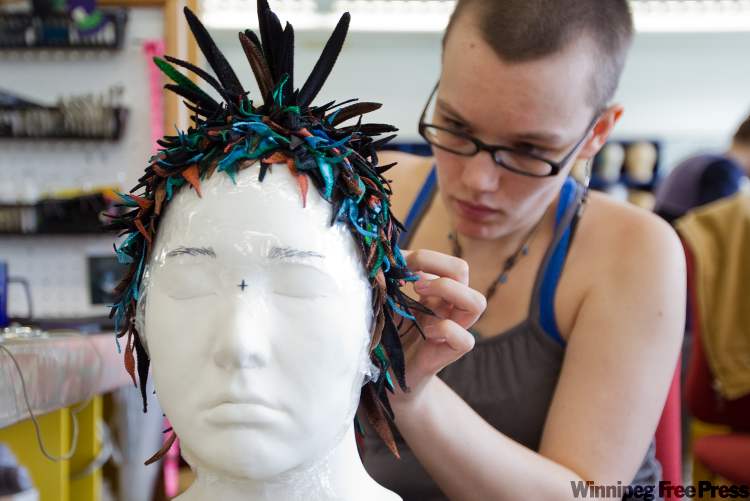
But it’s not a tourist place, she says. Nor does it look one, at least from the outside. Situated in one of Montreal’s most ethnically diverse but economically downtrodden neighbourhoods, the complex looks factory-like, sitting off the road next to the second-largest landfill and waste-sorting facility in North America. More than 2,000 people work in the sprawling, 36,700-square-metre headquarters. But just when you think it’s business as usual, reminders of Cirque’s colourful oeuvre march into view. It may be the young contortionists in full costume who shuffle by in the cafeteria. It may be the Argentine song-and-dance man practising Cirque’s complex makeup application in front of a mirror. It may be the hundreds of creepy-looking plaster heads — each one made from a real Cirque performer so busy artisans can custom-build costumes — that stare out ominously from the shelves in its wig and hat studio.
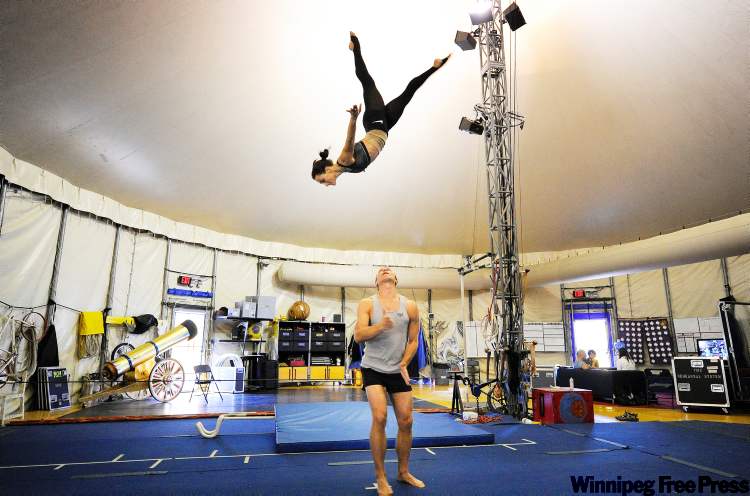
But if a moonwalking Madame Zazou best represents Cirque’s crazy heart, the bustling Studio E — a noisy, action-packed gymnasium filled with blue mats and more languages than a United Nations meeting — represents its body and soul. One of three acrobatic training facilities on the grounds, it’s smaller than you might imagine. But on this particular day it’s a beehive of activity. In the back, a young woman swings from a trapeze. Something called a Russian swing is in full operation in another part of the gymnasium. A muscular young man fixed with safety tethers leaps from it, curls into numerous flips and lands on a mat amid a shouting mob of spotters.
A Mongolian gymnast stretches out on a mat; a teenage contortionist from somewhere in Eastern Europe sits across from her. Up front, a small circle of young performers chant, twirl and dance the same scene over and over. While there is only half-a-dozen or so in this group, overseeing the young athletes is a coach barking orders and three interpreters translating those orders into Chinese and Russian. Cirque employs an army of 100 interpreters, including one who is fluent in sign language. There are nearly 50 nationalities represented at the headquarters and 25 languages spoken — making for a colourful, if at times confusing, cross-section of humanity.
“The very first meeting we had, I was sitting there trying to listen,” says Alexa Jollimore, an 18-year-old from Dartmouth, N.S., currently in general training at Cirque headquarters. “But I heard all this buzzing going on and I thought, ‘Why are people talking when someone else is talking?’ But it was the interpreters. That took a few weeks to get used to.”
Jollimore is among the hundreds of performers currently training in the facility. She is also part of the 51 per cent of recruits who come from an athletic rather than artistic background. A competitive gymnast, Jollimore was at a meet in Burlington, Ont., when she took advantage of an open casting call for the company. She is among the more starry-eyed of newbies, having dreamed of landing a spot with Cirque since she was five years old and would watch a Cirque acrobat train in a local gymnasium.
“We’d be allowed to watch her,” Jollimore says. “I just thought it was the most beautiful thing ever. So I told my mom, right that day, that I would be part of Cirque du Soleil when I grew up. So here I am.”
This is not to say that all those who go through training will land a contract with Cirque. Jollimore’s entry into the program through open auditions is just one of many ways a performer can enter the sights of Cirque’s discerning army of scouts. Some are asked to come for general training after gaining attention through YouTube or sending in DVDs of their performances. Casting agents are dispatched to other circuses around the world on a regular basis, or go to gatherings and conventions for clowns and street performers (yes, there are such things) to find the right people.
The Quiros family, for instance, had been performing breathtaking high-wire stunts for four or five generations in Spain before being recruited into the ranks for Kooza. The Colombian artists who perform the Wheel of Death stunts — an astonishing, edge-of-your-seat spectacle that involves two artists performing acrobatics on 730-kilogram rotating wheels — were also recruited specifically for this show.
Veteran performer Lisa Maree Skinner spent three-and-a-half years as part of the power track segment of the Cirque creation Alegria, an act that mixes trampoline-fuelled acrobatics and gymnastics. She’s now at the headquarters training for Quidam, which will start touring arenas around North America in a reconfigured form this December. Like Jollimore, she is a former gymnast. Well-known and beloved in her native Australia, Skinner competed in the 1996, 2000 and 2004 Olympics. Her balletic style seemed to make her a good candidate to follow up her years of competition with something more artistic.
Thousands go through the training process, some for specific shows, others trained and kept until they are needed. Some don’t make the cut at all. Fifteen to 20 per cent of the 1,200 artists and performers around the world need to be replaced every year. So the wheels keep turning in Saint-Michel.
“Personally, what I like to see on stage is something that can reach and touch me emotionally,” says Marie-Josée Laurau, who is in charge of artistic training at headquarters.
This often means overseeing the transformation of athletes, often driven by competition and repetition, into emotive artists who sing and dance.
“If it’s only about performing, to me it’s less powerful and less interesting,” she says. “If they are able to project something that is bigger than them and more intense, it comes through emotionally. You have to be able to transpose it on stage and live it. You need to become an artist.”

Jollimore was studying engineering at Dalhousie University when she got the call to come and train for Cirque in May. The engineering degree is now on hold. Cirque pays her a small stipend and she bunks in the residences across the street, where overcoming language barriers is a daily adventure.
While she knows the six months of training in no way guarantees her a spot in Cirque, she says she’s hopeful for a long career with the organization, even if the competition among her new friends is fierce.
Everyone wants the same thing, she says, before disappearing back into Studio E for a few more hours of training.
— Calgary Herald