

Those shifty goldfish are capable of anything
Advertisement
Read this article for free:
or
Already have an account? Log in here »
To continue reading, please subscribe:

Digital Subscription
One year of digital access for only $205*
- Enjoy unlimited reading on winnipegfreepress.com
- Read the E-Edition, our digital replica newspaper
- Access News Break, our award-winning app
- Play interactive puzzles
*First annual payment billed as $205.00 + GST for one year. This annual subscription will automatically renew at $233.00 + GST every 52 weeks (10% off the regular annual price of $259.35). Offer available to new and qualified returning subscribers only. Cancel any time.
To continue reading, please subscribe:
Add Free Press access to your Brandon Sun subscription for only an additional
$1 for the first 4 weeks*
- Enjoy unlimited reading on winnipegfreepress.com
- Read the E-Edition, our digital replica newspaper
- Access News Break, our award-winning app
- Play interactive puzzles
*Your next Brandon Sun subscription payment will increase by $1.00 and you will be charged $17.95 plus GST for four weeks. After four weeks, your payment will increase to $24.95 plus GST every four weeks.
Read unlimited articles for free today:
or
Already have an account? Log in here »
Hey there, time traveller!
This article was published 30/07/2011 (5507 days ago), so information in it may no longer be current.
At first glance, it looks like one of those feel-good stories about the tiny little miracles that sometimes emerge from catastrophic disasters. In Christchurch, New Zealand, 134 days after an earthquake devastated large chunks of that city and killed 181 people — long after there was any hope of finding any human survivors — two goldfish were found alive in the ruins.
In early July, when employees were finally allowed back into the offices of Quantum Chartered Accountants on Christchurch’s High Street — this all sounds just too perfect — they discovered two goldfish still swimming around in an aquarium in the office’s reception area. There had been no one to feed them, no electricity to power the pumps that filter their water, but there they were, a little faded, a little listless but otherwise none the worse for wear.
Goldfish experts — apparently there actually are people who devote their lives to this sort of thing — say the little fish are “hardy critters” and that these two may have survived by eating weeds and algae growing on the tank’s paraphernalia and that natural bacteria may have filtered the water for them.
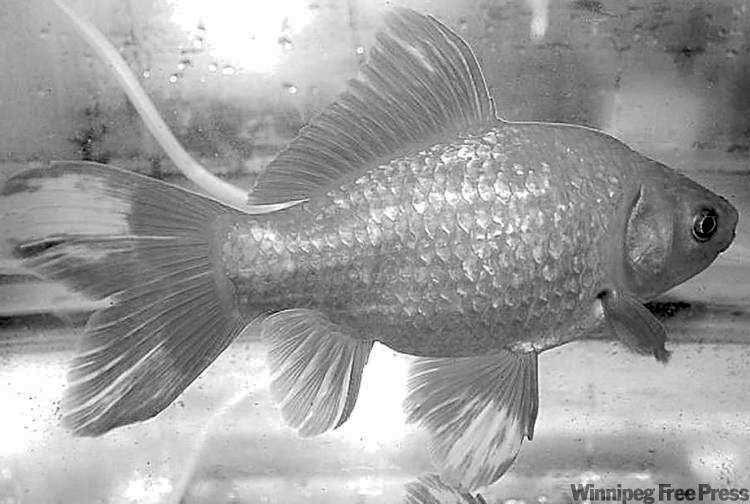
So, shall we chalk this down as the little miracle on High Street? Or is there a more sinister explanation for the survival of “Shaggy” and “Daphne,” the unlikely names these goldfish go by (“I’d like you to meet my goldfish, Shaggy?” Not likely.)
In any case, when the walls came down in Christchurch, there were actually six goldfish in the tank. When the dust had settled 134 days later, there were only a rather plumpish Shaggy and Daphne and one dead fish floating in the water — or on the menu, as some cynics suspect because they don’t believe in miracles.
There was no trace of the other three fish, leading to the suspicion that Shaggy and Daphne, like the pilot who ate the dead stewardess, the South American soccer team who ate each other and the survivors of the Donner Expedition who got through a winter stranded in a mountain pass by eating the only available food there was, are, in fact, cannibals.
That is not quite as uplifting a story as the little miracle on High Street, but for anyone who has observed goldfish carefully, it comes as no surprise. They are suspicious-looking fish and notorious omnivores — like pigs. Their blank, slow-blinking eyes are characteristic of psychopathic fish and their devious movements — has anyone ever seen a goldfish swim a straight line — scream out (in body language) “I cannot be trusted.”
Shaggy and Daphne are now in a new home with two other goldfish named Scooby and Fred. So far they have been content with the fish food supplied daily to them, but Scooby and Fred should hope the day never comes when someone forgets to feed them. That would be the little massacre on High Street.
Just take our money and get out of our way
It is a curious thing that it is almost impossible for Canadians to enjoy life’s simple pleasures without the government tagging along. Want a cigarette? Well, the government will tell you when and where you can enjoy one, but only after you have paid an exorbitant tax on it.
Feel like a beer? Well, you can only do that at the government’s discretion and again, only after you have paid an exorbitant tax on it.
Feel like making a small wager? Well, you can only do that in a government-run or government-franchised casino. The good news here is you don’t have to pay tax on that, perhaps because the odds against your winning anything worth keeping are so high that a tax on top of that would amount to cruel and unusual punishment and probably be unconstitutional.
At least government hasn’t yet found a way to put a bureaucrat in bed with us (unless, of course, you are married to one, in which case you have my sympathy) or to tax whatever it is we might do there. But that day may come.
There used to be in Winnipeg something called the Interdict, a list of names of problem drinkers who were not allowed in beer parlours or government-run grog shops. People didn’t volunteer for it — authorities put their names on it — and it was difficult to enforce because all you had to do was go a bar where no one knew you; a lot of fun that would be, but the government doesn’t really want you to have fun while you are enjoying the simple pleasures of life.
The Interdict has gone the way of all things inhuman, but it has been replaced by a list of problem gamblers. The difference is the gambler has to put his own name on the list and then the casino is obliged to keep him out.
Casinos do this with varying degrees of enthusiasm but some in Canada are now using facial-recognition technology to identify listed gamblers who try to sneak back in. Bells and whistles go off and the backslider is given the bum’s rush.
In its way, this is even more offensive to personal dignity than the Interdict was. Both are efforts by government to save us from ourselves — or if you want to look at it another way — to save ourselves from government services, but the Interdict at least was an honest imposition while this is just sanctimonious interference in our idle time. No one wants government as a partner in pleasure. Just take our money and get out of our way.
Does the have to be a manual for everything?
One of the steadiest and most reliable sectors of the publishing industry is self-help books, those handy little volumes that assure us that every day, in every way, we can get better and better, if only we buy this book and try hard.

There is almost no subject under the sun on which there is not a book offering hints on how to improve ourselves. They range from How to Be a Better Husband all the way to How to Make your Husband Better — the latter is the better seller — and they are hugely popular among incorrigible optimists.
One might think such books are the product of a 20th-21st century world where men are no longer men and women are almost unrecognizable, but the truth is they are almost as old as inadequacy. The 19th century, for example, abounded in books advising women on how best to endure the sexual side of marriage — lie back and think of the Empire. To cater to more traditionally masculine interests, in 1885 the anarchist Johann Most published Revolutionary War Science: A Little Handbook of Instruction in the Use and Preparation of Nitroglycerine, Dynamite, Gun-Cotton, Fulminating Mercury, Bombs, Fuses, Poisons, etc., etc., which I believe is, regrettably, now out of print, although it could hardly be more timely in today’s market.
I say regrettably because I would have been tempted to use the book last week when I was confronted by a broken toilet. The little chain thing that makes it flush was broken. I couldn’t fix it and it confounded even my son, who is sometimes sort of handy in a six-fingered way. I had to call in two sisters-in-law who finally got it working. The humiliation was, I suppose, preferable to blowing up the bathroom, but it underlined for me just how deeply we are emerged in this age of ineptitude when you need to either call a professional or buy a self-help book to do even the simplest chores.
There is even a self-help book on how to plan a picnic. Personally, I hope I never to have to go on a picnic again in my life. Unless you are a calf-eyed 17-year-old boy so desperately infatuated with a 16-year-old girl that you are willing to endure ant bites, wasp stings and sunburn for the sake of fantasies that will never be fulfilled, picnics are pure hell.
But even so, surely we are not so heavy with hopelessness that we can’t go on a picnic without expert advice — can’t we just throw some beer and sandwiches in a cooler, grab a blanket and find some place free of asphalt? Apparently not. The Free Press this week listed at least 10 must-dos in planning a picnic and one suspects that’s just the beginning. Which means, of course (good news), that I couldn’t go on a picnic even if I wanted to, unless, of course (bad news), I called in my sisters-in-law to organize it.
Related Articles
Does there have to be a manual for everything?
Advertisement Advertise With Us
Advertisement Advertise With Us