

Polar express
Tourists provide valuable photographic data for scientists studying Manitoba polar bears
Advertisement
Read this article for free:
or
Already have an account? Log in here »
To continue reading, please subscribe:
Monthly Digital Subscription
$1 per week for 24 weeks*
- Enjoy unlimited reading on winnipegfreepress.com
- Read the E-Edition, our digital replica newspaper
- Access News Break, our award-winning app
- Play interactive puzzles
*Billed as $4.00 plus GST every four weeks. After 24 weeks, price increases to the regular rate of $19.95 plus GST every four weeks. Offer available to new and qualified returning subscribers only. Cancel any time.
Monthly Digital Subscription
$4.99/week*
- Enjoy unlimited reading on winnipegfreepress.com
- Read the E-Edition, our digital replica newspaper
- Access News Break, our award-winning app
- Play interactive puzzles
*Billed as $19.95 plus GST every four weeks. Cancel any time.
To continue reading, please subscribe:
Add Free Press access to your Brandon Sun subscription for only an additional
$1 for the first 4 weeks*
*Your next subscription payment will increase by $1.00 and you will be charged $16.99 plus GST for four weeks. After four weeks, your payment will increase to $23.99 plus GST every four weeks.
Read unlimited articles for free today:
or
Already have an account? Log in here »
Hey there, time traveller!
This article was published 29/10/2011 (5273 days ago), so information in it may no longer be current.
Thanks to a crew of citizen “research assistants” from around the world, tracking individual polar bears around Churchill is literally a snap.
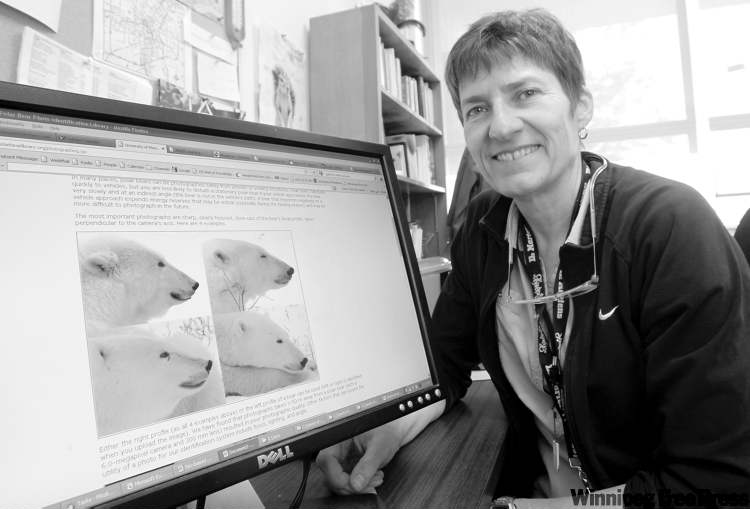
“We can’t handle and mark polar bears in the tourist region because the marks would interfere with their photography,” Jane Waterman said as she transferred photos of four polar bears from one computer screen on her desk to another.
“But, in order to study the behaviour of bears, we need to identify individuals.”
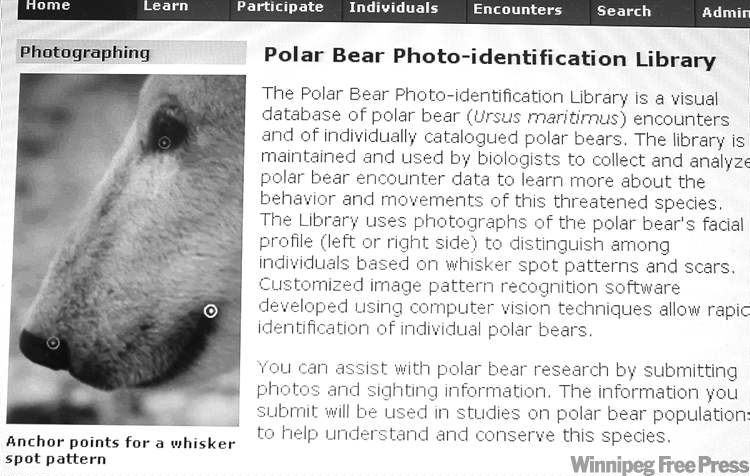
The solution was the University of Manitoba’s Whiskerprint Project, a database of polar bear photos — most of which have been taken by tourists around the rocky shores of Hudson Bay near Churchill, 1,465 kilometres northeast of Winnipeg.
“The library uses photographs of the polar bear’s facial profile (left or right side) to distinguish among individuals based on whisker-spot patterns and scars,” Waterman said.
The photos of the bears she was transferring — Lagoon, Ottawa, Ox and Pumpkin — are now part of the University of Manitoba Polar Bear Photo-identification Library.
It’s a visual database of polar bear encounters, said Waterman, a behavioural ecologist and an associate professor in the biological sciences department at the U of M.
Anyone can take part by submitting photographs, as long as they’re of a bear’s side profile — a bear mug shot — and they record the approximate date of the photos.
“With digital photography and our identification software, we can now follow individuals through time and space. And, since almost everyone who goes to Churchill carries a camera, we now have the possibility of hundreds of citizen research assistants.
“If they take photographs and upload them then we, as researchers, can get a lot of information about how long that bear stayed in the area, estimate the population of bears in an area and find out if these are the bears that end up in the polar bear detention centre. It’s another example of how basic research leads to applied solutions,” Waterman said.
Image-recognition software, which a former student of Waterman’s developed, can quickly identify individual polar bears.
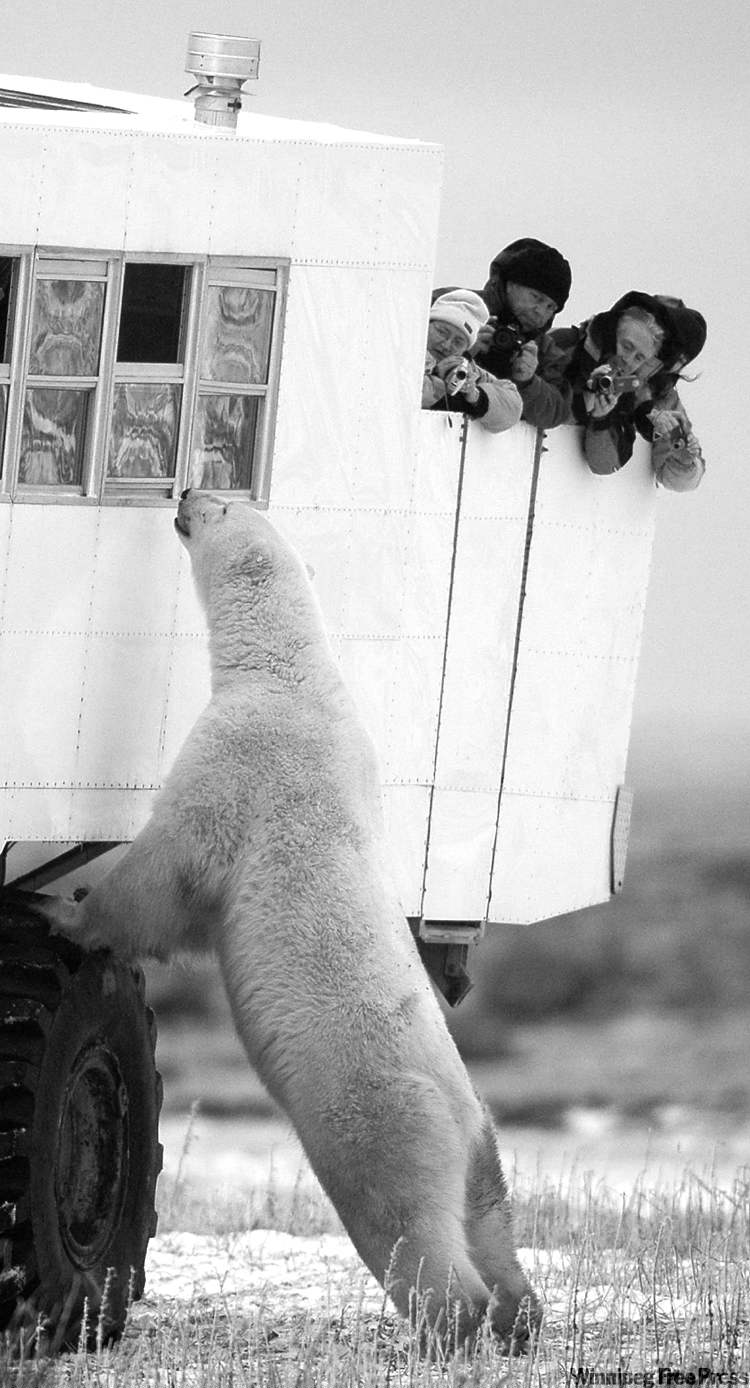
Although Waterman travels to Churchill in the autumn to photograph bears, she doesn’t really need to make the journey because her project is, as she puts it, oriented toward “citizen-science.” Dozens of photo-snapping tourists are pleased to be part of contributing to understanding and protecting this at-risk species.
France Rivet, a nature photographer from Gatineau, Que., had the chance to contribute to Waterman’s study last October during a five-day Lords of the Arctic learning vacation at the Churchill Northern Studies Centre. Waterman guest-lectures at the centre during their fall polar bear viewing vacations.
“We worked with Jane to classify the photos we wished to share with her,” said Rivet, who operates the website Polar Horizons/Polaires, www.polarhorizons.com
“We went through the photos and tried to group them by bear. Each unique bear was assigned a name linked to an alphabetic list. We used alcoholic beverages — Ale, Bourbon, Cider, Gin, Ice Wine.
“The task was not always obvious, and several criteria needed to be taken into consideration. More than once, Jane’s questions and comments made us realize how important it is that we not jump to conclusions too quickly.”
“I found it fascinating to hear Jane talk about her experiences in the field, and to find out what happens behind the scenes and describe the different bear behaviours.
“It made me feel proud that I could help even if it was in a very small way.”
Waterman’s research has focused on factors that influence the evolution of the bears’ sociality and mating systems.

In 1994, when she was a post-doctoral fellow with the late eco-physiologist Malcolm Ramsay at the University of Saskatchewan, Waterman went up to Churchill to study male polar bear groupings.
“Such all-male groups are quite rare among mammals and thus provide an excellent opportunity to gain important insight into forces leading to sociality,” Waterman said.
“Human-polar bear interactions are another focus of my research, in order to provide data for sound management and conservation of this species.”
To contribute to the polar bear library, go to http://www.polarbearlibrary.org/
mzeilig@mymts.net