

FROM HOPE TO HORROR Rescue aircraft plunges into icy river
Advertisement
Read this article for free:
or
Already have an account? Log in here »
To continue reading, please subscribe:

Digital Subscription
One year of digital access for only $205*
- Enjoy unlimited reading on winnipegfreepress.com
- Read the E-Edition, our digital replica newspaper
- Access News Break, our award-winning app
- Play interactive puzzles
*First annual payment billed as $205.00 + GST for one year. This annual subscription will automatically renew at $233.00 + GST every 52 weeks (10% off the regular annual price of $259.35). Offer available to new and qualified returning subscribers only. Cancel any time.
To continue reading, please subscribe:
Add Free Press access to your Brandon Sun subscription for only an additional
$1 for the first 4 weeks*
- Enjoy unlimited reading on winnipegfreepress.com
- Read the E-Edition, our digital replica newspaper
- Access News Break, our award-winning app
- Play interactive puzzles
*Your next Brandon Sun subscription payment will increase by $1.00 and you will be charged $17.95 plus GST for four weeks. After four weeks, your payment will increase to $24.95 plus GST every four weeks.
Read unlimited articles for free today:
or
Already have an account? Log in here »
Hey there, time traveller!
This article was published 07/07/2012 (5159 days ago), so information in it may no longer be current.
Four Degrees Celsius: A Story of Arctic Peril tells the true tale of Arctic exploration in 1929. A group of eight prospectors, led by C.D.H. MacAlpine of the Dominion Explorers, flew into the Arctic in search of mineral wealth. Grossly under-equipped, the expedition ran out of fuel and was stranded above the Arctic Circle. Within days, Western Canada Airways sent a rescue team headed by Capt. Andy Cruickshank on what was to become the most extensive aviation search in Canadian history.
The searchers encountered trouble: turbulent weather, forced landings and plane crashes. The prospectors were also struggling, as they waited edgily for freeze-up and the anticipated crossing to Cambridge Bay. While Cruickshank and his team were trying to reconstruct a damaged aircraft, MacAlpine and his men were forced to run more than 112 kilometres on barely frozen ice to arrive at Cambridge Bay, where they still awaited rescue.
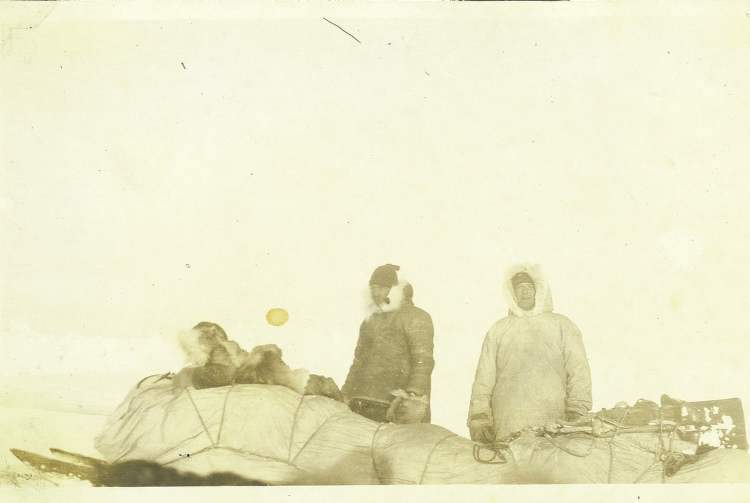
Oct. 26, 1929
Andy Cruickshank’s Diary, somewhere above the Arctic Circle
The country was absolutely barren, not a living creature was seen during the entire trip. The terrain was of a rolling rocky nature with thousands of lakes, some of immense size. Twenty or so miles before reaching Bathurst Inlet the terrain changed and became a series of mountains of ragged rock of approximately 1,000 to 1,500 feet in elevation.
When the pilots reached Bathurst they found only open water, making it impossible to land with ski-equipped planes. Flying south as planned, they located the very small Domex camp at Burnside River where they hoped that the ice would be strong enough to support the landings of four fully loaded planes.
ñü
Ice continued to be the issue both for the rescue teams and for the Domex men and their guides.
Oct. 25, 1929
Richard Pearce’s Diary, Kent Peninsula
Another day of blasted hopes. We got up at five — or at least the alarm went off then — and had our breakfast of half slice of bacon and a little piece of fish. We got away in good time and were making nice headway over rough hummocks of ice when we bumped into open water. It was a real blow. Our course was switched and we ran alongside the water half a mile or so, and found that tide and wind had united to make a break 100 yards or so wide between us and Cambridge Bay.
The men were devastated. Nearly a quarter of the way across the strait, they had no choice but to turn back to where they had begun their day. Since the igloos had deteriorated in the intervening hours, the Inuit did repairs and rebuilt another large structure. All were dismayed by their slow progress and the setback.
The next day dawned warmer and the Inuit, who had thus far been the most accurate weather predictors, said more warm weather was on the way. One would think that the far reaches of the Arctic Circle would be covered in ice, yet during the latter weeks of October 1929, cold temperatures had given way to a warm spell that had melted the ice in the strait.
The group was down to very sparse rations. The food consisted of whitefish and herring, which just happened to be the food brought for the dogs. None of the men wanted to cheat the dogs, who had been working so hard, but there was no option. Pearce commented, “There is a lot better food in the world, but it is a question of root, hog or die, and life is sweet.” The Inuit decided the only option was to send Charlie and Jimmie back to Dease Point for supplies.
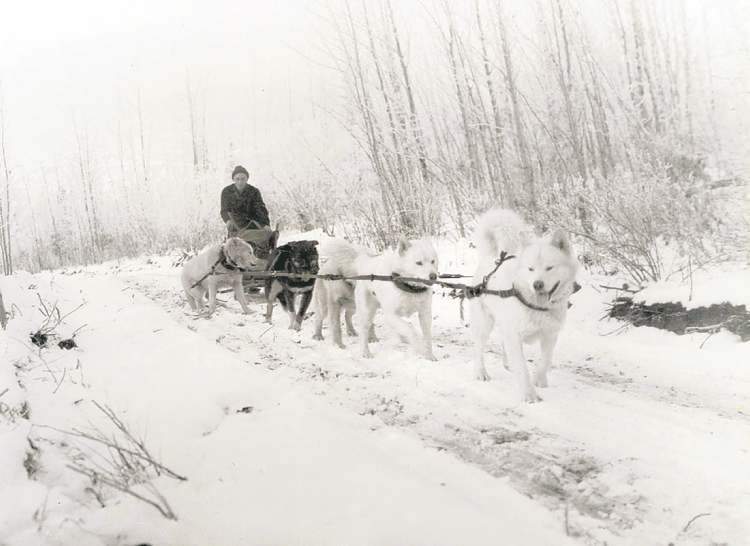
When the “three-day” trek to Cambridge Bay began, they had packed enough food for seven days. Seven days had now passed, but still the group was nowhere near the Hudson’s Bay Post at Cambridge Bay. Charlie and Jimmie anticipated a two-day return journey and set off with a dog team of 11 to bring back more dog food and the food the Domex men had left in their planes for trophies. They had caught some fine trout while at Dishwater Point, which they intended to mount for the colonel and Pearce when they returned to Winnipeg. There were ground squirrels as well, to be taken to a taxidermist upon arrival home.
ñü
Food for survival, however, was far more essential than a scrap of fur or a trout mounted on a wall.
Oct. 28, 1929
Richard Pearce’s Diary, Kent Peninsula
As the Eskimos prophesied, it is another warm day. The other igloo fell in, and ours shows signs of following suit. Charlie and Jimmie should be back either tomorrow or the next day and we are hoping to have a good feed before starting for Cambridge. The morale of the occupants of the other igloo is not so high today. The caving in of the igloo is perhaps responsible. It is now seven weeks since we landed at Dease Point. It seems more like seven years… The ice conditions in the straits is not very satisfactory today. A wind came up and big leads show close to shore. We had three meals of dog feed today, and it remains to be seen how it is going to affect the Colonel and me. Some of the other boys have had spells of sickness.
Living on such scant rations weakened the group both physically and mentally. The strain they were under was almost unbearable. Stomachs were reacting violently to what was being consumed as food, and there was not a thing they could do about it. Just when they thought things couldn’t get worse, one igloo caved in and the second was showing signs of doing the same. Both food and shelter were no longer sources of comfort and solace, but of frustration and trepidation.
Major Baker remarked that he could do without food, but being without tobacco was more than he could stand. The colonel and Pearce took pity on him, and between the two of them emptied their pockets and scraped up enough tobacco together to make one cigarette, which they rolled in toilet paper. A very grateful Baker savoured that single cigarette, making it last as long as he could.
A wind was blowing, much to the horror of the group who were acutely aware that a very thin layer of ice was all that stood between them and drowning. This wind continued to increase the leads (expanses of seawater opened when the ice began to fracture) in the strait, making the crossing impossible. A small crack in the ice could expand to a broad gap of icy water within minutes, which could result in their being stranded on a small ice floe. They estimated that there were about 38 miles to go to Cambridge Bay, but it may as well have been the same distance as to the moon, because, unless the waters froze, they were trapped.
ñü
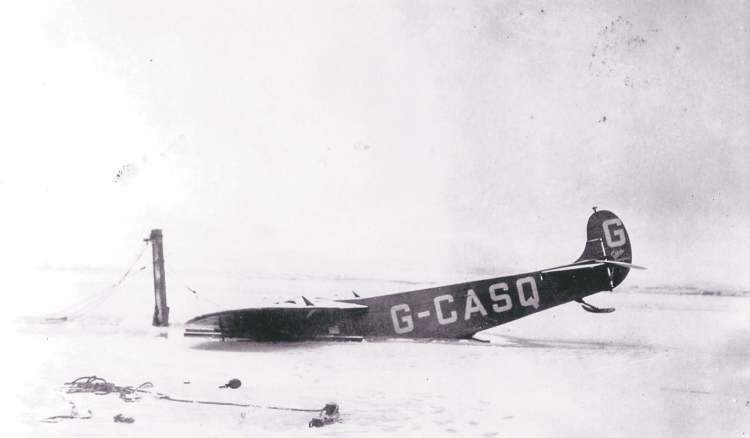
Only 200 miles away, the rescue pilots were circling the waters at Burnside River. From the air, the ice appeared to be suitable for a ski landing. Spence was the first to touch down. To his relief, the ice held. Brown followed suit, landing in Spence’s tracks. Both planes taxied further down the ice before cutting their engines. Cruickshank was third to land, but as he touched down, the ice, degraded by the rough landings of ‘CZ and ‘SO and now rubbery, gave way under his skis. ‘SQ, with Cruickshank, Walker, and Semple aboard, plunged into the icy depths of Burnside River.
The propeller and engine hit full force into the ice with a deafening crash. Frigid water and chunks of ice rushed into the cockpit through the ripped fuselage and open cracks and seams in the aluminum cowling. Hollick-Kenyon, still airborne, watched in horror as ‘SQ’s cockpit sank with her crew still on board. Spence and Brown saw the crash and had killed the engines on their planes, but since a ski plane has no brakes, they had to wait for the drag friction of the ice to slow their planes to a complete stop. Pushing open the side doors, the men clambered out of ‘CZ and ‘SO and raced towards the wreckage.
Unable to get to ‘SQ because of the broken ice surrounding the plane, they could only stand powerlessly and watch for signs of life.

Four Degrees Celsius: A Story of Arctic Peril, by Kerry Karram, is published by Dundurn Press.
Bio
Kerry Karram found her grandfather Andy Cruickshank’s diary tucked inside a worn, yellowed envelope and used it to chronicle the most extensive aviation search and rescue in Canadian history. Four Degrees Celsius reflects her deep interest in Canadian history, and her love for the North. She lives in North Vancouver.