The Winnipeg Free Press would like to show you notifications for breaking news and noteworthy local journalism.
No Thanks
Allow
Notification Settings
This browser doesn't support push notifications at the moment. Check browsers features, update your browser or try to use one from the list of recommended to manage your notifications settings:
Firefox (27+)
Google Chrome (30+)
Safari ( MacOS 13+ with browser 16.1+ and iOS 16.4+ ) / Note make sure Push API support enabled under Settings > Safari > Advanced > Experimental Features
Microsoft Edge
If you wish to manage your notification settings from this browser you will need to update your browser's settings for this site. Just click button below and allow notifications for this site
Note Safari 16.4+ working on iOS devices also need this site app to be installed at device's Home Screen for Push Notifications to work
Notifications are blocked for this site. If you wish to manage your notification settings from this browser you will need to update your browser's settings. Usually you'd need to click on site options icon to the left of address bar and change notifications preferences/permissions from there
*Billed as $5.77 plus GST every four weeks. After 52 weeks, price increases to the regular rate of $19.95 plus GST every four weeks. Offer available to new and qualified returning subscribers only. Cancel any time.
To continue reading, please subscribe:
Add Free Press access to your Brandon Sun subscription for only an additional
*Your next Brandon Sun subscription payment will increase by $1.00 and you will be charged $17.95 plus GST for four weeks. After four weeks, your payment will increase to $24.95 plus GST every four weeks.
It used to be the only time Prairie folks met Spanish-speaking people was when they vacationed down south.
Hey there, time traveller!
This article was published 29/09/2012 (4994 days ago), so information in it may no longer be current.
It used to be the only time Prairie folks met Spanish-speaking people was when they vacationed down south.
More often now, they’re the people next door.
The movement of Latin Americans to Manitoba has brightened the province’s multicultural mosaic. They seem to have glided effortlessly into mainstream Manitoba.
But many arrived in waves after political and economic catastrophes in Latin America.
They’re victims of physical torture from Chile with lessons to offer in democracy.
They’re young couples afraid of crime in Ecuador who want to dance until the early hours of the morning in safety.
They’re young folks from all over Latin America with stories of love and wanderlust fulfilled in Friendly Manitoba.
A psychology student in Brazil is drawn to the blond traveller from Roblin to practise her English.
A Chilean of Polish extraction comes to study engineering and falls in love with Winnipeg’s diversity.
A student from El Salvador ditches her dream of becoming a lawyer in her home country to work at the hog plant in Brandon to support her family and finds success she never imagined.
The numbers show a steady stream of Latin Americans embracing Manitoba. Here are some of the stories behind those numbers.
Phil Hossack / Winnipeg Free Press
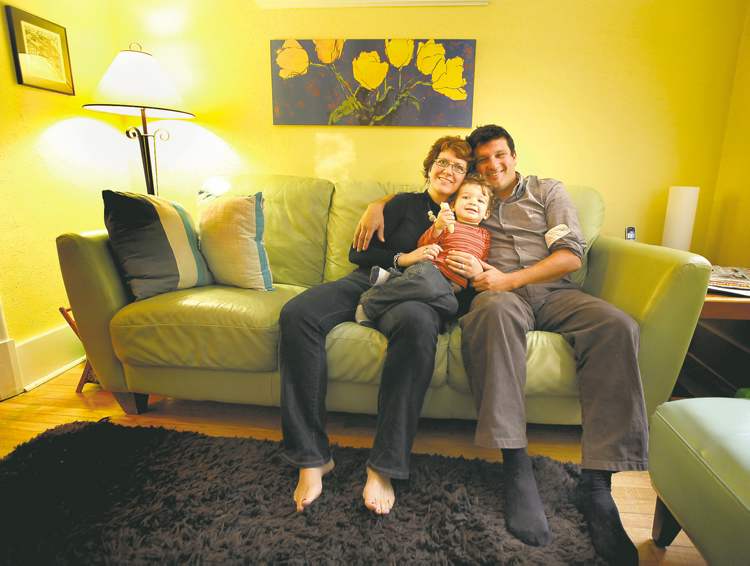
Chilean immigrant Stan Lozecznik, with Irmy Nikkel and their son, Tadeo. 'I met my roots here.'
Some come for education
Stan Lozecznik says most folks who see his name wouldn’t guess he was born in Chile. But the environmental engineer-in-training, who came to Winnipeg for post-graduate studies, says Chile, like Canada, has its share of diversity.
“There’s a lot of everything,” said Lozecznik, 36, whose Polish grandparents were displaced during the Second World War. His dad was born in a “DP” — displaced persons — camp near Nuremburg. He and his parents moved to Chile, and his dad married a Chilean woman. Growing up with a non-Hispanic name, he was not alone.
There were Croats, Germans, Palestinians, North Koreans and Japanese Chileans.
“Their last names are always different, and you can see that there,” said Lozecznik.
One of the things he loves about Winnipeg is its diversity, he said.
“I met my roots here,” he said with a laugh. More than a dozen of his fellow students at the University of Manitoba were of Polish descent and his professor was Polish.
He excelled in school here, won a host of awards and scholarships and organized a cross-border conference for the U of M Water Environment Federation. He had job offers from the U.S. but chose to stay in Winnipeg.
“I fell in love with Winnipeg,” said Lozecznik, who also fell in love with a librarian with whom he has a son, Tadeo, now two.
“You can travel anywhere in the world here in a day,” said the man who loves to eat and enjoys the diversity of restaurants in the West End and the multicultural mix in so many Winnipeg neighbourhoods.
“There are no ghettos here,” he said, referring to the closed ethnic enclaves that form in larger cities. Winnipeg is big enough to attract people from all over but small enough to make everyone mingle, said the outgoing Lozecznik, who is literally a poster boy for provincial immigration: www.gov.mb.ca/ie/study/t_stan_loz.html .
Tim Smith/Brandon Sun
Tim Smith / Brandon Sun
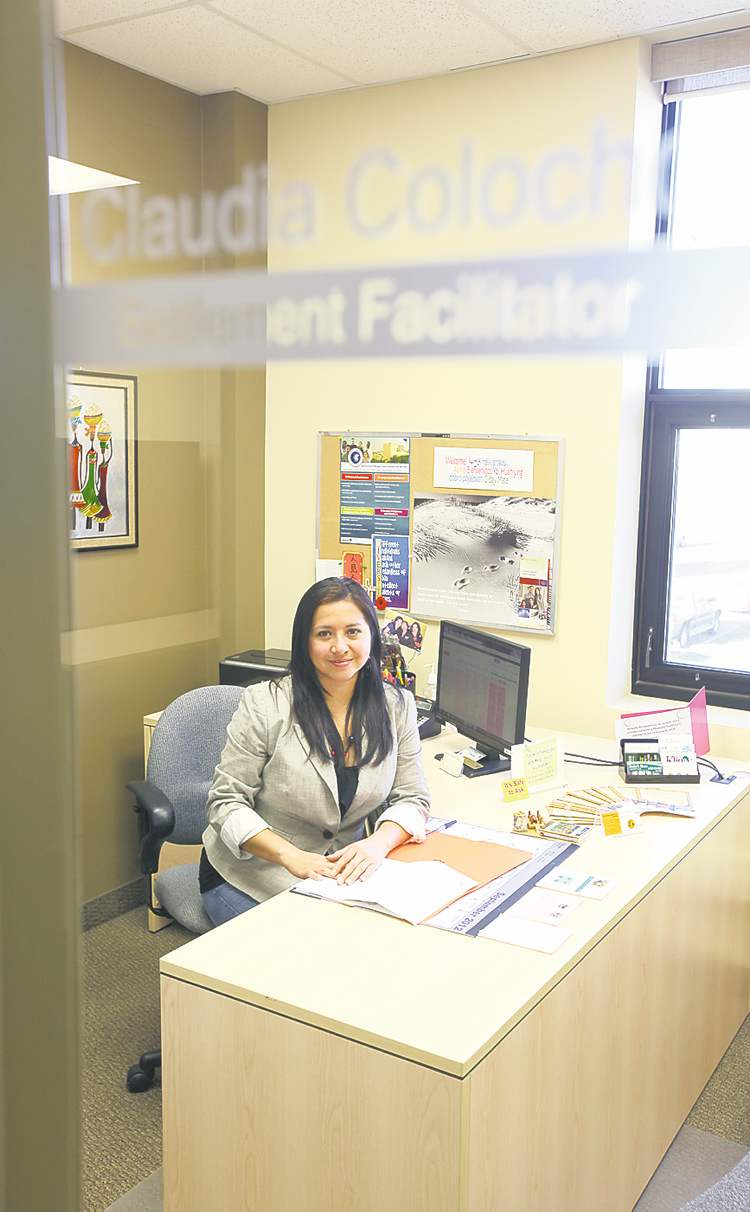
Settlement facilitator Claudia Colocho:
�Language is a big challenge. Not everyone learns or understands at the same speed.�
Some come for safety
Claudia Colocho went from being a law student in El Salvador one day to working on the floor of the Maple Leaf hog-processing plant in Brandon the next.
She was 23 and didn’t speak English when she arrived in 2005.
She found learning the language was the key to success in her new country. Today she’s fluent and works as a translator, helping others whose lives have shifted out of financial necessity.
“I couldn’t afford my school anymore,” she said. The average wage in El Salvador is $5 a day and her tuition cost nearly $80 a month, she said. With no student loans or bursaries there, she couldn’t continue her studies.
Colocho’s cousin, working at Maple Leaf in Brandon, suggested she apply for a job there.
She wasn’t scared of trying something new.
“Back home, I did several different types of jobs,” Colocho says. Nothing, however, compared to the work in Brandon.
“When I came to the plant, I found out it’s an extremely hard job,” she said. “The work is really hard. It’s repetitive.”
Colocho worked on the floor in production and sanitation for two years. Then she trained in procurement, basically inspecting hog carcasses before they were processed, which she did for another two years.
While working at the plant, she took English-language classes and volunteered at Westman Immigrant Services.
Now she’s employed at the non-profit settlement organization full time and works 10 to 15 hours a week as a translator for the United Food and Commercial Workers, which represents the Maple Leaf plant workers.
About 3,500 people from El Salvador live in the region, thanks to the plant’s recruiting. Hundreds more are from Honduras and Colombia.
“Language is a big challenge,” said Colocho, who had only a month of English-language training before she arrived in Brandon to start her new life. “Not everyone learns or understands at the same speed.”
It’s harder for older people to learn, especially if they’re working a lot of overtime to support families back in Latin America, she said. Young and single, even she found it a challenge to attend language classes after working a single shift.
“After working eight or nine hours in the plant, you just want to go home and eat and sleep. The work is so difficult.”
But it’s worth the challenge, she said.
“Besides the money part, there is also safety in Canada,” she said. “Brandon is very safe.” Back home it is not.
“We have social problem with gangs. It’s really bad. You shouldn’t wear some expensive clothes or you will become a target.”
No one lets it be known they have a relative working in Canada and sending money back home, she said.
“Sadly, it’s very unsafe,” she said. “I think we all love our country and miss our country, but I think most people are willing to live here. A lot of people are buying houses and cars.”
She said newcomers — and that includes people from China, Colombia, Brazil, Mauritius and more — are getting involved with Brandon’s WinterFest.
They’re sharing their language as well as their culture. Car dealers, banks, churches and health-care facilities have employees who speak Spanish, she said.
And the culture flows both ways.
“A friend who is Canadian and used to teach us English, he speaks perfect Spanish now.”
At the plant, a backup lead hand she knows has also become bilingual.
“He mostly speaks Spanish at work,” she said. “A lot of people want to learn Spanish.”
Ruth Bonneville / Winnipeg Free Press
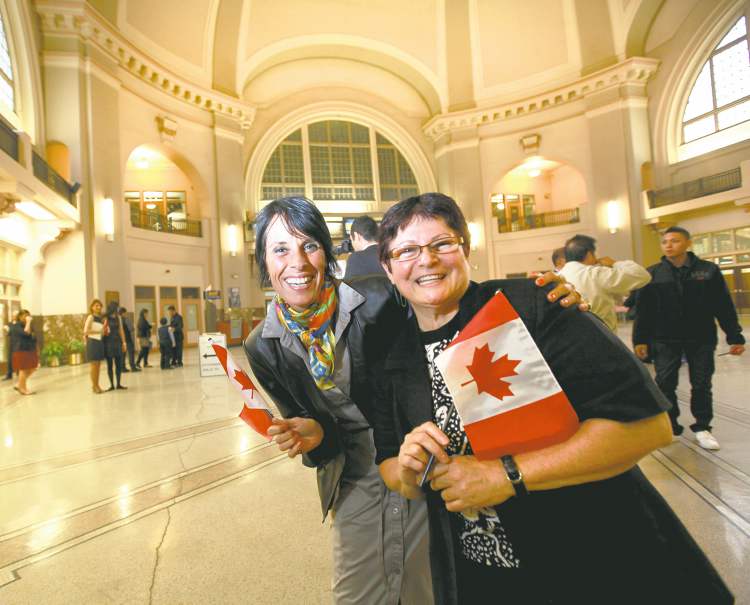
Maria Pol (left, from Argentina) and Rita Prokopetz (from Brazil) in the Via Rail Station, a starting point for many early immigrants to Winnipeg. 'We are true believers that we create our future,' Pol says of herself and her husband.
Some come for a better future
At the Red River College Language Training Centre in Winnipeg, a cluster of instructors from Latin American countries are teaching newcomers from around the world how to speak English and stay positive.
“We are true believers that we create our future,” said instructor Maria Pol, who immigrated from Argentina with her husband and two kids nearly a decade ago.
“It was hard, but we knew we were going for something better,” she said. “Argentina was going through a huge financial crisis. There was no hope for us. We said ‘That’s it. Period. We need a change.’ “
They sold practically everything they had, arriving with little but their sense of purpose.
“We came with 12 bags to rebuild a family and a home. It was an enriching, learning experience for all of us… We came looking for a better life for our children and ourselves.”
Pol said she shares her experience with students, and that encourages them.
“It’s like a shot of optimism: ‘If she can do it, I can do it too.’ That’s the most important message I bring to the classroom every day.”
Her family didn’t exactly receive a warm welcome when they arrived in Winnipeg in January 2003.
“It was terrible… In 24 hours it was a shift from plus 30 to minus 30.”
She was an English instructor in the private sector in Argentina. She found work in a daycare at first. Her husband had a master’s degree in business administration and wasn’t “fantastically fluent” in English but learned on the job.
“He started off in the produce section at Extra Foods.” It was close to their home, and his supervisor was a good English teacher, Pol said.
“He had to make a real effort to learn,” she said.
Then he applied to get a job as a Transit bus driver. He learned more English through classes provided by the union. Now he’s back in business and she’s teaching English again, but that wasn’t the key to their happiness.
“You have to be happy all the way through — not just when you achieve your goal,” said the instructor.
“I was a happy daycare worker and my husband was a happy bus operator and happy when he was putting away bananas. We were always happy, from the moment we got our visas.”
She can’t imagine what life would be like if they’d stayed in Argentina.
“I don’t want to think about that,” she said.
She’s met people in Winnipeg who came from Argentina during previous decades of political and economic turmoil.
“It’s a different type of immigration,” she said.
“Today, it’s much more demanding,” especially for skilled workers.
“Getting a job back then, there weren’t as many barriers. Diplomas weren’t assessed the way they are today.”
Some come for love
In Brazil, university student Rita Zuba met a tall, blond traveller with baggy jeans from Roblin named Prokopetz.
As a Grade 12 high school exchange student in Little Rock, Ark., she’d become fluent in English. Back in Brazil, she taught English at a private school while studying psychology in university. She was trying to keep her English from getting rusty, and thought she could practise her language skills with the fellow from Canada.
Then they married and moved to Winnipeg in 1980.
“According to most people, 1980 was a lovely winter,” said Zuba Prokopetz, an instructor at Red River College’s language training centre. “I was freezing to death.”
And homesick, like most newcomers.
“I felt very lonely.”
Her English skills helped her find a job, but not one that rewarded her psychology degree. She worked for a trophy company for $3.75 an hour. In three months, she got a raise to $4.25 an hour.
“That was a big deal.”
She eventually was recruited to teach English full time, and today is an instructor at Red River College.
Her kids are now 22 and 24. She took them to Brazil every three years when they were growing up, and they’re familiar with the food and the culture. Now others are getting to know more about Brazil, too.
In the run-up to the 2014 FIFA World Cup and the 2016 Olympics in Rio, she sees more of a local focus on Brazil.
“Brazilians like to party,” she said.
“The community is not extremely large,” Prokopetz said.
There are several professors from Brazil teaching at the University of Manitoba, including in the faculty of dentistry, she said. They have higher levels of education, but they can’t be dentists here, she said.
Other PhDs from Brazil teach in the faculties of engineering and agriculture, she said.
“Some stay, some go back.”
A Brazilian steak house is opening in the East Exchange District this fall, adding to the South American flavour being dished out by one popular restaurant in the area.
“Hermanos employs a lot of Brazilians,” she said.
She very rarely sees a student from Brazil in one of her English-language classes but won’t be surprised to see more in the future. Brazil’s economy isn’t as robust as many think, said the woman who keeps in touch with her five sisters and three brothers who live there.
“It’s fine overall but not for everyone.”
Some come for faith
Recruitment efforts by the Jewish Federation of Winnipeg have brought 522 people to Winnipeg from Argentina, said Faye Rosenberg-Cohen.
The Federation’s GrowWinnipeg initiative and Argentina’s economic collapse in October 2001 spurred their arrival. They came through the federal skilled worker program then as provincial nominees, both economic classes of immigration where applicants have to demonstrate skills and sufficient funds to get settled.
Rosenberg-Cohen said applicants come on an exploratory visit first to see what it’s like here before they apply. That way, they and the federation can tell if this is the right place for them to resettle.
She said the families who come to our community are looking for a stable economy where they and their children can prosper and live in a safe environment.
“Stories of theft and ‘express kidnappings’ from Argentina and Brazil make you appreciate what you have in Manitoba,” she said in an email.
“They are looking for a welcoming Jewish community, and we are thrilled to have them join us.”
Nearly a quarter of Winnipeg’s Jewish community is made up of newcomers who moved here from other countries in the last dozen years, she said.
The South Americans have been a good fit and bring a vibrancy to Winnipeg’s Jewish community, she said.
For Mennonites, there’s been a sort of return exodus after many fled Manitoba for Mexico and Paraguay when the province forced the consolidation of the school system in the mid-1920s. They’d left Russia in 1874 for Manitoba to be exempt from military service, find freedom of religion and the right to teach their children in their own schools.
The provincial nominee program has helped to bring many of their descendants back.
Since 2000, 522 people have immigrated to Manitoba from Paraguay.
Half settled in Winnipeg and half in what’s been called the Bible Belt, including Winkler, Blumenort, Rosenfeld, Niverville and Steinbach.
More than 1,000 newcomers came from Mexico during the same period.