

From soldiers to settlers
They came for the live ammunition, but stayed for the Manitoba opportunities

Advertisement
Read this article for free:
or
Already have an account? Log in here »
To continue reading, please subscribe:

Digital Subscription
One year of digital access for only $205*
- Enjoy unlimited reading on winnipegfreepress.com
- Read the E-Edition, our digital replica newspaper
- Access News Break, our award-winning app
- Play interactive puzzles
*First annual payment billed as $205.00 + GST for one year. This annual subscription will automatically renew at $233.00 + GST every 52 weeks (10% off the regular annual price of $259.35). Offer available to new and qualified returning subscribers only. Cancel any time.
To continue reading, please subscribe:
Add Free Press access to your Brandon Sun subscription for only an additional
$1 for the first 4 weeks*
- Enjoy unlimited reading on winnipegfreepress.com
- Read the E-Edition, our digital replica newspaper
- Access News Break, our award-winning app
- Play interactive puzzles
*Your next Brandon Sun subscription payment will increase by $1.00 and you will be charged $17.95 plus GST for four weeks. After four weeks, your payment will increase to $24.95 plus GST every four weeks.
Read unlimited articles for free today:
or
Already have an account? Log in here »
Hey there, time traveller!
This article was published 27/10/2012 (5040 days ago), so information in it may no longer be current.
The Berlin Wall coming down and the end of the Cold War created a sense of peace around the world and, inadvertently, a bunch of skilled new workers for Manitoba.
When their time was up, close to 100 German soldiers training at CFB Shilo as part of their compulsory national service decided to stay in Manitoba for good.
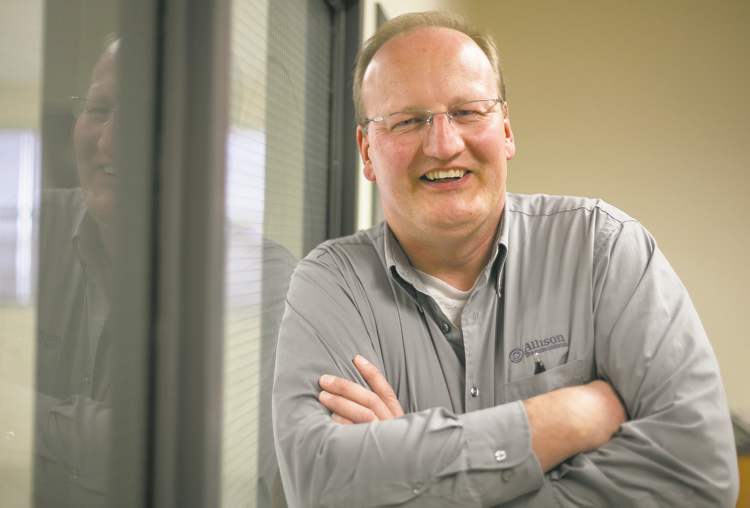
Frank Arndt arrived with the German army in 1992.
“On the eighth of March, we flew into Winnipeg and drove through a snowstorm. We didn’t see anything till we hit Shilo,” he said.
“I’ve been here 20 years now,” said the president of myITsource.ca and Corral Communications.
The standard of living was a draw, said Arndt, who apprenticed as an industrial electrician at a hydro plant in Germany prior to his military service.
“The economy over here is pretty good,” Arndt said.
When he came to Canada, the Berlin Wall was coming down and Germany was in the midst of reunification.
“New taxes were implemented to build up Eastern Germany, where there was nothing spent on infrastructure for 50 years,” said Arndt.
“They’d take 1.5 per cent of paycheques and it was supposed to be for three years.”
“It’s still there, I think.”
Trucker Florian Ludwig decided to stay in Manitoba after his military service, too.
“When I had to join the army, it was just the beginning of the Cold War ending,” he said by phone from the cab of his big rig somewhere in Kentucky.
“When the wall came down, everything came with it.” The wall separating East and West Germany needed to be removed. But reunification came with a price, he said.
“Economically, for a lot of West Germans, it was kind of a bummer.”
Germany may have the strongest economy in Europe, but individually, people there “are still struggling,” said Arndt, who returns regularly to visit family.
Germany is seen as Europe’s economic powerhouse, but its people aren’t all powerfully wealthy.
“In Germany, two or three generations are paying off a mortgage,” Arndt said. “Your grandparents are staying with you so you can afford to pay down a mortgage.
“Over here, it’s a pretty good country when you compare how long it takes for you to pay for your own home.”
He stayed, started his own communications firm and married a Canadian woman.
“My dad encouraged me: ‘You’ve gotta go where the opportunities are, not where you live,'” said Arndt.
“My mom didn’t want me to be 6,000 kilometres away.”
From 1974 to 2000, he was one of more than 150,000 German soldiers trained at the German Army Training Establishment at Shilo. Germany had conscription for men from 1956 to 2011.
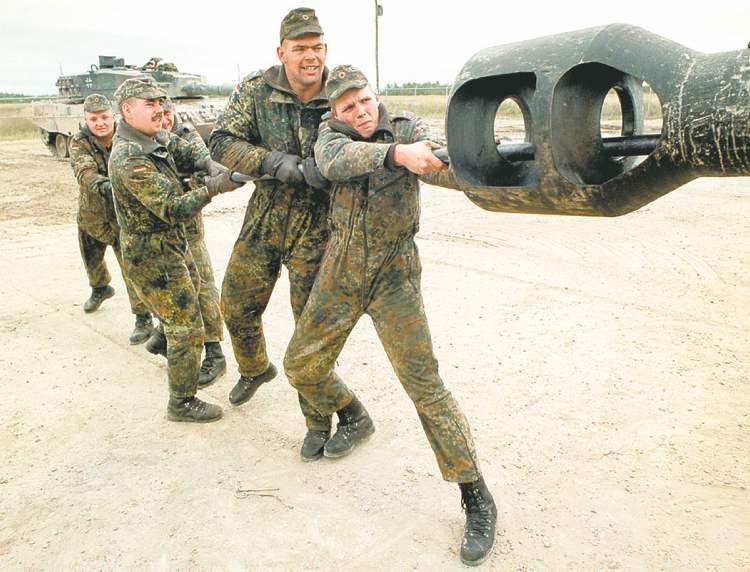
Each year, German soldiers were sent to the base for three weeks of training at the weapons range. Military families were also posted at Shilo for up to five years as part of the program.
During the Cold War, Germany’s military played a major role in NATO in Central Europe. It had nearly a half-million military personnel and an army made up of three corps with 12 divisions, most of them heavily armed with tanks.
It needed a place to train soldiers using live ammunition and Shilo fit the bill. But as the bills piled up from reunification, the writing was on the wall for the German training base at Shilo, said tank mechanic Thor Ebert.
At the time, they used live rounds for training and needed a big base like Shilo for firing tank cannon, howitzers, “the whole nine yards,” said Ebert, a mechanic who ended up working on tanks at Shilo.
“I liked it,” said Ebert, who stayed with the German army at Shilo for five years. “It kind of grows on you.”
When the Germans pulled out of Shilo for good in 2000, Ebert wasn’t surprised. Germany paid Ottawa $25 million a year to use the base that pumped an estimated $10 million into the Brandon-area economy. There was no longer a need for such a vast facility because sophisticated lasers could be used to replace live rounds for training, Ebert said.
He decided to stay in Canada, but he couldn’t work as a mechanic because his German credentials were not recognized. He put his know-how to work in other ways at truck dealerships in Brandon and then in Winnipeg, where he now lives.
Driving across the Prairies for the first time as young soldiers 20 years ago, they didn’t think they’d stay for good, said Ebert.
“We had no expectations.”
For some German soldiers though, staying was a wish fulfilled.
“In the ’80s, when I grew up, North America was a dream for a lot of Europeans, I think,” said Ludwig the trucker, who now lives in Winnipeg.
“A lot of music came out of England and the States, fast-food chains were popping up in Europe, Harley Davidsons — there are certain things” that appealed to him.

“That’s how I grew up,” said Ludwig, whose family vacationed in the U.S. when he was five years old.
“A couple of things stuck in my head,” said Ludwig. “I wanted to ride motorbikes, to tour the North American continent and South America. Then the army brought us over.
“It wasn’t so bad.”
carol.sanders@freepress.mb.ca
Carol Sanders
Legislature reporter
Carol Sanders is a reporter at the Free Press legislature bureau. The former general assignment reporter and copy editor joined the paper in 1997. Read more about Carol.
Every piece of reporting Carol produces is reviewed by an editing team before it is posted online or published in print — part of the Free Press‘s tradition, since 1872, of producing reliable independent journalism. Read more about Free Press’s history and mandate, and learn how our newsroom operates.
Our newsroom depends on a growing audience of readers to power our journalism. If you are not a paid reader, please consider becoming a subscriber.
Our newsroom depends on its audience of readers to power our journalism. Thank you for your support.
Carol Sanders
Legislature reporter
Carol Sanders is a reporter at the Free Press legislature bureau. The former general assignment reporter and copy editor joined the paper in 1997. Read more about Carol.
Every piece of reporting Carol produces is reviewed by an editing team before it is posted online or published in print — part of the Free Press‘s tradition, since 1872, of producing reliable independent journalism. Read more about Free Press’s history and mandate, and learn how our newsroom operates.
Our newsroom depends on a growing audience of readers to power our journalism. If you are not a paid reader, please consider becoming a subscriber.
Our newsroom depends on its audience of readers to power our journalism. Thank you for your support.
Advertisement Advertise With Us
Advertisement Advertise With Us