A forgotten friend of Canada
Advertisement
Read this article for free:
or
Already have an account? Log in here »
To continue reading, please subscribe:

Digital Subscription
One year of digital access for only $205*
- Enjoy unlimited reading on winnipegfreepress.com
- Read the E-Edition, our digital replica newspaper
- Access News Break, our award-winning app
- Play interactive puzzles
*First annual payment billed as $205.00 + GST for one year. This annual subscription will automatically renew at $233.00 + GST every 52 weeks (10% off the regular annual price of $259.35). Offer available to new and qualified returning subscribers only. Cancel any time.
To continue reading, please subscribe:
Add Free Press access to your Brandon Sun subscription for only an additional
$1 for the first 4 weeks*
- Enjoy unlimited reading on winnipegfreepress.com
- Read the E-Edition, our digital replica newspaper
- Access News Break, our award-winning app
- Play interactive puzzles
*Your next Brandon Sun subscription payment will increase by $1.00 and you will be charged $17.95 plus GST for four weeks. After four weeks, your payment will increase to $24.95 plus GST every four weeks.
Read unlimited articles for free today:
or
Already have an account? Log in here »
Hey there, time traveller!
This article was published 10/11/2012 (5003 days ago), so information in it may no longer be current.
L’ABBAYE D’ARDENNES
Jacques Vico, a former French resistance fighter who dedicated part of his life to honouring Canadian soldiers who were murdered here in the bitter fighting after D-Day, died last August, just weeks after our tour group visited him in this 12th-century abbey that has belonged to his family for 90 years.
Vico had supervised the construction of a memorial for the murdered Canadians, as well as generously giving his time to academics and battlefield tourists to ensure the story is never forgotten.
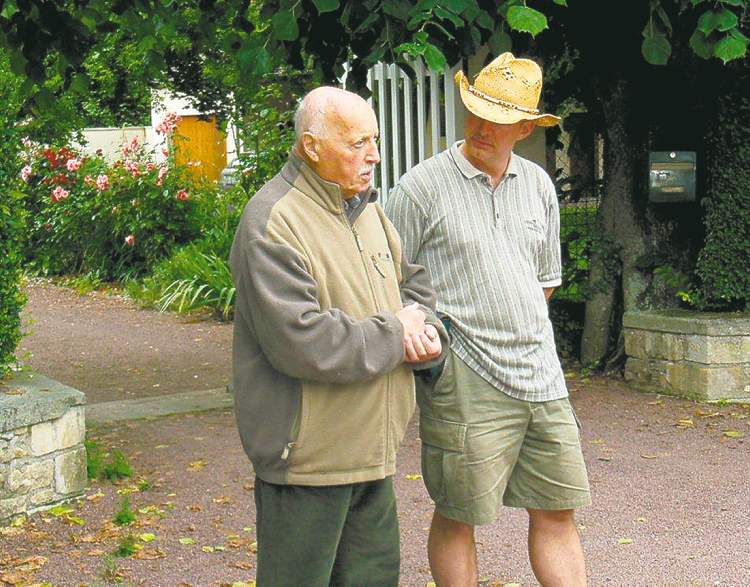
Unfortunately, no Canadian newspaper appears to have reported Vico’s death on Aug. 5, an example, perhaps, of our collective indifference to the work of many non-Canadians who care deeply about Canada’s wartime legacy.
Vico should be remembered as a great humanist and friend of Canada and its history.
It’s unclear who, if anyone, will continue his work at this historic site, located a few kilometres west of Caen.
Vico was 89 and in poor health, but he stood tall and strong, with a powerful voice, as he explained how a group of Canadian soldiers was murdered here in 1944.
“They came through there,” Vico said through a translator, pointing to a door that led from a courtyard to the enclosed garden where we were standing. “They came in one by one. Before each came, they shook hands with each other. One said a prayer.”
He was referring to the fate of seven soldiers, members of the North Nova Scotia Highlanders, who were shot in the back of the head by SS soldiers under the command of Kurt Meyer, a colonel in the 12th SS Panzer Division, also known as the Hitler Youth, because it was composed mainly of teenagers, with NCOs and officers who were veterans of the Russian front.
Another 13 prisoners are believed to have been murdered at or near the abbey, about 20 kilometres south of Juno Beach.

Some of the bodies were buried in a garden but not discovered until the following spring when Vico’s mother noticed her flowers were emerging in an irregular fashion. It suggested the bulbs had been damaged, so the garden was dug up and the bodies discovered.
A Canadian military court tried Meyer for war crimes, the only Nazi a Canadian court tried after the war, and sentenced to death. The penalty was commuted to life in prison, but he was eventually released from Dorchester Penitentiary after serving less than 10 years, a decision that remains controversial today.
As many as 156 Canadians, including 58 soldiers from the Royal Winnipeg Rifles, were also murdered in separate actions around the same time and in the same area.
The Canadians are known to have retaliated, but not in the same way as the SS, who murdered prisoners not just in the heat of battle, but sometimes days after they had been captured.
dave.obrien@freepress.mb.ca