Surrender to an ice-cream maker
Wageningen
Advertisement
Read this article for free:
or
Already have an account? Log in here »
To continue reading, please subscribe:

Digital Subscription
One year of digital access for only $205*
- Enjoy unlimited reading on winnipegfreepress.com
- Read the E-Edition, our digital replica newspaper
- Access News Break, our award-winning app
- Play interactive puzzles
*First annual payment billed as $205.00 + GST for one year. This annual subscription will automatically renew at $233.00 + GST every 52 weeks (10% off the regular annual price of $259.35). Offer available to new and qualified returning subscribers only. Cancel any time.
To continue reading, please subscribe:
Add Free Press access to your Brandon Sun subscription for only an additional
$1 for the first 4 weeks*
- Enjoy unlimited reading on winnipegfreepress.com
- Read the E-Edition, our digital replica newspaper
- Access News Break, our award-winning app
- Play interactive puzzles
*Your next Brandon Sun subscription payment will increase by $1.00 and you will be charged $17.95 plus GST for four weeks. After four weeks, your payment will increase to $24.95 plus GST every four weeks.
Read unlimited articles for free today:
or
Already have an account? Log in here »
Hey there, time traveller!
This article was published 10/11/2012 (5045 days ago), so information in it may no longer be current.
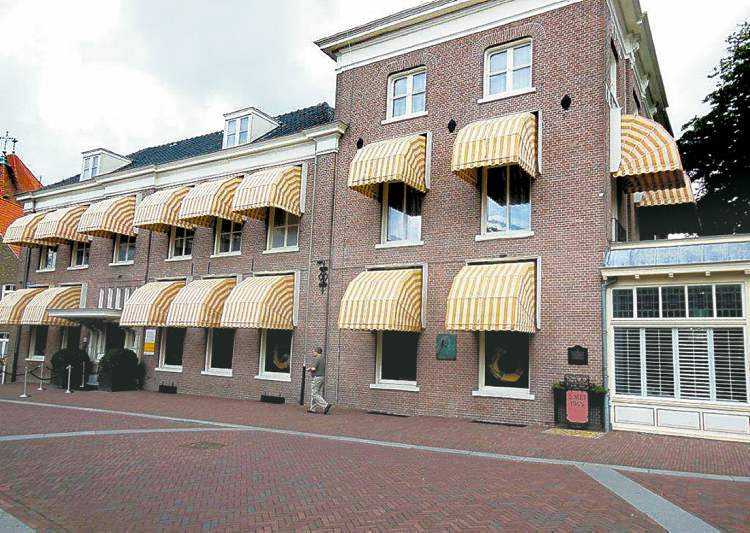
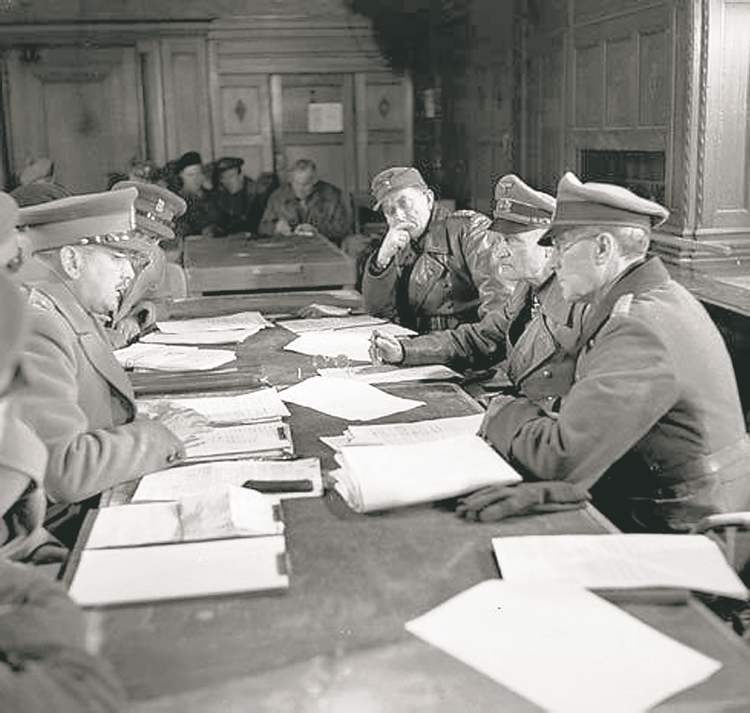
The end of the Second World War for Canada occurred here in this Dutch town on May 5 when German Gen. Johannes Blaskowitz sat down in the Hotel De Wereld with Canada’s Gen. Charles Foulkes to negotiate terms for surrendering all German forces in Holland.
A grainy, black-and-white, 1945 film shows Hitler’s general and his small contingent walking into the hotel to meet Foulkes, who in 1951 became chief of the general staff, the first person to hold that post.
For the lack of a typewriter — not one could be found in the town about 15 kilometres west of Arnhem — the signing of the surrender document was delayed a day when the parties returned. The actual document was signed in a building next to the hotel.
May 5 has since been celebrated as Liberation Day in the Netherlands, while May 4 is marked as Remembrance Day for all the people who fought and died in the war.
Today, the room where the terms of the surrender were negotiated looks very much like the scenes in the contemporary newsreel footage, with the original wall panelling and furniture.
On the same day, Canadian forces just inside Germany near the Dutch border sought the surrender of German formations confronting them, but it was a difficult task because of the general confusion and poor communications on the German side.
Finally, Brig.-Gen. Jim Roberts of the 8th Canadian Infantry Brigade was assigned to escort Gen. Eric Von Straube to the surrender ceremony.
Sitting in the back of the Jeep, Von Straube asked what Roberts did before the war.
“I replied,” Roberts said, “that I was never a professional soldier but that, like most Canadian soldiers, I was a civilian volunteer and that, in my former pre-war life, I had been an ice-cream maker.”
The German seemed offended he had been forced to surrender to “a common civilian,” Roberts said in his memoir, The Canadian Summer, a title he borrowed from the Dutch characterization of the summer of 1945.
In fact, 98 per cent of the soldiers in the Canadian army were civilians before the war. The pre-war army was made up of about 5,000 regulars, with roughly 50,000 militia. By war’s end, the armed forces had swelled to 1.1 million soldiers, sailors and airmen.
Like Roberts, they were carpenters, postal workers, farmers and school teachers. Some had been unemployed. These were the men who won the war and rose to senior command levels, where they quickly learned the skills of seasoned professionals, although, as historian Jack Granatstein has said, it took four years of hard training, missteps and mistakes before the army was ready to confront the Germans in northwest Europe.
According to historian Terry Copp, about two-thirds of the men were between 18 and 25, and the rest weren’t much older. One-third had not finished primary school, one-third had only reached Grade 7 and only one out of eight had a high school diploma.
Despite the popular view that most men were unemployed, the Depression had actually eased by the end of the 1930s. As result, many recruits had jobs when war broke out. According to Copp, in the first three years of the war, 87 per cent of the force was made up of people who left jobs to become soldiers.

The average soldier was 5-7 and about 160 pounds. Surveys at the time showed they understood the war “in simple but clear terms.”
The highest ranks were another matter. Research by Copp, Granatstein and others shows they weren’t very good as strategists or administrators, and they were prone to petty squabbling. Many officers were fired or dismissed both before and after D-Day, some for good reasons, others because of bad luck or the equivalent of old-fashioned office politics.
It wasn’t just the Canadians who suffered from weakness in high command.
“The senior levels of the Allied armies were plagued by rivalry and lack of imagination,” Copp wrote in Cinderella Army.
dave.obrien@freepress.mb.ca