

Tears, sorrow, guilt — one grave at a time
Bény-sur-mer Canadian War Cemetery
Advertisement
Read this article for free:
or
Already have an account? Log in here »
To continue reading, please subscribe:

Digital Subscription
One year of digital access for only $205*
- Enjoy unlimited reading on winnipegfreepress.com
- Read the E-Edition, our digital replica newspaper
- Access News Break, our award-winning app
- Play interactive puzzles
*First annual payment billed as $205.00 + GST for one year. This annual subscription will automatically renew at $233.00 + GST every 52 weeks (10% off the regular annual price of $259.35). Offer available to new and qualified returning subscribers only. Cancel any time.
To continue reading, please subscribe:
Add Free Press access to your Brandon Sun subscription for only an additional
$1 for the first 4 weeks*
- Enjoy unlimited reading on winnipegfreepress.com
- Read the E-Edition, our digital replica newspaper
- Access News Break, our award-winning app
- Play interactive puzzles
*Your next Brandon Sun subscription payment will increase by $1.00 and you will be charged $17.95 plus GST for four weeks. After four weeks, your payment will increase to $24.95 plus GST every four weeks.
Read unlimited articles for free today:
or
Already have an account? Log in here »
Hey there, time traveller!
This article was published 10/11/2012 (5007 days ago), so information in it may no longer be current.
For Gordon Watt, a retired pilot from Winnipeg, it was the first time he cried.
Watt, 70, said it was the ages on the markers that affected him. The soldiers were just kids, 18 or 19 years old, sometimes younger.
“You look at their ages, and you think they missed out on their lives,” he said.
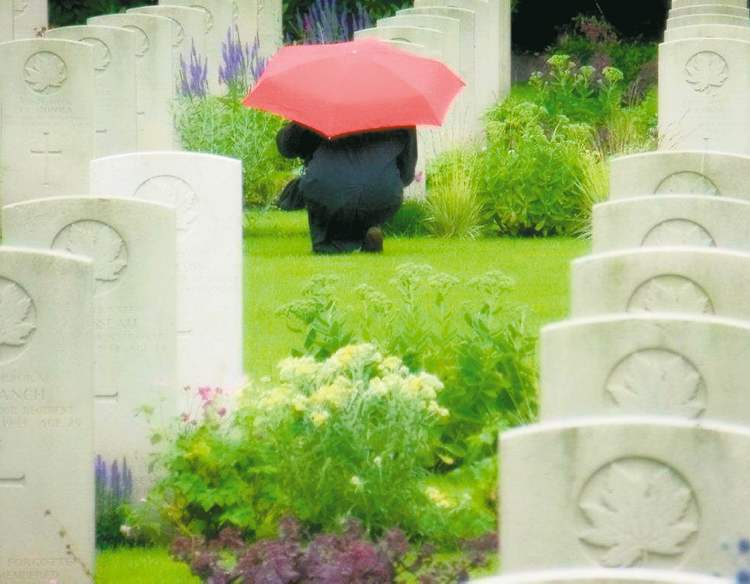
The inscriptions themselves are halting: “To the world he was just another one. To us he was our darling son,” the parents of one soldier wrote. (Family members were limited to 66 characters if they wanted a personal inscription on the gravestone.)
There are more than 2,000 Canadians buried here, all killed in the early Normandy battles. Located within sight of Juno Beach, it’s just one of 18 Commonwealth war cemeteries located among the small farms and villages of Normandy. The 18 cemeteries contain the graves of 22,000 servicemen.
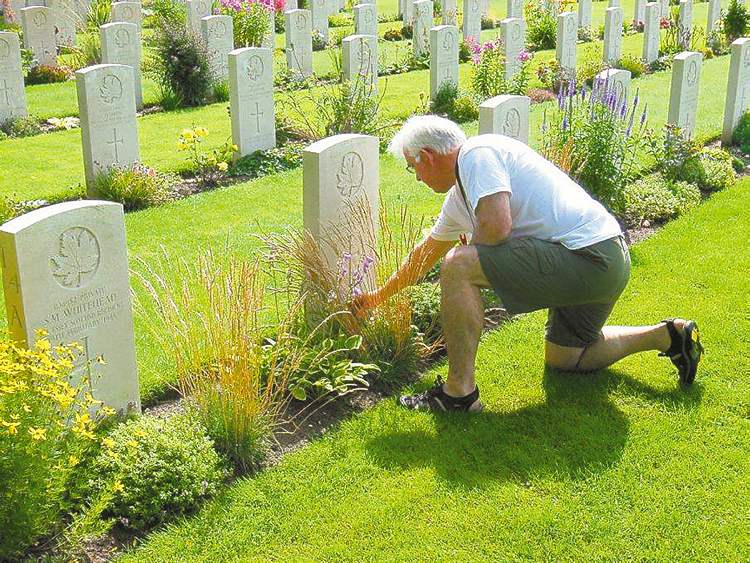
During a visit to another Canadian war cemetery, Bert Furlong said he became obsessed with the need to look at every gravestone.
“I walk by one, stare at it and read the inscription, then the next one, the next one and then I start over in the next row,” Furlong said. “I feel guilty if I don’t see every one. Is that survivor’s guilt? I don’t know.”
The tour visited cemeteries in France, Belgium and Holland, all of them immaculately maintained, and the impact was always the same. Solemn, silent figures walking slowly through the rows, occasionally stooping to read an inscription or take a picture. Some people planted Canadian flags attached to popsicle sticks, with private inscriptions written in ink. A teacher in our group planted messages from his students.
Nearly 50,000 Canadians killed in the two world wars are buried in France, Belgium and Holland alone, almost half the total dead of 110,355. When the allied dead and the Germans are added, the number soars to the millions.
Some cemeteries from the first war contain only three or four graves in a farmer’s field or in a church graveyard, but they all look like they are under the care of a loving relative.
John Thorpe said he was walking through the Normandy American Cemetery above Omaha Beach, a breathtaking site and the most sacred American cemetery after Arlington, with tears coming down his face “without realizing I was crying.”
Thorpe, a retired geophysicist, said he was overwhelmed by the size and beauty of the cemetery, where nearly 10,000 Americans are buried on the bluff overlooking the beach. Another 1,600 Americans whose remains could not be identified are memorialized on a ceremonial wall.
Unlike Commonwealth nations, American families had the choice of repatriating their loved ones, so not all Americans killed overseas are buried in foreign lands.
Martin Urquhart, another member of our group, was surprised by the response he received when he asked officials at the American cemetery for directions to the grave of an uncle whom he never knew, but who had fought at Omaha Beach. He was escorted to the site and when he returned, an American flag had already been lowered and folded military style before being offered to him.
American policy is to award a flag to any relative of the deceased if the grave has never been visited by a member of the immediate family, Urquhart said he was told. He fit the bill, but he declined the flag, saying he couldn’t accept it because he never knew his uncle, who was killed before he was born.
“I didn’t think it would be right for me to take it,” he said, adding he later wondered if he had made the right decision.
Nearly 80,000 German soldiers are buried in the Norman countryside alone, but their cemeteries are different in several ways.
The La Camba German cemetery was originally an American graveyard, but after the war the Americans began exhuming the remains and transferring them in accordance with the wishes of their families. About two-thirds of the fallen from this site were relocated back to the United States while the remainder were reinterred at the cemetery overlooking Omaha Beach.
More than 21,000 Germans are buried at La Camba, located near a major British cemetery at Bayeux, but unlike the Allied cemeteries, there are no individual headstones. Instead, small groups of German crosses made of black granite are spread across the cemetery. Flat markers on the ground mark the graves of several German soldiers who were buried in groups. As a result, La Camba is smaller than Omaha Beach, even though it has twice as many dead. The fallen range in age from 14 to 72, evidence of the desperate condition of the German army by 1944.
And while Commonwealth cemeteries are presented without editorial comment, the German cemeteries offer messages about peace and reconciliation.
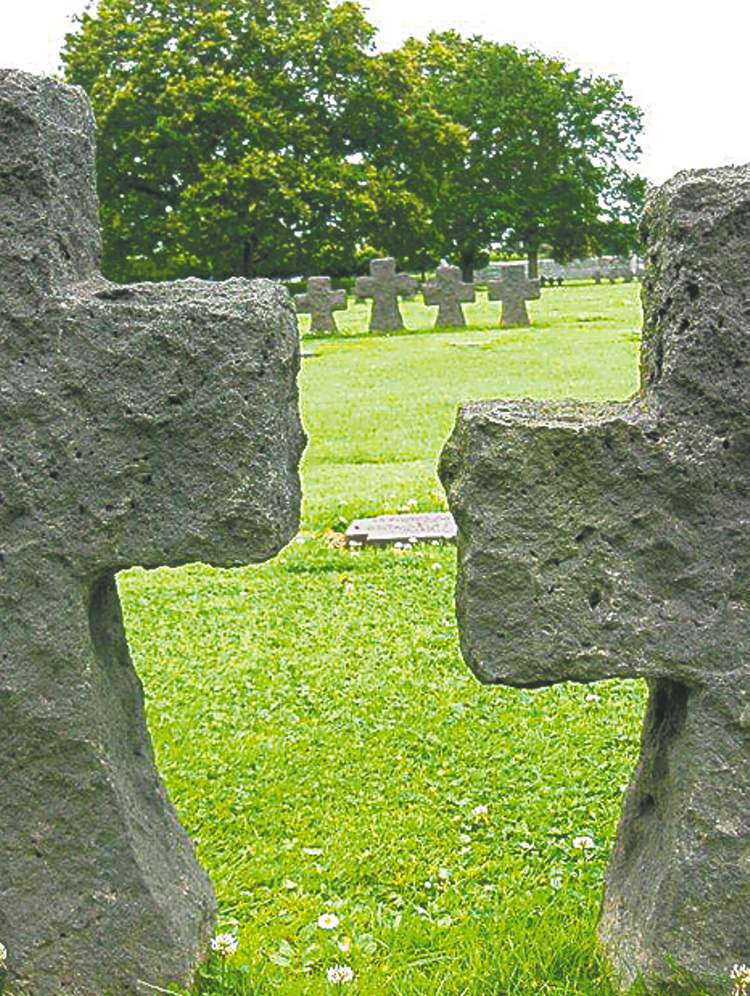

The sign in front of the cemetery at La Camba, for example, reads: “With its melancholy rigour, it is a graveyard for soldiers not all of whom had chosen either the cause or the fight.”
The German War Graves Commission maintains the graves, but it depends on contributions and donors for its work, which includes intensive research in eastern Europe, particularly Russia, to find the lost graves of hundreds of thousands of Germans.
The fate of 1.5 million German soldiers has still not been clarified, according to the German commission, which enlists thousands of young people every year to tend German graves under the banner of arbeit fur den frieden, or working for peace.
dave.obrien@freepress.mb.ca
History
Updated on Saturday, November 10, 2012 1:28 PM CST: rearranges photos, fixes cutlines