

How ‘something’ came from ‘nothing.’ Really
Advertisement
Read this article for free:
or
Already have an account? Log in here »
To continue reading, please subscribe:
Monthly Digital Subscription
$1 per week for 24 weeks*
- Enjoy unlimited reading on winnipegfreepress.com
- Read the E-Edition, our digital replica newspaper
- Access News Break, our award-winning app
- Play interactive puzzles
*Billed as $4.00 plus GST every four weeks. After 24 weeks, price increases to the regular rate of $19.95 plus GST every four weeks. Offer available to new and qualified returning subscribers only. Cancel any time.
Monthly Digital Subscription
$4.99/week*
- Enjoy unlimited reading on winnipegfreepress.com
- Read the E-Edition, our digital replica newspaper
- Access News Break, our award-winning app
- Play interactive puzzles
*Billed as $19.95 plus GST every four weeks. Cancel any time.
To continue reading, please subscribe:
Add Free Press access to your Brandon Sun subscription for only an additional
$1 for the first 4 weeks*
*Your next subscription payment will increase by $1.00 and you will be charged $16.99 plus GST for four weeks. After four weeks, your payment will increase to $23.99 plus GST every four weeks.
Read unlimited articles for free today:
or
Already have an account? Log in here »
Hey there, time traveller!
This article was published 21/04/2012 (5082 days ago), so information in it may no longer be current.
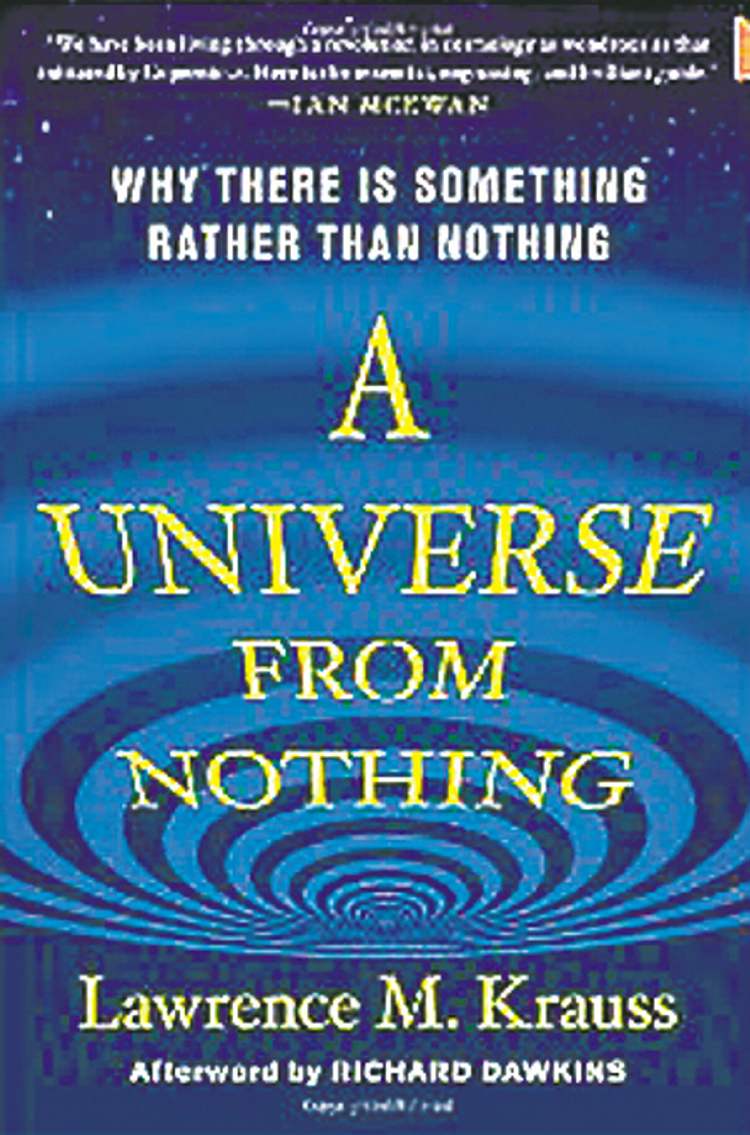
HOW can something come from nothing? This latest book from popular American physicist Lawrence Krauss aims to not only explain how this might have happened, but convince the reader that it must have happened.
Krauss, who burst onto the popular science scene in 1995 with the bestseller The Physics of Star Trek, has spent most of his professional career trying to untangle the origins (and destiny) of the cosmos. In 11 brief chapters, he lays out the evidence for the Big Bang, hyperinflation, and several multiverse scenarios, each of which is essentially guaranteed to produce — from nothing — an arbitrarily large number of universes with the conditions right for life.
Krauss thus deftly tackles cosmic mysteries of the sort pondered by philosophers and theologians for thousands of years, by drawing on scientific results from the last 10. He deals with questions like “why are we here?” or “why is there something rather than nothing?” by first deconstructing them.
The word “why” begs the question, argues Krauss, assuming that some cosmic puppet-master has a detailed plan for us all. What we really want to know, Krauss assures us, is “how” did we get here? How did something come from nothing?
A Universe from Nothing isn’t a primer on cosmology, quantum physics or string theory, though it dips into each of those topics. The book manages to avoid blowing up into a 400-page technical behemoth by staying focused on the basic question and avoiding equations or end-notes. The Elegant Universe has already been written, and Krauss has no interest in rehashing it.
What he’s interested in is “nothing.” And just as German mathematician Georg Cantor made history by saying “there’s ‘infinity,’ sure, but then there’s infinity,” so Krauss tells us that, from a physical perspective, the idea of nothing is equally a matter of degree.
Is empty space nothing? Before quantum mechanics came into the picture this seemed reasonable enough. But we now know empty space is full of quantum foam, particle/anti-particle pairs popping briefly into and out of existence, virtual photons living on energy borrowed from the future.
What about a realm outside of space-time? Is that nothing? Almost. But are there still physical laws in this space outside space? Then it’s not really nothing either, is it?
This is just the tip of the iceberg. There’s a lot of weird stuff in leading theories on the beginning of everything: gravity acting in reverse; an endless knitting of the fabric of space resulting in an ever-larger universal sweater; negative energy, which can be explained only by the even more nonsensical idea of negative pressure.
Yet the cosmic questions can never have intuitive answers. They’re too far outside the realm of human experience. It’s hard to picture a universe without beginning or end, while an ultimate beginning, when applied to space and time, raises more questions. For instance, what’s before time?
What modern science has that the ancient mystics lacked is solid evidence.
The concept of a sea of nothing out of which bubble universes spontaneously appear sounds about as far-fetched as the world perched upon a cosmic turtle. But Krauss goes into great detail on every major measurement and calculation: red-shifted galaxies; the cosmic microwave background radiation; the large-scale flatness of space.
None of this data points to a turtle. Thus the best part of this weird, whirlwind tour of the universe is that all of it is very possibly true.
Joel Boyce is a Winnipeg writer and teacher.
A Universe from Nothing
Why There Is Something Rather Than Nothing
By Lawrence M. Krauss
Free Press, 224 pages, $29