

Letters, Oct. 22
Advertisement
Read this article for free:
or
Already have an account? Log in here »
To continue reading, please subscribe:

Digital Subscription
One year of digital access for only $205*
- Enjoy unlimited reading on winnipegfreepress.com
- Read the E-Edition, our digital replica newspaper
- Access News Break, our award-winning app
- Play interactive puzzles
*First annual payment billed as $205.00 + GST for one year. This annual subscription will automatically renew at $233.00 + GST every 52 weeks (10% off the regular annual price of $259.35). Offer available to new and qualified returning subscribers only. Cancel any time.
To continue reading, please subscribe:
Add Free Press access to your Brandon Sun subscription for only an additional
$1 for the first 4 weeks*
- Enjoy unlimited reading on winnipegfreepress.com
- Read the E-Edition, our digital replica newspaper
- Access News Break, our award-winning app
- Play interactive puzzles
*Your next Brandon Sun subscription payment will increase by $1.00 and you will be charged $17.95 plus GST for four weeks. After four weeks, your payment will increase to $24.95 plus GST every four weeks.
Read unlimited articles for free today:
or
Already have an account? Log in here »
Hey there, time traveller!
This article was published 22/10/2022 (1424 days ago), so information in it may no longer be current.
Walk the talk
Scott Gillingham, currently running for mayor, has stated that if elected he will address homelessness and poverty in our city.
Interesting — just recently he voted against a “living wage” increase. So, Mr. Gillingham, addressing poverty is important to you, but you don’t support a living wage? Your voice is saying one thing, but your actions loud and clearly say another.
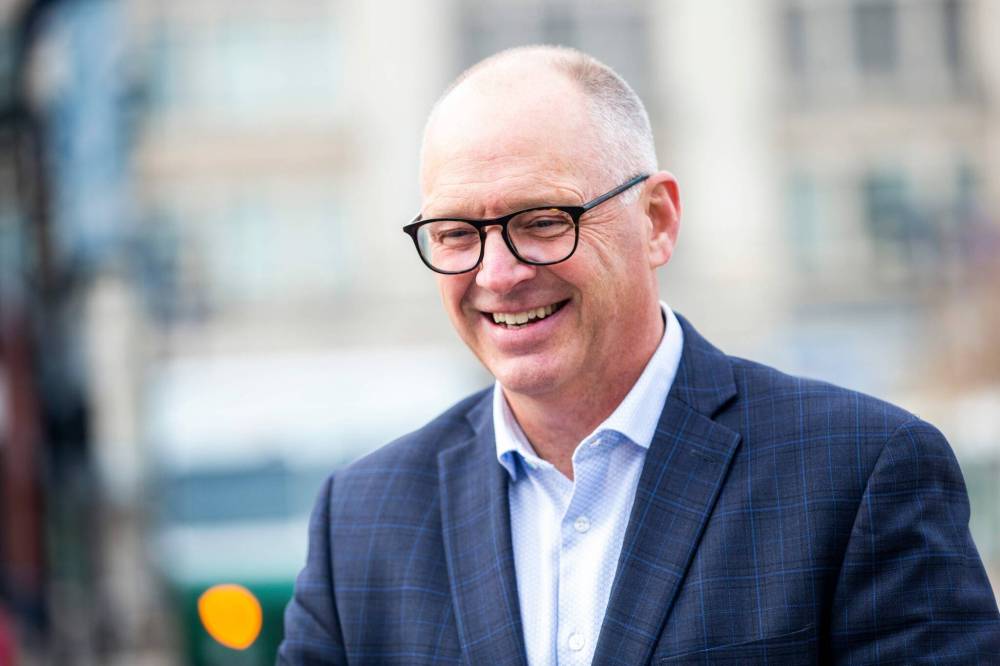
Mayoral candidate Scott Gillingham (Mikaela MacKenzie / Winnipeg Free Press files)
Mike Davidson
Winnipeg
Questioning PST plan
Re: Murray finds clever way to bolster city coffers (Opinion, Oct. 15)
Columnist Dan Lett thinks Winnipeg mayoral candidate Glen Murray’s plan to “grab a share of provincial retail sales tax revenue … is a fair and progressive way to fund local government.” Lett did not report on Murray’s complete proposal. As Murray said during an interview with CBC last Saturday, his plan is not to ask for a share of the existing PST revenue, but to ask the provincial government to increase PST by one percentage point and dedicate those net funds to Winnipeg.
I think this proposal is both impractical and unfair. It’s impractical because Murray proposes to rely on other levels of government for money to solve Winnipeg’s financial issues. It is not certain the province will agree to Murray’s proposal, since a very unpopular PST increase set by the previous NDP government was clawed back by the current government.
Also, Murray is the cause of Winnipeg’s lack of financial resources, because he was the mayor, he proudly says, who set the policy, followed for years by successive city councils, not to increase property taxes in Winnipeg.
The proposal is unfair for two reasons. Firstly, it’s a tax on all Manitobans, not just Winnipeg citizens. Other Manitobans will have to pay for the poor choices made by our past city councils and their administrations. Secondly, since it’s a tax that applies to everyone regardless of their ability to pay or where they live, it will disproportionately cause financial hardship to those citizens of Manitoba and Winnipeg with low incomes.
Rather than do the work required to cost out a complete election platform and have a plan to fund his proposals, including increasing taxes, Murray simply extends his hand to other governments that do have a plan complete with funding. If his plan A for lobbying the provincial government for a one percentage point PST increase is not successful, Murray has no plan B.
Randie Kushnier
Winnipeg
Having been convinced to move back to my hometown in 2002 to serve as Winnipeg’s director of planning, property and development under then-mayor Glen Murray, I couldn’t agree more with Dan Lett’s observation that what Murray brings to the table as a candidate for mayor in the current election campaign is “his capacity to think big and come up with potentially game-changing ideas.” I witnessed this firsthand, many times.
While Lett correctly recognizes the significance of the federal government’s decision to allocate a portion of gasoline taxes to municipalities as well as to provide a full rebate to municipalities for the GST, he fails to make mention of the significant role Murray played in making this happen. I was there at the news conference when then-prime minister Paul Martin announced these new funding arrangements and personally recognized the role Murray played in convincing him of their merits.
Murray understands the challenges the City of Winnipeg faces when it comes to its finances, and in many ways wrote the book on the “New Deal for Cities.” If anybody can convince the next Manitoba government to forego annual operating grants to Winnipeg in exchange for a one-percentage-point share of the PST, it’s Glen Murray.
Harry Finnigan
Winnipeg
Past performance as mayor incomplete
Re: Murray’s tenure acclaimed (Letters, Oct. 15)
Paul Moist and Annitta Stenning reminisce about Glen Murray’s performance during his one and a half terms as mayor, which they recall as being laudable. I have nothing but respect for Moist and Stenning, but note some gaps in their history of Murray’s performance.
These include his penchant to occasionally “fly off the handle” and threaten staff in a very public way with dismissal, poor listening skills and “talking over” when receiving briefings from staff, and the lack of commitment, character and judgment that Murray displayed when he resigned midterm, abandoning Winnipeg so he could run for the federal Liberals.
Some of these issues are a matter of public record, and others reflect discussions with elected officials of the day and my experience when I was a senior manager at the city. Based upon media reports, it appears these characteristics were exacerbated (perhaps due to personal problems) after Murray left Winnipeg in the middle of his second term as mayor.
With this background, I remain unconvinced that Moist and Stenning have provided a complete portrayal of Murray’s past performance, and would further note that this is a poor predictor of what Murray might, and might not, do as mayor in the future.
Tom Pearson
Winnipeg
The price is… high
C’mon down to the Manitoba legislature!
Behind door No. 1: the highest prevalence of the COVID-19 virus in Canada. Behind door No. 2: a critically ill health-care system. And behind door No. 3: a nasty flu season predicted for this fall and winter.
Premier Heather Stefanson and Health Minister Audrey Gordon should stop saying “things are in the works to address” these dire situations, and stop telling Manitobans the pandemic response system is at “limited risk” and at level green.
Again, look behind door No. 1.
Rennie Bodi
Winnipeg
Time to update liquor laws
To purchase liquor in the 1960s, Manitobans had to line up outside a government liquor store, one at a time, peruse a board that showed what was available, with the costs outlined. They would then complete an order form with their name, address, the number and type of liquor requested, so all orders could be tracked back to the purchaser. They presented the order to a clerk with payment and then proceeded to a second window where they provided proof of payment to pick up their goods, leaving quickly so as to not hold up the line. Thank heavens, we have advanced past that system.
However, through a series of inept decisions over the last three years, mainly in combatting theft and coping with COVID-19, the president and board of the Liquor, Gaming and Cannabis Authority, who ultimately decide everything concerning liquor in Manitoba, has returned Winnipeggers to 1960. Other stores, such as Canadian Tire, use facial recognition software to alert security to escort previous troublemakers out immediately. Only a public monopoly would punish all their customers to solve a business problem.

We now line up outside the government store even in -40 C weather, sometimes 10-15 people deep, waiting our turn to be allowed to purchase liquor. The clerk holds up your submitted ID to your face, checks the birthdate and then runs your identification through a separate scanner that records and checks to see that you haven’t done anything wrong previously. No one enters until the clerk decides to let the first person waiting between glass partitions into the main store. Visitors to the city cannot believe what they have to go through to buy liquor.
Bill 42, introduced in May by MLA Andrew Smith, would give existing liquor, beer and wine stores the ability to apply for new licences, allowing all of those retailers to carry any type of alcohol sold by Manitoba Liquor and Lotteries. The new legislation would also allow the province to launch a five-year pilot project expanding liquor sales to more businesses, such as grocery stores.
Saskatchewan already has passed this type of legislation for happier consumers.
Robb Miles
Winnipeg
Related Articles
Getting your letter to the editor published
Advertisement Advertise With Us
Advertisement Advertise With Us