Resilient wood frogs keep researcher hopping

One of the Churchill region’s most resilient animals is a lesser-known critter, one that has the ability to freeze like a hockey puck to weather the North’s frigid winters and has a habitat range that dips south all the way to North Carolina.

Read this article for free:

or

Already have an account? Log in here »

To continue reading, please subscribe:

Subscribe and receive a limited-edition Free Press branded hat or tote.

Digital Subscription

One year of digital access for only $205*

  • Enjoy unlimited reading on winnipegfreepress.com
  • Read the E-Edition, our digital replica newspaper
  • Access News Break, our award-winning app
  • Play interactive puzzles

*First annual payment billed as $205.00 + GST for one year. This annual subscription will automatically renew at $233.00 + GST every 52 weeks (10% off the regular annual price of $259.35). Offer available to new and qualified returning subscribers only. Cancel any time.

To continue reading, please subscribe:

Add Free Press access to your Brandon Sun subscription for only an additional

$1 for the first 4 weeks*

  • Enjoy unlimited reading on winnipegfreepress.com
  • Read the E-Edition, our digital replica newspaper
  • Access News Break, our award-winning app
  • Play interactive puzzles
Start now

*Your next Brandon Sun subscription payment will increase by $1.00 and you will be charged $17.95 plus GST for four weeks. After four weeks, your payment will increase to $24.95 plus GST every four weeks.

Hey there, time traveller!
This article was published 23/10/2020 (2110 days ago), so information in it may no longer be current.

One of the Churchill region’s most resilient animals is a lesser-known critter, one that has the ability to freeze like a hockey puck to weather the North’s frigid winters and has a habitat range that dips south all the way to North Carolina.

It’s Canada’s most widely distributed amphibian: the wood frog.

Jon Davenport, assistant professor of biology at Appalachian State University in North Carolina, makes annual trips to Churchill (at least when he isn’t blocked from field work by a global pandemic) to monitor the wood frog population and understand how it is being affected by climate change.
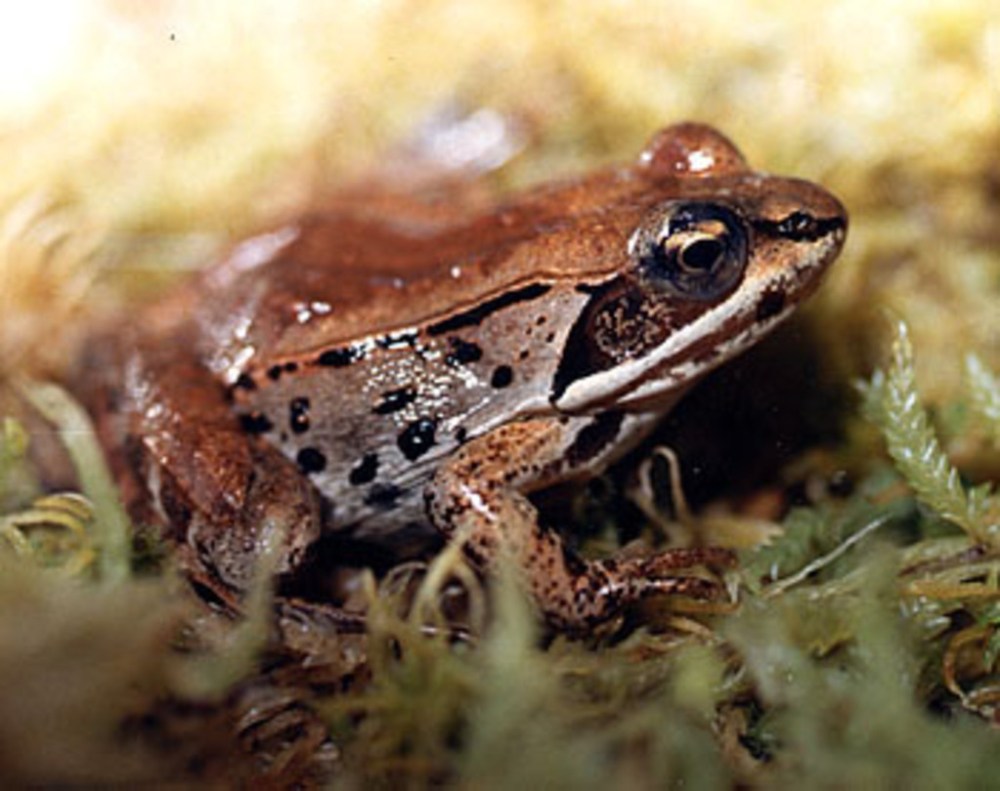
In Churchill frogs can live for four years but some evidence suggests there are frogs that can live up to eight years.

“It’s amazing to me that they’re even up there. Why go through all the trouble to be up there when it’s so extreme? And that’s what we’re trying to understand. And as the environment becomes even more extreme, how resilient are they?” Davenport says.

Overall, the northern Manitoba population remains stable, but there are stressors, such as drying ponds where frogs lay eggs.

In tracking adult and juvenile frog movements over the past four years, unsurprisingly, the animals avoid hot, dry areas, Davenport says. What is surprising is the amount of time the frogs spend on the tundra landscape when they are more adapted to living in the woods.

“We’re trying to understand how are they so stable, given that the environment is changing? There’s a couple things we think are going on. Because maybe the ponds are drying earlier, and the frogs aren’t necessarily getting there any earlier, but they can speed up their growth to respond to that,” he says.

“It’s amazing to me that they’re even up there. Why go through all the trouble to be up there when it’s so extreme?”
– Jon Davenport, assistant professor of biology at Appalachian State University in North Carolina

“And even as those ponds are drying, and they come out, the adults and some of the smaller ones do spend a lot of time out in the open tundra…. We think it’s because the shrubs — which (previously) weren’t on the tundra as much — they’ve encroached onto the tundra. So the frogs can hop out of the pond, even if they have to a little earlier… and there’s a shrub that provides them with some relief from the UV radiation.

“So, that shrub encroachment, that changing of the environment, could actually benefit the adults in some ways, but the ponds drying could negatively affect the juveniles and the larvae.”
SUPPLIED
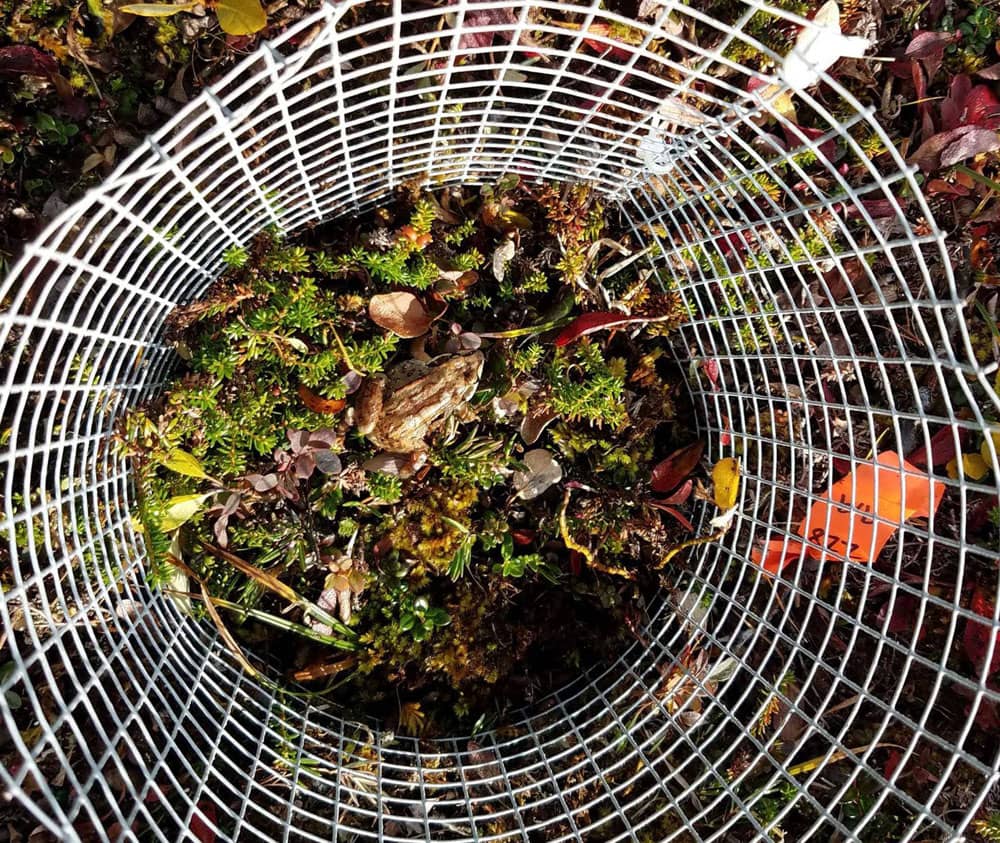
A frog settles into its new caged enclosure for the duration of the winter months.
SUPPLIED A frog settles into its new caged enclosure for the duration of the winter months.

This led Davenport to venture into the frog real-estate market. He started building what he calls “frog condos” — cages the research team erects around a frog as it selects its winter hibernation spot.

“They basically turn into a little frozen hockey puck. We call it super-cooling. They prevent ice crystals from forming in organs and they change over their sugars in a manner that prevents them from getting any damage to organs and basically allows them to shut down most functions and just be a little frozen Popsicle for, roughly up there in Churchill, it’s about 8 1/2 months of the year,” he says.

“At that spot, they dig a little bit into the soil and they just freeze.”

He’s itching to know: why that spot?

Based on limited data so far, Davenport believes the longer time spent in hibernation expands the frog’s lifespan. Where he lives, in North Carolina, the lifespan of frogs is two to three years; in Churchill, they know the frogs can live until they’re at least four, with some evidence suggesting there are eight-year-old frogs hopping around.

“We call it super-cooling. They prevent ice crystals from forming in organs and they change over their sugars in a manner that prevents them from getting any damage to organs and basically allows them to shut down most functions and just be a little frozen Popsicle for, roughly up there in Churchill, it’s about 8 1/2 months of the year.”
– Jon Davenport

“It kind of makes sense, if you think about it. If they’re frozen for eight months of the year, they’re really only actively hopping around doing stuff for four months, so their equivalent of eight years is really only 2 1/2 years for a normal frog,” he says.

Monitoring of the frog population, despite its continued stability, is important, Davenport says, because of its position at the bottom of the food web.

After 10 years of research, going in with an expectation he would see declines in this frog population, Davenport is now reasonably confident in the animal’s incredible ability to adapt to whatever Mother Nature throws at it.

“They are being pushed, but these are the populations that are on the edge of their range and have already been pushed for however many thousands of years. So maybe for them, they are actually more resilient and we shouldn’t expect as crazy of a change for them, as we should expect if those changes occur at lower (latitudes).”

sarah.lawrynuik@freepress.mb.ca

Report Error Submit a Tip

More Stories

‘Definitely a tough one’: Travel delays drag down Sea Bears in 114-90 loss to Vancouver Bandits

Joshua Frey-Sam 5 minute read Preview

‘Definitely a tough one’: Travel delays drag down Sea Bears in 114-90 loss to Vancouver Bandits

Joshua Frey-Sam 5 minute read Yesterday at 7:19 PM CDT

The Winnipeg Sea Bears will head into the playoffs on a disheartening note.

Winnipeg’s pro hoops squad had hoped to ride a wave of confidence into the Canadian Elite Basketball League post-season on the strength of locking up the top seed in the Western Conference.

Instead, the Sea Bears ended the regular season after being handed their worst defeat of the season, a 114-90 rout at the hands of the Vancouver Bandits at the Langley Events Centre in British Columbia on Sunday.

“Definitely a tough one, but we got a home game coming next week. Just get ready for that,” said Simon Hildebrandt, who was the only member of the Sea Bears available for a post-game interview.

Read
Yesterday at 7:19 PM CDT

Use summer’s hard truth to mend your heart

Maureen Scurfield 4 minute read 2:15 AM CDT

Dear Miss Lonelyhearts: I refused to go stay at my girlfriend’s cabin in July, because her alcoholic ex-husband still owns the lot beside her. He’s building a big fancy cabin this summer and she’s more than OK with that, even though they’re divorced.

I seriously criticized him — calling him a drunk and a loser — and she actually dumped me before she went off to the lake for all of July!

When she finally came back home I went to see her. She told me I “just wasn’t enough of a lake person” for her.

Then the fight began! I said, “So are you back with him permanently?” and she said, “What do you think? You let me go!”

Long journey to home ownership for Eritrean couple

Zoe Pierce 4 minute read Preview

Long journey to home ownership for Eritrean couple

Zoe Pierce 4 minute read Saturday, Aug. 1, 2026

Solomon Ghebru and his family have been building a life together in Winnipeg for the past three years after years of living apart in various countries. Now, they are working toward a new goal: owning a home.

Their story is the focus of this year’s Habitat for Humanity Manitoba Cycle of Hope fundraising ride, a seven-day cycling event through southern Manitoba that begins Monday. The ride aims to raise $150,000 to support Ghebru, his wife, Mehret Awate, and their two daughters as they work toward affordable homeownership.

The couple’s journey to Canada started in Eritrea, where they grew up and attended the same church together. They left Eritrea separately, hoping to build a better life together out of the country. Ghebru travelled through Sudan and Libya before reaching Malta, while Awate travelled to Sudan and then Uganda.

After he found work in Malta, he tried to have his family join him, but government policies prevented them from reuniting. The couple married in Uganda in 2016, and their first daughter, Peniel, was born there the following year.

Read
Saturday, Aug. 1, 2026

Resilient wood frogs keep researcher hopping

Sarah Lawrynuik 5 minute read Preview

Resilient wood frogs keep researcher hopping

Sarah Lawrynuik 5 minute read Friday, Oct. 23, 2020

One of the Churchill region’s most resilient animals is a lesser-known critter, one that has the ability to freeze like a hockey puck to weather the North’s frigid winters and has a habitat range that dips south all the way to North Carolina.

It’s Canada’s most widely distributed amphibian: the wood frog.

Jon Davenport, assistant professor of biology at Appalachian State University in North Carolina, makes annual trips to Churchill (at least when he isn’t blocked from field work by a global pandemic) to monitor the wood frog population and understand how it is being affected by climate change.

“It’s amazing to me that they’re even up there. Why go through all the trouble to be up there when it’s so extreme? And that’s what we’re trying to understand. And as the environment becomes even more extreme, how resilient are they?” Davenport says.

Read
Friday, Oct. 23, 2020

Lewis says he won’t run for office until the NDP is ‘ready’ for a general election

David Baxter, The Canadian Press 6 minute read Preview

Lewis says he won’t run for office until the NDP is ‘ready’ for a general election

David Baxter, The Canadian Press 6 minute read Updated: Yesterday at 10:52 AM CDT

MONTREAL - Four months into the job, NDP Leader Avi Lewis is still in no rush.

Since winning the leadership of a party knocked to its knees in the 2025 federal election, Lewis has maintained his immediate priority is preparing the NDP for an election — not winning a seat in the House of Commons. Multiple byelections are set to take place before the end of the year; Lewis will be door-knocking with candidates in those ridings but won’t be on the ballot himself.

“I think there will be a point in the next year where I feel we're election-ready across the country. We want to run serious campaigns everywhere,” Lewis said in a recent interview in Montreal’s Plateau neighbourhood.

“We're in a position as a party on the rebound where I can't just pursue a seat at all costs. So I do need a litmus test for when is it time for me to get in there? And that's going be either in the next election or the run-up to the next election, once we are election-ready.”

Read
Updated: Yesterday at 10:52 AM CDT

Pimicikamak lockdown lifted after fatal shooting

Malak Abas 2 minute read Preview

Pimicikamak lockdown lifted after fatal shooting

Malak Abas 2 minute read Yesterday at 3:28 PM CDT

Pimicikamak Cree Nation Chief David Monias said an arrest has been made and the community-wide lockdown has now been lifted after a shooting Friday that left one person dead.

RCMP were called by local First Nations Safety Officers about a seriously injured person at around 9:30 p.m. Friday on Main Road in Pimicikamak Cree Nation. Officers found two men at the scene. A 42-year-old man with a gunshot wound died at the scene. The other person was not injured.

The community went into immediate lockdown as the RCMP sought the suspect. An advisory posted by Monias Saturday had asked residents to stay inside their homes, lock doors and windows, keep children inside and not to open their doors to anyone they did not know.

In a statement on social media Sunday afternoon, Monias said the RCMP had arrested one person.

Read
Yesterday at 3:28 PM CDT