

Airport adds LED sanitizers to anti-virus practices

Advertisement
Read this article for free:
or
Already have an account? Log in here »
To continue reading, please subscribe:
Digital Subscription
One year of digital access for only $1.44 a week*
- Enjoy unlimited reading on winnipegfreepress.com
- Read the E-Edition, our digital replica newspaper
- Access News Break, our award-winning app
- Play interactive puzzles
*Billed as $5.77 plus GST every four weeks. After 52 weeks, price increases to the regular rate of $19.95 plus GST every four weeks. Offer available to new and qualified returning subscribers only. Cancel any time.
To continue reading, please subscribe:
Add Free Press access to your Brandon Sun subscription for only an additional
$1 for the first 4 weeks*
- Enjoy unlimited reading on winnipegfreepress.com
- Read the E-Edition, our digital replica newspaper
- Access News Break, our award-winning app
- Play interactive puzzles
*Your next Brandon Sun subscription payment will increase by $1.00 and you will be charged $17.95 plus GST for four weeks. After four weeks, your payment will increase to $24.95 plus GST every four weeks.
Read unlimited articles for free today:
or
Already have an account? Log in here »
Hey there, time traveller!
This article was published 21/08/2020 (2257 days ago), so information in it may no longer be current.
In the latest of an ever-expanding list of sanitization practices being implemented in Winnipeg’s high-traffic spaces, the city’s main airport now has LED handrail sterilizers.
The LED UV-C handrail is the first of its kind to be installed by Otis Canada – an elevator company – in Winnipeg. The sterilizer, which is installed at the main escalator in the arrivals hall at Winnipeg James Armstrong Richardson International Airport, utilizes ultraviolet wavelengths and mirror-like side reflectors to sanitize the handrails as they pass through it.
“Every flyer, every traveller travelling domestically within Canada, would be going down this escalator and this set of stairs as they arrived at Winnipeg Richardson International Airport,” airport communications specialist Michel Rosset said.
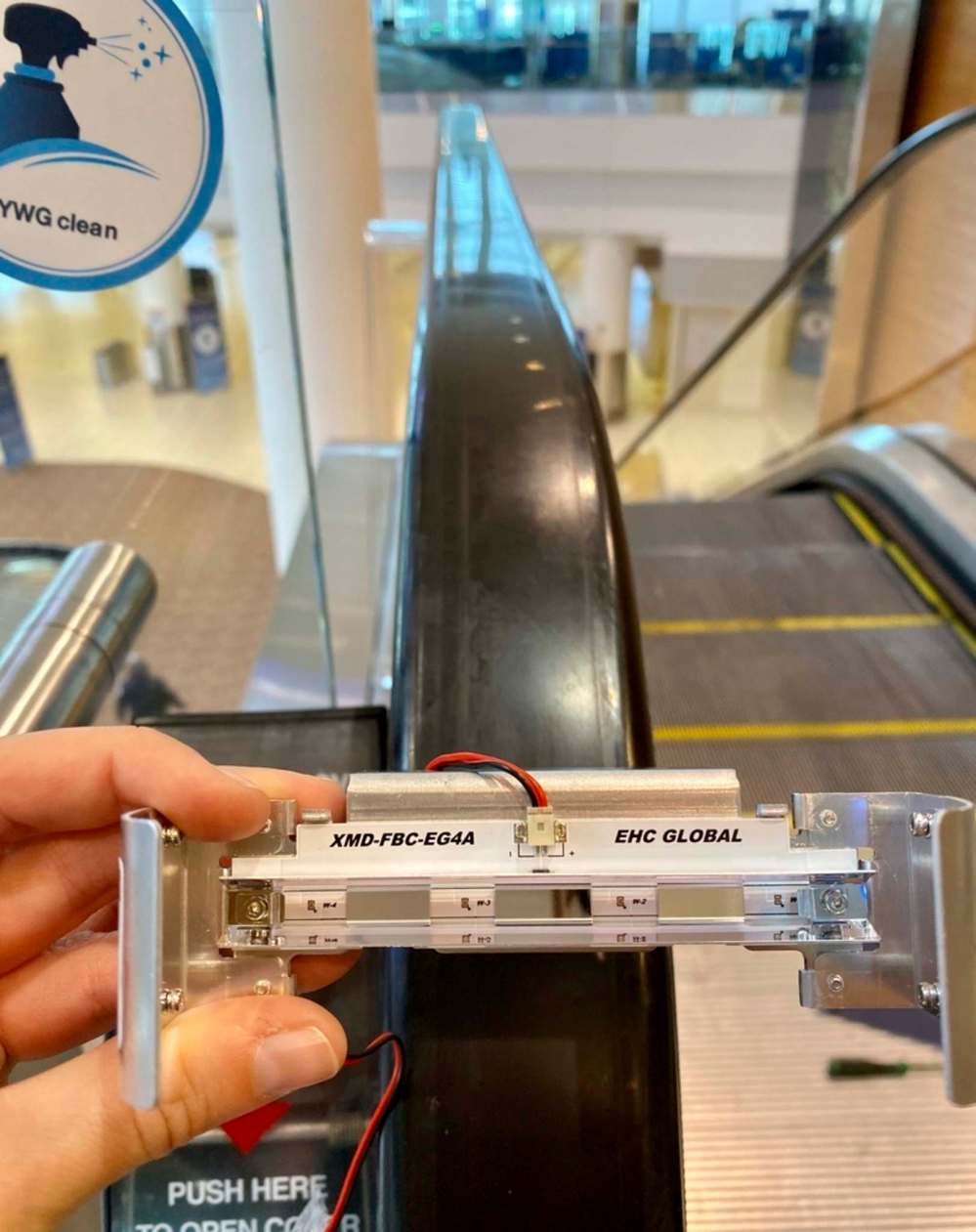
“So, we want to make sure that everyone who enters the terminal, everyone that arrives at Winnipeg, feels safe and has that level of confidence.”
This is not the first piece of technology installed by the airport to keep up with expanded hygiene practices — cleaning staff now utilize an electric static sprayer, which mists a fine disinfectant that clings to surfaces, and there are “enhanced cleaning” icons around the airport, meant to distinguish which high-traffic areas are being subject to more extensive cleaning.
While Rosset did not state the cost of implementing these measures, he noted the airport has taken steps to mitigate the financial impact of COVID-19.

“We’ve turned down lights where no longer needed, we adjust temperatures so it’s more energy-efficient,” he said. “We’re always looking at ways to mitigate the cost because it’s no secret that COVID-19 has had a huge impact on the air travel industry.”
The handrail UV sanitizer is a relatively new technology — they were first introduced by LG Innotek in 2017 — but using UV-C light to kill germs and bacteria is an increasingly popular practice. In China, buses are hit with ultraviolet radiation after-hours to disinfect them, and personal UV-sanitizing devices have become widely available for purchase as people look for more convenient ways to sanitize products.
However, the U.S. Food and Drug Administration has warned that while UV-C radiation may be effective in killing the COVID-19 virus, the level of effectiveness is unknown due to the “limited published data about the wavelength, dose, and duration of UV-C radiation required” and the World Health Organization has warned against using UV rays to disinfect skin, as it can cause irritation and eye damage.
malak.abas@freepress.mb.ca
Twitter: malakabas_
Malak Abas is a city reporter at the Free Press. Born and raised in Winnipeg’s North End, she led the campus paper at the University of Manitoba before joining the Free Press in 2020. Read more about Malak.
Every piece of reporting Malak produces is reviewed by an editing team before it is posted online or published in print — part of the Free Press‘s tradition, since 1872, of producing reliable independent journalism. Read more about Free Press’s history and mandate, and learn how our newsroom operates.
Our newsroom depends on a growing audience of readers to power our journalism. If you are not a paid reader, please consider becoming a subscriber.
Our newsroom depends on its audience of readers to power our journalism. Thank you for your support.
Advertisement Advertise With Us
Advertisement Advertise With Us