

Colony life turned upside down
'Massive paradigm shift' required as Hutterite communities deal with COVID-19
Advertisement
Read this article for free:
or
Already have an account? Log in here »
To continue reading, please subscribe:
Digital Subscription
One year of digital access for only $1.44 a week*
- Enjoy unlimited reading on winnipegfreepress.com
- Read the E-Edition, our digital replica newspaper
- Access News Break, our award-winning app
- Play interactive puzzles
*Billed as $5.77 plus GST every four weeks. After 52 weeks, price increases to the regular rate of $19.95 plus GST every four weeks. Offer available to new and qualified returning subscribers only. Cancel any time.
To continue reading, please subscribe:
Add Free Press access to your Brandon Sun subscription for only an additional
$1 for the first 4 weeks*
- Enjoy unlimited reading on winnipegfreepress.com
- Read the E-Edition, our digital replica newspaper
- Access News Break, our award-winning app
- Play interactive puzzles
*Your next Brandon Sun subscription payment will increase by $1.00 and you will be charged $17.95 plus GST for four weeks. After four weeks, your payment will increase to $24.95 plus GST every four weeks.
Read unlimited articles for free today:
or
Already have an account? Log in here »
Hey there, time traveller!
This article was published 31/08/2020 (2130 days ago), so information in it may no longer be current.
The coronavirus has upended the communal way of life for Hutterite colonies that have been forced to contain the spread of the virus just as schools are about to reopen.
“Because of COVID-19, we have had to undergo a massive paradigm shift, and this has been exceedingly difficult for some to do,” said Kenny Wollmann, a member of the Hutterian Safety Council’s pandemic task force.
Hutterites are a religious minority who live in colonies that collectively own virtually all property; residents work, eat, worship and socialize in large groups.
The typical colony houses six to 12 families in a remote area. While Hutterites sell agricultural goods and take advanced schooling in cities, their main purpose for travelling is to visit relatives in other colonies across the Prairies.
“Our lifestyle has been intentionally organized in such a way that everybody gets up into everybody’s business — this is how we care for each other,” Wollmann said.
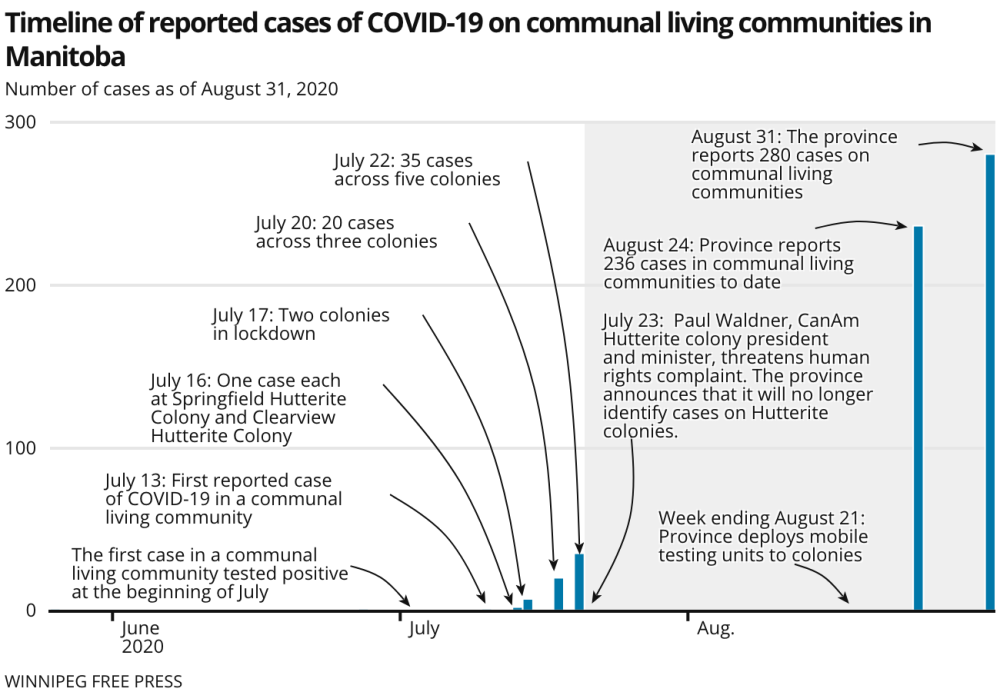
Their lifestyle kept COVID-19 out of Hutterite communities until the province detected one case on a colony on July 13. Within nine days, officials logged 35 cases on five colonies.
But the province stopped specifying colony cases due to concern about Hutterites being stigmatized. Hutterites have often felt maligned and persecuted over the decades, especially for their opposition to war.
On Aug. 24, the province disclosed that 236 cases had occurred in “communal-living communities.”
Some believe that rapid spread stemmed from visitors to a funeral at an Alberta colony, but Wollmann said contact tracing hasn’t confirmed that link.
“It’s difficult to pin down,” he said. “It’s beside the point; we don’t have the resources to obsess about this.”
Instead, communities are focused on changing their daily lives.
Hutterites usually eat all three meals together in large halls, which some colonies have now spaced out to limit contact. Families with a sick relative have food delivered to their homes.
Some colonies that have multiple cases have shifted to cooking at home in kitchenettes that are normally only used for preparing snacks.
Worship services are being broadcast on public-address systems, or held outside.
While the harvest of crops takes place outdoors, some tasks have been spread out. Communities have designated members to take farm products, such as hogs and eggs, into cities.
Public health officials have asked Hutterites with infections to self-isolate. The officials test and monitor all people who have come into contact with an infected person.
Wollmann said compliance with those measures seems to be the norm.
“There’s a wide variety of responses to COVID-19 in Hutterite communities, just the same as there is in Winnipeg. Everybody’s doing the best they can, to cope with this unsettling situation that we find ourselves in.”– Kenny Wollmann, member of the Hutterian Safety Council’s pandemic task force
“There’s a wide variety of responses to COVID-19 in Hutterite communities, just the same as there is in Winnipeg,” Wollmann said. “Everybody’s doing the best they can, to cope with this unsettling situation that we find ourselves in.”
Wollmann said the RCMP have been checking on people who returned from trips abroad during their mandatory two-week isolation.
The province has been vigilant in daily contact-tracing calls, which involve checking symptoms for people who might have been exposed, and verifying that those who are supposed to isolate are indeed at home.
“It’s a mixed bag. There are some people who are appreciative, and find it reassuring. There are also some cases where some people find it frustrating. They’re not well, and to just contend with the phone calls day in, day out; it’s a bit much for them,” said Wollman.
He hopes communities keep complying with the rules, so the province doesn’t have to issue fines.
Overall, he said Manitoba’s public-health team and provincial ministers have been supportive.
“We are just so deeply grateful for their willingness to hear our concerns and collaborate with us; to educate our people and develop the best possible responses.”
Like most Manitobans, the impending return to school is top of mind for many Hutterites. Colonies tend to follow the same protocols as public school divisions, and the amount of at-home technology varies by community.
Ian Kleinsasser is at teacher at the Crystal Springs colony near Ste. Agathe, which has active cases.
He says an existing videoconferencing system has come in handy.
Most colonies have 60 to 170 people, so it’s common to have just a handful of children per grade, or just a few who want to take an elective course.
For years, children have been taught through “interactive television,” where a teacher instructs children at multiple schools remotely, and checks in separately as they complete tasks.
In the spring, schools relied on that technology, and sanitation and distancing measures, as they let teenagers attend schools for digital lessons. That allowed families to focus on elementary students at home.
His schools expect classes to resume this fall, with the usual mix of teachers from within and outside the colony.
“The stress level for parents right across the province was tremendous, and still is,” said Kleinsasser.
His colony is within the Niverville-Ritchot district, which had 17 active cases as of Friday. The community has limited access to and from the colony to those who have tested negative or have never presented symptoms, and only for essential trips.
Kleinsasser said Hutterites are living through the same problems as other Manitobans.
“In a pandemic, people really have to have the sense that we are all in this together.”
dylan.robertson@freepress.mb.ca
History
Updated on Tuesday, September 1, 2020 11:51 AM CDT: Updates graphic with August 31, 2020 total
Updated on Tuesday, September 1, 2020 12:05 PM CDT: Updates annotation text in graphic