

Drug choices shifting as meth costs rise
City holds out for support from Ottawa to tackle drug-related crime
Advertisement
Read this article for free:
or
Already have an account? Log in here »
To continue reading, please subscribe:
Monthly Digital Subscription
$1 per week for 24 weeks*
- Enjoy unlimited reading on winnipegfreepress.com
- Read the E-Edition, our digital replica newspaper
- Access News Break, our award-winning app
- Play interactive puzzles
*Billed as $4.00 plus GST every four weeks. After 24 weeks, price increases to the regular rate of $19.95 plus GST every four weeks. Offer available to new and qualified returning subscribers only. Cancel any time.
Monthly Digital Subscription
$4.99/week*
- Enjoy unlimited reading on winnipegfreepress.com
- Read the E-Edition, our digital replica newspaper
- Access News Break, our award-winning app
- Play interactive puzzles
*Billed as $19.95 plus GST every four weeks. Cancel any time.
To continue reading, please subscribe:
Add Free Press access to your Brandon Sun subscription for only an additional
$1 for the first 4 weeks*
*Your next subscription payment will increase by $1.00 and you will be charged $16.99 plus GST for four weeks. After four weeks, your payment will increase to $23.99 plus GST every four weeks.
Read unlimited articles for free today:
or
Already have an account? Log in here »
Hey there, time traveller!
This article was published 27/07/2020 (2063 days ago), so information in it may no longer be current.
The escalation in violent crime, fuelled by drug users switching to substances more dangerous than meth, has prompted Winnipeg police and the city’s mayor to join the province in asking the federal government for urgent financial help to combat the scourge.
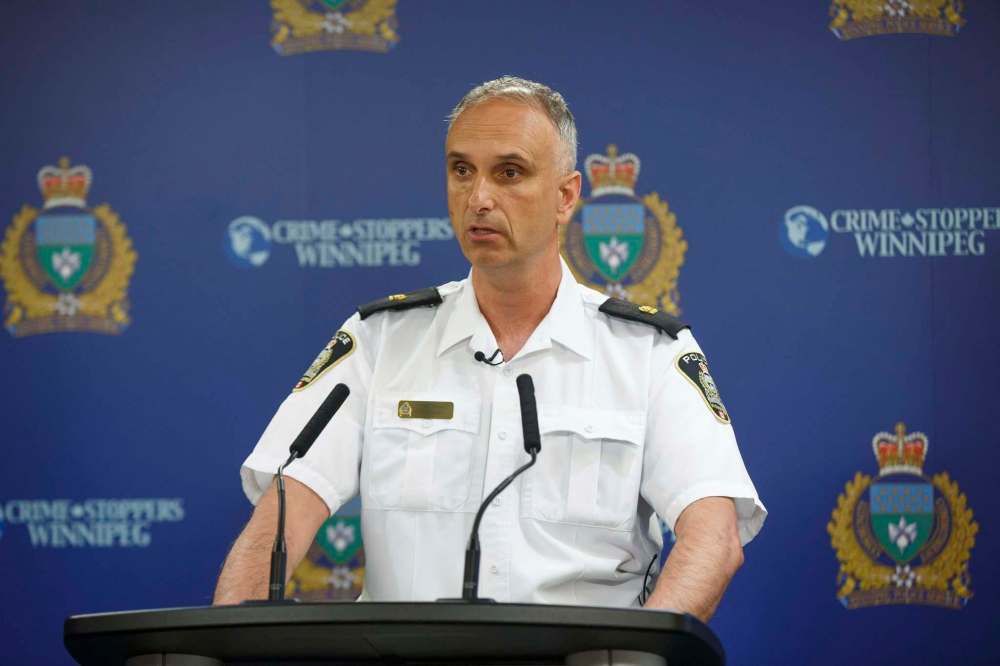
“People who would normally be using methamphetamines are turning to whatever other drug they can get their hands on,” said police Insp. Max Waddell.
Closed borders due to the pandemic have put a lid on the importation of methamphetamine and its precursors. Compared with the start of the year, the lack of supply doubled the cost of meth by April, and has since tripled to $30 for one-tenth of a gram, Waddell said.
Meth has become so costly that users are switching to a new drug dubbed “purple down.”
“There’s been an rise in a fentanyl-heroin mixture… it’s kind of a newer drug we’re seeing on the streets that is obviously very concerning,” he said.
Before the pandemic, when meth was the target of police and politicians, the Manitoba government asked the federal Liberals for $10 million to step up efforts to curb meth-related crime in Winnipeg. Now, city police and Mayor Brian Bowman have echoed that call as crime has become more violent.
“What we truly need is to get people off the initial cycle of (drug) use and focus on education, intervention and health,” Waddell said.
Mayor Brian Bowman said he hopes Ottawa will soon answer the province’s request for $10 million.
It would pay to boost downtown safety, among other things. That would include closed-circuit cameras, foot patrols and enhanced lighting and “tactical interventions for chronic and prolific offenders.”
Provincial Justice Minister Cliff Cullen announced $5 million for the downtown project last month. His office said federal Public Safety Minister Bill Blair discussed the issue in a call, but hasn’t promised any funding.
“Obviously, any dollars for (the project) is welcomed; it’s one that we are absolutely a partner to,” Bowman told the Free Press.
He said he needs clarity on whether there is a long-term funding commitment or just one-time cash from both levels of government.
Federal Manitoba cabinet minister Dan Vandal responded by pointing out Ottawa has already announced several programs to curb violence, stem the spread of drug use and treat people who have addictions.
“As a former Winnipeg city councilor, I have long advocated for improved public services in the areas of crime prevention, addictions and health services,” Vandal wrote Friday.
“We know that more can be done in collaboration with all orders of government and community organizations. We cannot simply arrest ourselves out of this situation.”
Fentanyl is so potent that even small doses can be fatal. Often it is mixed with other substances. Deaths in Kenora and Regina have been linked to fentanyl; Waddell said they are likely contributing to Winnipeg deaths, but he won’t know for sure until he receives toxicology reports, which take months to process.
As for meth, federal officials have said it comes into Canada through Mexico and the Netherlands. The supply has been cut because of the COVID-19 pandemic. Internal federal records show there was an increase in domestic meth production late last year, before the lockdown.
“Domestic production of methamphetamine has increased,” says a December analysis by Public Safety Canada.
“Much of the illicit drug is trafficked nationwide,” reads the document, titled “Western Canada’s Interdiction Strategy.”
Winnipeg police say the city has so far only had small-scale labs.
Police Chief Danny Smyth said Friday that meth seems to arrive in Manitoba from British Columbia or the Toronto area, and that it’s often contaminated with opioids.
“We’re seeing more overdose deaths right now, and I think these things are all connected,” he said.
The Winnipeg Fire Paramedic Service says calls for suspected opioid overdoses have doubled, compared with a year ago.
An April analysis by the Canadian Centre on Substance Use and Addiction said opioids in meth appears to be a regional trend.
“In the West, stimulant-containing samples were more likely to include fentanyl and its analogues, which might be why more harms associated with methamphetamine are reported in Western Canada,” reads the report.
Meanwhile, almost 43 per cent of meth samples analyzed by Health Canada from April 2018 to August 2019 contained caffeine; allergy medicine was frequently added. The government doesn’t analyze all meth seized by police forces across the country.
“The presence and quantity vary from one batch of drugs to another and can influence the concentration of the expected psychoactive substance in the drug, making it unpredictable,” reads the report.

In late 2018, Ottawa, Manitoba and the city formed a drug task force, which issued its report in June 2019.
It’s unclear what progress has been made since then. Bowman said he’s been pushing all levels of government to publish a detailed account of what actions and funding each has done to help stem the use of drugs in the city.
“For us to be open and transparent, all three levels of government, I want to get that in a form that can be made public, so that we can all be held accountable.”
— with files from Ryan Thorpe
dylan.robertson@freepress.mb.ca
Internal federal records on meth trends + national study on contaminants