

First Nations COVID numbers blurred by faulty data reporting
Advertisement
Read this article for free:
or
Already have an account? Log in here »
To continue reading, please subscribe:
Monthly Digital Subscription
$1 per week for 24 weeks*
- Enjoy unlimited reading on winnipegfreepress.com
- Read the E-Edition, our digital replica newspaper
- Access News Break, our award-winning app
- Play interactive puzzles
*Billed as $4.00 plus GST every four weeks. After 24 weeks, price increases to the regular rate of $19.95 plus GST every four weeks. Offer available to new and qualified returning subscribers only. Cancel any time.
Monthly Digital Subscription
$4.99/week*
- Enjoy unlimited reading on winnipegfreepress.com
- Read the E-Edition, our digital replica newspaper
- Access News Break, our award-winning app
- Play interactive puzzles
*Billed as $19.95 plus GST every four weeks. Cancel any time.
To continue reading, please subscribe:
Add Free Press access to your Brandon Sun subscription for only an additional
$1 for the first 4 weeks*
*Your next subscription payment will increase by $1.00 and you will be charged $16.99 plus GST for four weeks. After four weeks, your payment will increase to $23.99 plus GST every four weeks.
Read unlimited articles for free today:
or
Already have an account? Log in here »
Hey there, time traveller!
This article was published 19/01/2021 (1922 days ago), so information in it may no longer be current.
OTTAWA — First Nations people remain over-represented in Manitoba’s COVID-19 cases, though not to the extent widely reported, due to problems in how the province records its data.
Under official metrics, First Nations make up 73 per cent of active COVID-19 cases in Manitoba as of Monday; the number is realistically closer to 43 per cent.
The discrepancy stems from the province taking weeks to clear COVID-19 cases from its datasets.
The vast majority of people with COVID-19 recover within 10 days and are no longer infectious; those who are still sick tend to be in hospital.
Provinces such as Quebec faced a similar data issue in the spring, and crafted algorithms to tabulate who had a COVID-19 diagnosis more than 10 days earlier without ending up in hospital.
Last week, Dr. Jazz Atwal, acting deputy chief provincial public health officer, told reporters there was a total of 1,394 active cases in Manitoba as of last Thursday — despite the province officially reporting 2,866 active cases for that day.
This issue in the data emerged in October 2020, when Manitoba appeared to have nearly five times as many active cases as Saskatchewan, due to its faulty data reporting.
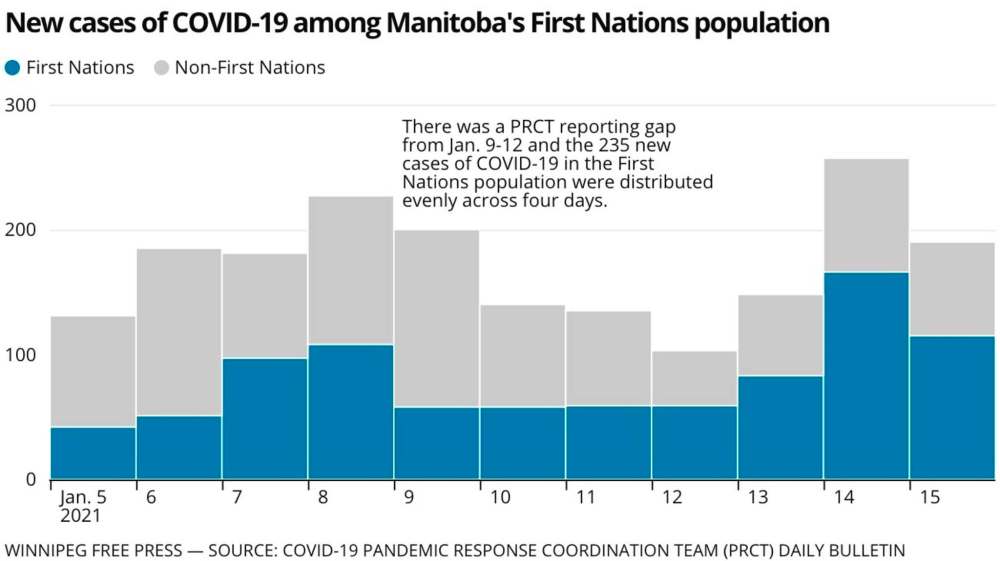
The Free Press tabulated all new cases reported in the daily updates from both the provincial government and the Manitoba First Nations COVID-19 Pandemic Response Coordination Team between Jan. 5 and 14.
There were 1,734 new cases of COVID-19 across Manitoba logged in that period, of which 740 were First Nations people, both on- and off-reserve.
That would suggest 42.67 per cent of active cases as of last Thursday were First Nations people — not the 70 per cent tabbed by the response team in a news release that day.
That’s still a drastically high number, disproportionate to the 10.5 per cent of Manitobans who identified as First Nations in the 2016 census.
Grand Chief Garrison Settee, who represents northern reserves, said that’s the culmination of decades of inequities, particularly crowded houses where the coronavirus thrives.
“It’s because of decades of neglect of the obligations of the federal government to our First Nations people,” the Manitoba Keewatinowi Okimakanak leader said during a videoconference last Friday.
“The system that we inherited has just been flawed from the get-go,” he said, arguing First Nations must oversee their own health systems. “It’s time to have a paradigm shift, especially in the North.”
It remains undisputed First Nations COVID-19 patients are also over-represented in hospital wards and deaths in Manitoba.
The response team did not provide anyone for an interview Monday.
The multi-organizational body has been hailed for giving First Nations a leadership role in pandemic response, but has struggled to keep up with data reporting, public messaging, vaccine prioritization and logistical distribution.

Manitoba’s first quota of Moderna doses sat unused for 12 days in Winnipeg, as the group grappled with deciding which communities would be prioritized for vaccination.
The Pallister government says it’s confident this slower start will pay off in the long run, as First Nations will trust their own leaders telling them to roll up their sleeves.
— with files from Danielle Da Silva
dylan.robertson@freepress.mb.ca
michael.pereira@freepress.mb.ca
History
Updated on Tuesday, January 19, 2021 9:31 AM CST: Corrects typos
Updated on Tuesday, January 19, 2021 10:18 AM CST: corrects typos