

Furry friends on hold
Not yet ready to bring pups back to St. B pet therapy program

Advertisement
Read this article for free:
or
Already have an account? Log in here »
To continue reading, please subscribe:
Monthly Digital Subscription
$1 per week for 24 weeks*
- Enjoy unlimited reading on winnipegfreepress.com
- Read the E-Edition, our digital replica newspaper
- Access News Break, our award-winning app
- Play interactive puzzles
*Billed as $4.00 plus GST every four weeks. After 24 weeks, price increases to the regular rate of $19.95 plus GST every four weeks. Offer available to new and qualified returning subscribers only. Cancel any time.
Monthly Digital Subscription
$4.99/week*
- Enjoy unlimited reading on winnipegfreepress.com
- Read the E-Edition, our digital replica newspaper
- Access News Break, our award-winning app
- Play interactive puzzles
*Billed as $19.95 plus GST every four weeks. Cancel any time.
To continue reading, please subscribe:
Add Free Press access to your Brandon Sun subscription for only an additional
$1 for the first 4 weeks*
*Your next subscription payment will increase by $1.00 and you will be charged $16.99 plus GST for four weeks. After four weeks, your payment will increase to $23.99 plus GST every four weeks.
Read unlimited articles for free today:
or
Already have an account? Log in here »
Hey there, time traveller!
This article was published 22/02/2021 (1887 days ago), so information in it may no longer be current.
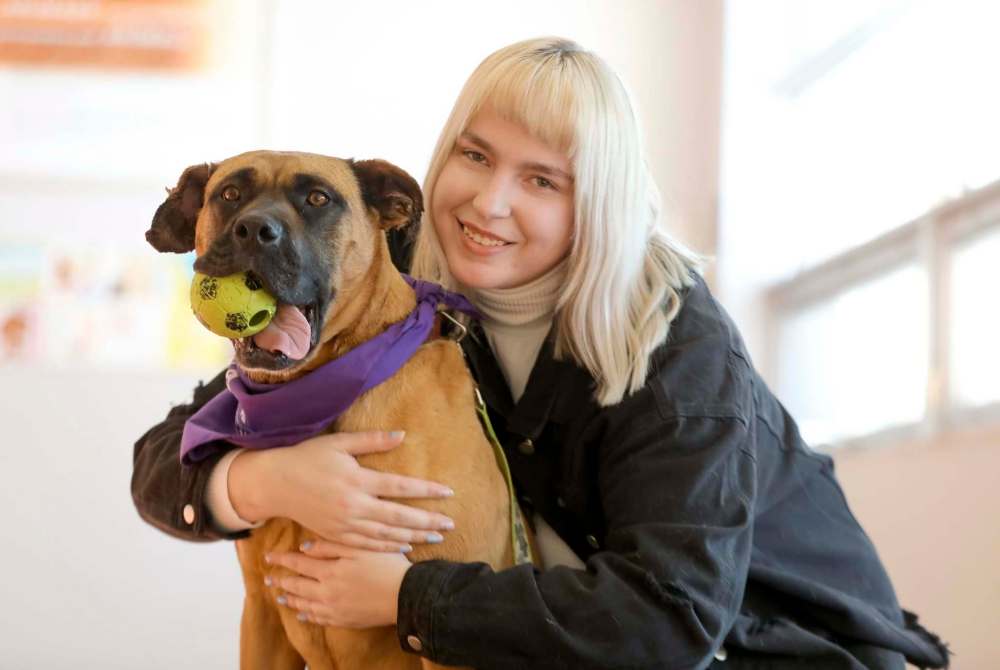
The furry friends of St. Boniface Hospital are sorely missed by patients and staff alike.
“A lot of people will ask when the dogs are coming back — because they hold a special place in the hearts of many people,” St. B volunteer services manager Jennifer Cawson says.
The Winnipeg hospital’s therapy dog pet visitation program has been on hold since March 2020, when all volunteer initiatives were paused amid the COVID-19 pandemic. Some have returned, including ambassador roles and gift shop employees — but bringing pups back in will have to wait.
“I think it goes back to, I’m going to quote (Manitoba chief provincial public health officer Dr. Brent) Roussin here, the fundamentals,” Cawson said. “If you can imagine, it would not be safe in a good infection-control practice to have a dog going from room to room.”
Typically, six teams of pets — which have to abide by strict grooming and dietary requirements to be considered as volunteers — would take shifts throughout the week, setting up at various areas around the hospital, including palliative care, the mental health ward and atrium.
They play an important role, Cawson said, and visitors often build bonds with the pets. Last year, the death of well-loved therapy dog Rusty made headlines.
Staff and patients most miss “the connection and comfort that a dog can bring.”
“A lot of the time, people, patients, were comfortable talking to the dogs, dogs are not judgmental. And they would also speak to, ‘I have a dog at home, I miss my dog so much, this reminds me so much of my dog, this is so nice,’” Cawson said. “So I think that’s the biggest thing that patients would miss the most, just having that connection and sense of familiarity.”
Meanwhile, the Winnipeg Humane Society found itself having similar conversations on how to approach its pet therapy and pet empathy programming.
Without the restrictions afforded to a hospital in the depths of a pandemic, however, those conversations were entirely different.
“Our pet empathy and pet therapy programs are probably our most booked out of any of our curriculum-linked (programs),” Humane Society director of education Cat Ross said.
“So when it came to the overall discussions of should we shut it down or should we continue on, it wasn’t even really a discussion. It was: ‘How do we work around this?’ Because the actual need in the community, if anything, has only increased.”
The challenge came from the group settings both the pet empathy and therapy programs utilize. The pet therapy program sends Humane Society educators and trained dogs to personal care homes, schools, even businesses — and the pandemic has made it nearly impossible to continue those trips.
Ross said some schools and personal care homes are still booking visits, but the work to keep people socially-distanced when a dog comes in looking for pets isn’t easy.

The pet empathy program is session-based and focuses on a facilitator and dog working with a group through tough topics such as self-care, conflict, grief and loss. These have gone virtual for the time being, where a dialogue can take place and ends with a video-chat “show and tell” with the animals.
“It kind of allows a third party to come in and just say, ‘Hey, we’re thinking about you, and here’s some things we can talk about, or here’s some time with this amazing animal,’ that’s going to alleviate some of the stress of your day,” she said.
The Humane Society plans to ramp up its outreach when restrictions are loosened further in hopes of letting people in need know their services are available.
malak.abas@freepress.mb.ca
Twitter: malakabas_
Malak Abas is a city reporter at the Free Press. Born and raised in Winnipeg’s North End, she led the campus paper at the University of Manitoba before joining the Free Press in 2020. Read more about Malak.
Every piece of reporting Malak produces is reviewed by an editing team before it is posted online or published in print — part of the Free Press‘s tradition, since 1872, of producing reliable independent journalism. Read more about Free Press’s history and mandate, and learn how our newsroom operates.
Our newsroom depends on a growing audience of readers to power our journalism. If you are not a paid reader, please consider becoming a subscriber.
Our newsroom depends on its audience of readers to power our journalism. Thank you for your support.
Malak Abas is a city reporter at the Free Press. Born and raised in Winnipeg’s North End, she led the campus paper at the University of Manitoba before joining the Free Press in 2020. Read more about Malak.
Every piece of reporting Malak produces is reviewed by an editing team before it is posted online or published in print — part of the Free Press‘s tradition, since 1872, of producing reliable independent journalism. Read more about Free Press’s history and mandate, and learn how our newsroom operates.
Our newsroom depends on a growing audience of readers to power our journalism. If you are not a paid reader, please consider becoming a subscriber.
Our newsroom depends on its audience of readers to power our journalism. Thank you for your support.
Advertisement Advertise With Us
Advertisement Advertise With Us
History
Updated on Monday, February 22, 2021 9:56 AM CST: Adds web headline