

Military support set to arrive in Pimicikamak

Advertisement
Read this article for free:
or
Already have an account? Log in here »
To continue reading, please subscribe:
Monthly Digital Subscription
$1 per week for 24 weeks*
- Enjoy unlimited reading on winnipegfreepress.com
- Read the E-Edition, our digital replica newspaper
- Access News Break, our award-winning app
- Play interactive puzzles
*Billed as $4.00 plus GST every four weeks. After 24 weeks, price increases to the regular rate of $19.95 plus GST every four weeks. Offer available to new and qualified returning subscribers only. Cancel any time.
Monthly Digital Subscription
$4.99/week*
- Enjoy unlimited reading on winnipegfreepress.com
- Read the E-Edition, our digital replica newspaper
- Access News Break, our award-winning app
- Play interactive puzzles
*Billed as $19.95 plus GST every four weeks. Cancel any time.
To continue reading, please subscribe:
Add Free Press access to your Brandon Sun subscription for only an additional
$1 for the first 4 weeks*
*Your next subscription payment will increase by $1.00 and you will be charged $16.99 plus GST for four weeks. After four weeks, your payment will increase to $23.99 plus GST every four weeks.
Read unlimited articles for free today:
or
Already have an account? Log in here »
Hey there, time traveller!
This article was published 23/02/2021 (1849 days ago), so information in it may no longer be current.
MORE than 20 Canadian military personnel are en route to a northern Manitoba First Nation to help a “fatigued — mentally, emotionally and physically” community COVID-response team.
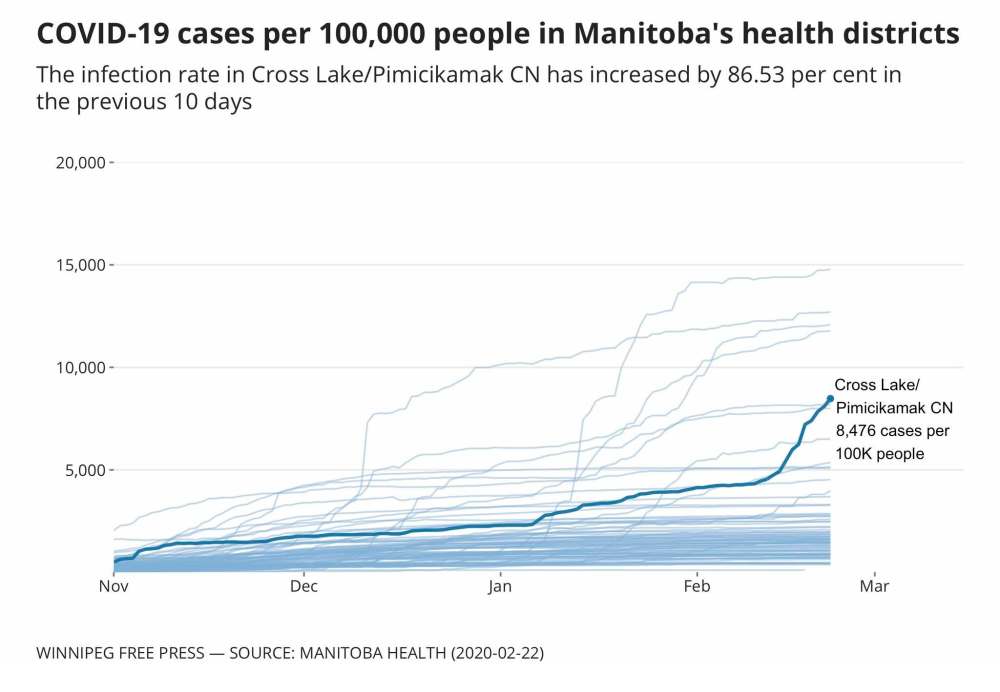
Pimicikamak Chief David Monias said military members are expected to arrive by this morning, to provide “human resources” support as the First Nation of about 8,100 deals with a spike in cases of the coronavirus.
“It’s not that we’re unable to do it on our own, it’s that we’re fatigued,” Monias said Monday, a day after his community logged the majority of new COVID-19 cases in northern Manitoba.
“They’re here to assist us and make sure that they give us the manpower to be able to do the things that we need, such as checking on contacts of COVID patients, helping us out with checking on people that are in isolation.”
Of the 25 cases detected in the Northern Health region Sunday, 16 were Pimicikamak residents, according to a bulletin issued by the band council.
So far, 258 residents have been infected, and people gathering at events such as birthday parties, wakes and funerals have been responsible for much of the spread, Monias said.
About 40 people are part of the community’s pandemic response team, which has been announcing radio updates and posting daily online bulletins. The level of detail provided is more specific than the case count data released by the provincial or federal governments.
Monias said he wants transparency, so as many people as possible follow the lockdown and self-isolation rules, which are complicated by overcrowding and a serious lack of housing on the reserve located more than 500 kilometres north of Winnipeg.
“Without compliance, we are dead in the water with this COVID. We are not going to be able to beat it. But with everybody’s effort and co-operation, we can fight it and we can beat it,” he said.
The goal, he said, is for people “to take ownership for the solutions, not just the problem, that’s what we want, and that’s why we share this information. At the same time, we want to document everything that we do.”
Northern communities dealing with outbreaks may be able to take a lesson from Lynn Lake.

The town of less than 500 people, located some 320 km (by road) northwest of Thompson, hasn’t had any new COVID-19 cases for more than two weeks, after seeing its infection rate surge in mid-January. Almost half all of residents contracted the virus.
Chief administrative officer Tom Matus said the strict 8 p.m. curfew the town imposed appears to have worked, and restrictions have since been lifted.
“You have to follow the restrictions, that’s all there is to it. If you want to get out of it, don’t congregate, wear your masks, just do what they tell you to do and you’ll get out of it. I believe that’s what we did and we’re out of it,” he said Monday. “We still need to be vigilant because of those other strains that are apparently much more contagious.”
katie.may@freepress.mb.ca
Twitter: @thatkatiemay
Katie May is a multimedia producer for the Free Press.
Our newsroom depends on a growing audience of readers to power our journalism. If you are not a paid reader, please consider becoming a subscriber.
Our newsroom depends on its audience of readers to power our journalism. Thank you for your support.
Katie May is a multimedia producer for the Free Press.
Our newsroom depends on a growing audience of readers to power our journalism. If you are not a paid reader, please consider becoming a subscriber.
Our newsroom depends on its audience of readers to power our journalism. Thank you for your support.
Advertisement Advertise With Us
Advertisement Advertise With Us