

Mobile-only app has costly price: health advocates
COVID-19 tracking app leaves out those without cellphone

Advertisement
Read this article for free:
or
Already have an account? Log in here »
To continue reading, please subscribe:
Monthly Digital Subscription
$1 per week for 24 weeks*
- Enjoy unlimited reading on winnipegfreepress.com
- Read the E-Edition, our digital replica newspaper
- Access News Break, our award-winning app
- Play interactive puzzles
*Billed as $4.00 plus GST every four weeks. After 24 weeks, price increases to the regular rate of $19.95 plus GST every four weeks. Offer available to new and qualified returning subscribers only. Cancel any time.
Monthly Digital Subscription
$4.99/week*
- Enjoy unlimited reading on winnipegfreepress.com
- Read the E-Edition, our digital replica newspaper
- Access News Break, our award-winning app
- Play interactive puzzles
*Billed as $19.95 plus GST every four weeks. Cancel any time.
To continue reading, please subscribe:
Add Free Press access to your Brandon Sun subscription for only an additional
$1 for the first 4 weeks*
*Your next subscription payment will increase by $1.00 and you will be charged $16.99 plus GST for four weeks. After four weeks, your payment will increase to $23.99 plus GST every four weeks.
Read unlimited articles for free today:
or
Already have an account? Log in here »
Hey there, time traveller!
This article was published 23/06/2020 (2112 days ago), so information in it may no longer be current.
It may be free but the mobile app the federal government announced last week to notify Canadians they’ve been exposed to COVID-19 may not be available to all Manitobans, anti-poverty and First Nations advocates say.
“Many low-income people survive without a cellphone or if they have a phone, it’s pay as you go, not a smartphone,” said Molly McCracken, Manitoba director of the Canadian Centre for Policy Alternatives.
The COVID Shield app uses Bluetooth software to create and share an anonymous identification code from a user’s phone to any phone that also has the app and comes into close proximity for an extended period of time. Phone logs will use anonymized codes, and the app is most effective when as many people as possible have it, Prime Minister Justin Trudeau said June 18.
Human rights watchdogs have questioned whether the app violates privacy.
Its makers — Canadian Digital Service, Ontario Digital Service, Blackberry Ltd., and volunteers from Shopify Inc. — as well as Canada’s privacy commissioner, say the app is voluntary and will not share or store personal information, including a user’s location.
Ontario is testing the app, and it is to be available to all Canadians to download for free in the coming weeks.
Others question its use as an app that leaves out those living in poverty.
“We have concerns about people who are highly marginalized in our society and have been left out of a number of COVID responses,” said Leila Sarangi, national co-ordinator of Campaign 2000 to end poverty in Canada.
“Not everybody has a cellphone,” said Toronto-based Sarangi, whose organization is calling for minimum basic income in Canada. Not everyone can access data plans or broadband service for affordability and accessibility reasons, she said.
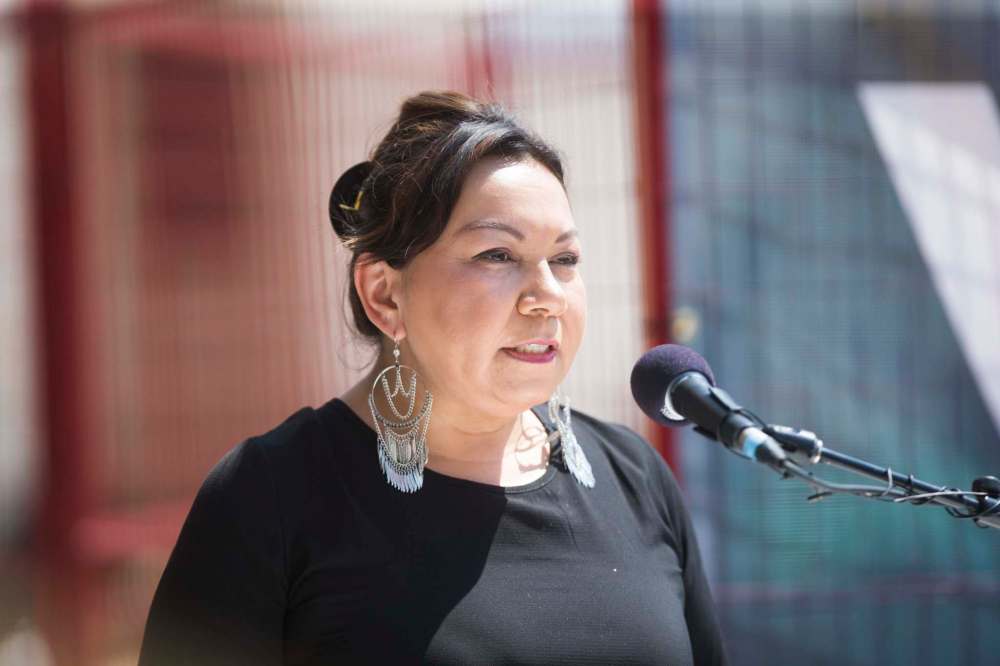
In Manitoba, that’s a reality, said Sheila North, former grand chief of Manitoba Keewatinowi Okimakanak and a member of Bunibonibee Cree Nation.
“Once again, people from northern and remote First Nations could be left out of the process, simply by not having the same access as other Canadians in tracking or being notified about the latest on COVID-19, making them even more vulnerable, and potentially harmed further, at no fault of their own,” North said Monday.
“That’s simply not fair and potentially very harmful.”
Infrastructure on First Nations and access for all Indigenous people has to be a top priority, she said. “This pandemic has shown the importance of that.”
Groups such as Make Poverty History Manitoba have for years called on the province to fund phones for those on assistance, said McCracken. At $800 per month for a single adult or $1,033 for a person with a disability, people do not have resources for a cellphone, she said.

“It is a huge barrier for low-income people who face many barriers already,” she said.
“Very little has been done to help those on social assistance get access to information necessary during COVID.”
Providing cellphones and more support such as rent relief, income for healthy food and for cleaning supplies now could save lives and the public health system money down the road, McCracken said.
“A second wave is very possible.”
carol.sanders@freepress.mb.ca
Carol Sanders
Legislature reporter
Carol Sanders is a reporter at the Free Press legislature bureau. The former general assignment reporter and copy editor joined the paper in 1997. Read more about Carol.
Every piece of reporting Carol produces is reviewed by an editing team before it is posted online or published in print — part of the Free Press‘s tradition, since 1872, of producing reliable independent journalism. Read more about Free Press’s history and mandate, and learn how our newsroom operates.
Our newsroom depends on a growing audience of readers to power our journalism. If you are not a paid reader, please consider becoming a subscriber.
Our newsroom depends on its audience of readers to power our journalism. Thank you for your support.
Carol Sanders
Legislature reporter
Carol Sanders is a reporter at the Free Press legislature bureau. The former general assignment reporter and copy editor joined the paper in 1997. Read more about Carol.
Every piece of reporting Carol produces is reviewed by an editing team before it is posted online or published in print — part of the Free Press‘s tradition, since 1872, of producing reliable independent journalism. Read more about Free Press’s history and mandate, and learn how our newsroom operates.
Our newsroom depends on a growing audience of readers to power our journalism. If you are not a paid reader, please consider becoming a subscriber.
Our newsroom depends on its audience of readers to power our journalism. Thank you for your support.
Advertisement Advertise With Us
Advertisement Advertise With Us