

No place to hide
Public-health demands for isolation meaningless to city's homeless population; outreach workers urgently search for vulnerable people before deadly virus finds them
Advertisement
Read this article for free:
or
Already have an account? Log in here »
To continue reading, please subscribe:
Monthly Digital Subscription
$1 per week for 24 weeks*
- Enjoy unlimited reading on winnipegfreepress.com
- Read the E-Edition, our digital replica newspaper
- Access News Break, our award-winning app
- Play interactive puzzles
*Billed as $4.00 plus GST every four weeks. After 24 weeks, price increases to the regular rate of $19.95 plus GST every four weeks. Offer available to new and qualified returning subscribers only. Cancel any time.
Monthly Digital Subscription
$4.99/week*
- Enjoy unlimited reading on winnipegfreepress.com
- Read the E-Edition, our digital replica newspaper
- Access News Break, our award-winning app
- Play interactive puzzles
*Billed as $19.95 plus GST every four weeks. Cancel any time.
To continue reading, please subscribe:
Add Free Press access to your Brandon Sun subscription for only an additional
$1 for the first 4 weeks*
*Your next subscription payment will increase by $1.00 and you will be charged $16.99 plus GST for four weeks. After four weeks, your payment will increase to $23.99 plus GST every four weeks.
Read unlimited articles for free today:
or
Already have an account? Log in here »
Hey there, time traveller!
This article was published 11/04/2020 (2205 days ago), so information in it may no longer be current.
It’s 6:04 a.m. Thursday and — pandemic be damned — Robert Lidstone is out searching for people in need.
The moon, glowing and nearly full, hangs in the sky as the van manoeuvres through old St. Boniface, its tires rolling over dirty, slush-filled streets as disconcerting radio reports on the novel coronavirus play over the stereo.
Light is peeking through the early morning darkness as the van pulls up to a bus shelter across the street from St. Boniface Hospital, where four people spent the night sleeping inside the small, confined space.
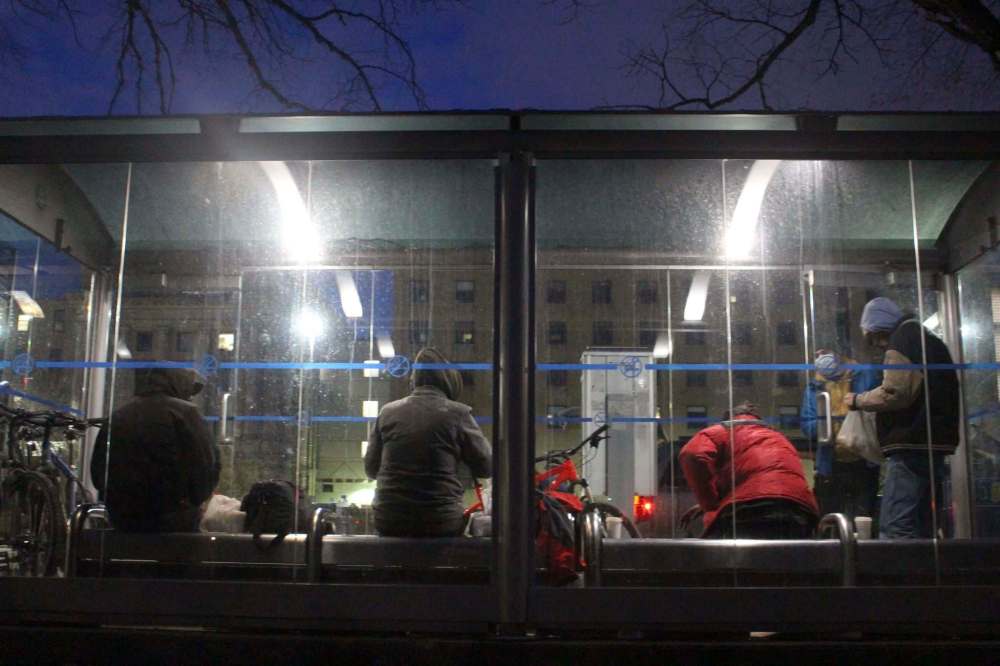
“This triggers memories for me of sleeping in these bus shacks myself,” says Lidstone, 38, a member of the St. Boniface Street Links outreach team.
Up to three times a day, every day, Lidstone — alongside Derek Henderson, 33, and Mario Chaput, 57 — pile into the van and go out in search of people sleeping outside.
They try to connect the homeless with social services, help them get indoors and off drugs, and — these days — inform them about the COVID-19 global pandemic and what they can do to try to keep safe.
“I have vivid memories of it being mid-winter and staying in bus shelters. I remember sleeping in a stairwell at the U of W. I was sleeping around here and using for days at a time,” Lidstone says.
“All three of us have our own experiences with homelessness and addiction.”
But the risk associated with living on the streets of Winnipeg isn’t the same as when Lidstone, Henderson and Chaput were homeless. The danger has ratcheted up as community spread of the virus has begun.
It’s scenes such as this one in the bus shelter across Tache Avenue from the hospital — multiple people crammed into a small space — that have Lidstone and other front-line social service workers worried.
If one of them has the virus, after a night in tight quarters, it’s possible all of them do.
“There’s a range in this community. It ranges from denial — we had one person tell us it was all a conspiracy and the media and government are trying to control us — and we’ve had other people say they’re terrified of infection,” Lidstone says.
“This triggers memories for me of sleeping in these bus shacks myself.” – Robert Lidstone
“I think we’ll see the isolation units fill up. I think, because of the level of unmet need in this population, we will see it spread pretty widely over the course of the next few months.”
A handful of years ago, Lidstone was enrolled in a PhD program at York University in Toronto, writing a dissertation on refugee claims by LGBT people in Canada. But he had a secret: he was addicted to methamphetamine.
Eventually, his addiction deepened, he dropped out school and moved back to Winnipeg, his hometown. Soon, he was living on the streets.
Chaput was a microbiologist and high school teacher who, at the age of 51, got addicted to meth and lost everything. His story is unusual, having come to the drug late in life at the tail end of a successful career.
“I know,” Chaput says, with a shrug of the shoulders. “It makes no sense to me, either.”
Henderson spent five years on Winnipeg’s streets addicted to drugs. He says he’d often cook a mixture of meth and opiates and inject it into his veins.
When tragedy struck in his life, he decided it was time to get clean.
“I had given up on myself. I didn’t care if I lived or died. Not too long ago, my ex, my kids’ mom — I was with her for eight years — she killed herself because of her addiction. She hung herself,” Henderson says as the van creeps down a back alley.
“My kids don’t have their mom no more, they needed me, so I’m here doing my best.”
“I had given up on myself. I didn’t care if I lived or died. Not too long ago, my ex, my kids’ mom– I was with her for eight years — she killed herself because of her addiction. She hung herself.” – Derek Henderson
The three occupants in the van got help through Morberg House, a 12-bed residential treatment program for men overcoming homelessness, drug addiction and mental illness. The program is run by St. Boniface Street Links, a scrappy, unfunded charity led by executive director Marion Willis.
And now that they’ve sobered up, they’re trying to give back as part of the agency’s outreach team, helping others going through the same situation they did.
With Chaput behind the wheel, the men follow their normal circuit, driving past bus shelters, down back alleys and along the river in search of the most marginalized and at-risk in their community. Whenever they find someone, they stop, put on masks and gloves and help however they can.
On a side street near the Provencher Bridge, Chaput puts the van in park, and Lidstone and Henderson get out to check on an encampment hidden underneath the span. As they walk, the Canadian Museum for Human Rights looms large across the river.
“We’re constantly looking at the human rights museum and it’s a contrast to how some people are living over here,” Lidstone says.
Standing at the foot of the bridge, Henderson yells out the name of one of the men known to live under it.
There is no response.
He shouts the name once more.
“I think we’ll see the isolation units fill up. I think, because of the level of unmet need in this population, we will see it spread pretty widely over the course of the next few months.” – Robert Lidstone
Again, no one answers.
“I’m going to go check if he’s alive,” Henderson says. “I want to make sure he’s not frozen.”
Willis says many people don’t realize the depth of the need in St. Boniface, or the extent to which homelessness is a problem in the community.
She also says government funding for social-service agencies is concentrated around Main Street — the epicentre of homelessness in the city — and none of that money flows across the river.
“The homeless population is very diverse, and it’s spread out along a very large area, around riverbanks, parks, open spaces, stairwells, bank ATM vestibules. It’s a very expansive and difficult area to cover,” Willis says.
“We’re one organization, and we’re unfunded, and so we do the best we can with what we have.”
After checking on the camp under the bridge, the men continue their route, handing out care packages of bottled water and sandwiches, granola bars and pasta salad.
They also give out clean syringes upon request. Lidstone says they’ve heard that an increasing number of addicts in St. Boniface are shooting up with dirty needles.
Whenever they can, they talk to people about the pandemic and discuss common symptoms and the necessity of social distancing.
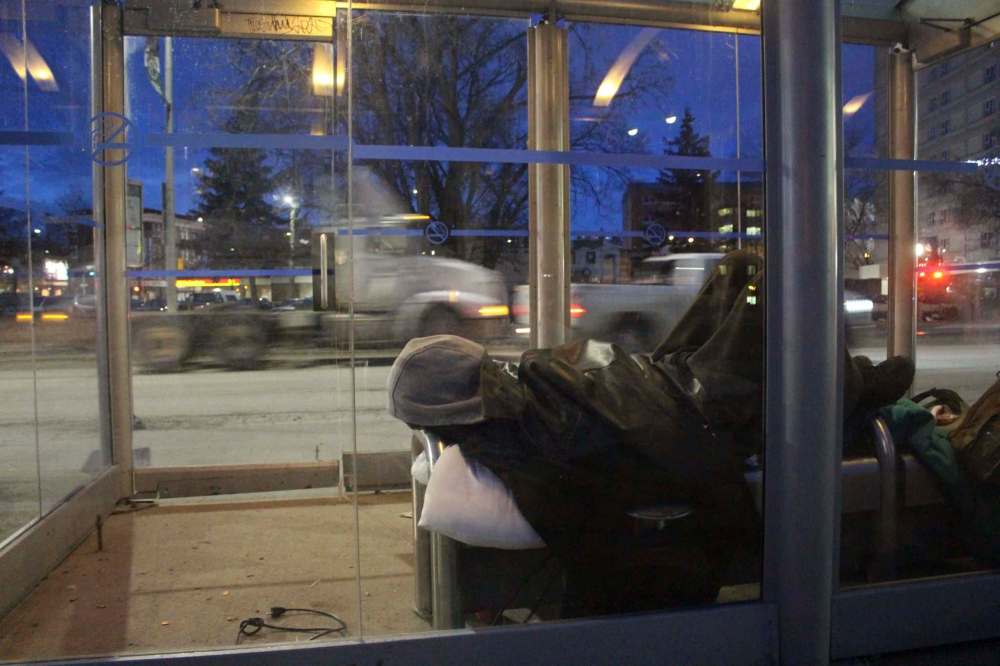
Towards the end of their shift, they find a man sleeping on a bench. He is sitting upright, his uncovered head hanging slack, his chin resting on his chest.
Henderson wakes him and asks if he’s alright. He returns to the van and gets a cup of hot coffee to give him. The man’s hands shake as he raises the cup to his lips.
“We’ve also got sandwiches,” Lidstone says.
“Marry me,” the man mumbles.
Snow is falling and the wind blows stiff.
“I’ve been walking for days,” the man says. “My feet are frozen… It’s tearing at the skin. It’s absolutely burning.”
Lidstone asks if he can manage to walk to the nearby hospital and the man says no. Then he calls 911, identifying himself as a member of Street Links, and says they need an ambulance dispatched to the scene.
As they wait, Lidstone, Henderson and the man talk in the cold.
“I’ve been in your shoes,” Lidstone says. “I know how terrible it is.”
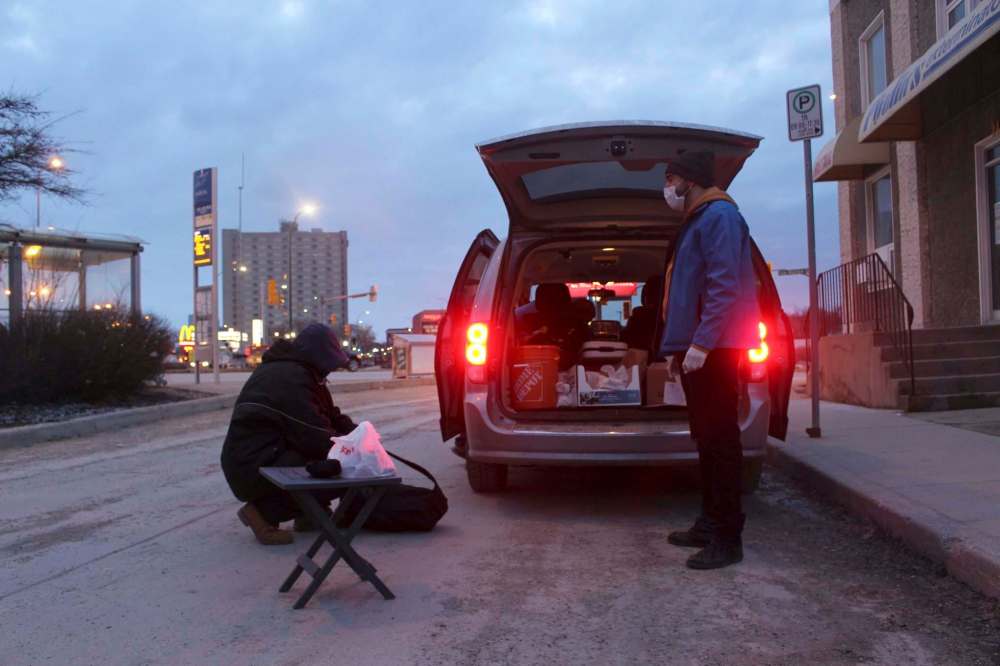

A few minutes later, an ambulance arrives, and two paramedics, both wearing face masks, help the man into the vehicle before driving off.
Wrapping up their shift, the trio get back in the van and head home for a video conference call with the rest of the Street Links team. After that, they’ll take a short break, before loading up once more and heading back into the streets.
And when they’re finished, they’ll do it again.
ryan.thorpe@freepress.mb.ca
Twitter: @rk_thorpe
Related Articles
Political leaders mark Easter amid COVID-19
Advertisement Advertise With Us
Advertisement Advertise With Us