

Outdoor masks may be staring us in the face
Manitoba explores idea after experience elsewhere

Advertisement
Read this article for free:
or
Already have an account? Log in here »
To continue reading, please subscribe:
Monthly Digital Subscription
$1 per week for 24 weeks*
- Enjoy unlimited reading on winnipegfreepress.com
- Read the E-Edition, our digital replica newspaper
- Access News Break, our award-winning app
- Play interactive puzzles
*Billed as $4.00 plus GST every four weeks. After 24 weeks, price increases to the regular rate of $19.95 plus GST every four weeks. Offer available to new and qualified returning subscribers only. Cancel any time.
Monthly Digital Subscription
$4.99/week*
- Enjoy unlimited reading on winnipegfreepress.com
- Read the E-Edition, our digital replica newspaper
- Access News Break, our award-winning app
- Play interactive puzzles
*Billed as $19.95 plus GST every four weeks. Cancel any time.
To continue reading, please subscribe:
Add Free Press access to your Brandon Sun subscription for only an additional
$1 for the first 4 weeks*
*Your next subscription payment will increase by $1.00 and you will be charged $16.99 plus GST for four weeks. After four weeks, your payment will increase to $23.99 plus GST every four weeks.
Read unlimited articles for free today:
or
Already have an account? Log in here »
Hey there, time traveller!
This article was published 14/04/2021 (1802 days ago), so information in it may no longer be current.
Manitoba’s top doctor, Brent Roussin, has hinted masks could soon become mandatory in outdoor settings as the third wave takes off, taking a page from the playbook of other cities and regions.
Quebec’s outdoor mask mandate, introduced last week, was tightened Tuesday to apply to any outdoor activity involving two or more people who don’t live in the same household.
In Alberta, officials warned last month they’d seen evidence of COVID-19 spreading between people who went for a long walk together without wearing masks, likely because of more highly contagious strains. Some U.S. states have ordered masks be worn outdoors as well as in indoor public places, and a similar law was recently imposed in Spain.
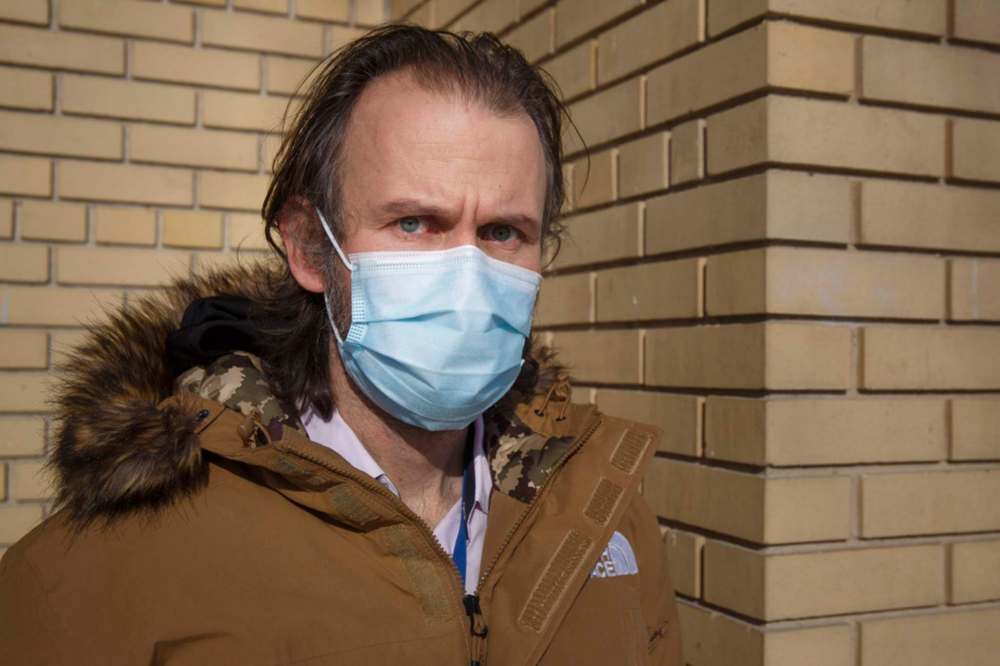
Experts agree wearing a mask is a good idea when people are in close contact, even if they’re outside, where the risk of spreading the virus is much lower than indoors. Local public-health messages have always said to wear a mask, especially if you can’t stay at least two metres apart from another person, but there hasn’t been a provincewide requirement to wear masks outdoors.
Winnipeg medical microbiologist Dr. Philippe Lagacé-Wiens said mandatory masks would likely be beneficial in the context of outdoor gatherings where people have a tendency to get closer.
“If you’re actually hosting a gathering, whether that’s a picnic, or a wedding or an event (of any kind) that’s outdoors with a whole bunch of other people, it’s essentially impossible to anticipate that everybody will always be two metres or three metres apart,” he said.
It’s clear proper mask use reduces transmission of the virus, but it’s harder to find data that show how much outdoor transmission rates decrease when masks are worn, as well as how that’s affected by the more infectious variants. That means imposing any new restrictions must come with a clear explanation, Lagacé-Wiens said.
“You’re trying to find a sweet spot where you can get compliance along with risk reduction,” he said.
“That’s sort of been the case all along with these recommendations. I think there’s understandably a frustration with these changing recommendations, but in reality, what we see is just new information, new data coming out constantly that requires us to adapt to it.”
Manitoba hasn’t released any information about cases that have been traced to outdoor transmission. In the summer, before the second wave hit the province but while the Prairie Mountain region was dealing with a surge in cases, Brandon became one of the first cities to impose an indoor/outdoor mask mandate. It was lifted about a month later as cases declined.
There’s a concern imposing blanket restrictions now could cause more harm than good, especially when it comes to limiting relatively low-risk activities. Socializing outdoors is a much lower risk than indoors, so it might not make sense to spend a lot of time or money enforcing outdoor mask rules, said Ilan Schwartz, assistant professor in the infectious diseases division at the University of Alberta.
He said masks make sense in “high-density” situations, such as concerts, or in cases where people are walking close together for more than a few minutes.

“If they’re going to be that way for a prolonged period of time, more than just passing by somebody on the sidewalk, but actually walking alongside them for some distance, I think that that might be worthwhile. I think that there does need to be a little bit of nuance to the application (of increased restrictions), and I think that blanket rules, when most circumstances are of low and negligible risk are, in general, unhelpful,” he said.
Imposing more rules, even in lower risk situations, could have the opposite effect if people stop following fundamental orders, he said, noting indoor gatherings still drive most of the virus’s spread.
“I think that public-health officials have already exhausted the low-hanging fruit and the interventions that are going to have the highest yield. And yet we’re still left with high rates of cases, and so it’s tempting just to add on more rules, which doesn’t, I think, address the fact that some people aren’t abiding by the more critical restrictions,” he added.
“If there was an easy solution, then I think we wouldn’t be in the situation that we’re in right now.”
katie.may@freepress.mb.ca
Katie May is a multimedia producer for the Free Press.
Our newsroom depends on a growing audience of readers to power our journalism. If you are not a paid reader, please consider becoming a subscriber.
Our newsroom depends on its audience of readers to power our journalism. Thank you for your support.
Katie May is a multimedia producer for the Free Press.
Our newsroom depends on a growing audience of readers to power our journalism. If you are not a paid reader, please consider becoming a subscriber.
Our newsroom depends on its audience of readers to power our journalism. Thank you for your support.
Advertisement Advertise With Us
Advertisement Advertise With Us