Regional approach to COVID-19 beginning as feds roll out new measures

Advertisement

Advertise with us

Regional disparities in Canada's COVID-19 crisis emerged with growing clarity on Friday, as some provinces celebrated relative success while the federal government rolled out new measures to help others still grappling with the pandemic.

Read this article for free:


or

Already have an account? Log in here »

To continue reading, please subscribe:

Subscribe and receive a limited-edition Free Press branded hat or tote.

Digital Subscription

One year of digital access for only $205*

  • Enjoy unlimited reading on winnipegfreepress.com
  • Read the E-Edition, our digital replica newspaper
  • Access News Break, our award-winning app
  • Play interactive puzzles

*First annual payment billed as $205.00 + GST for one year. This annual subscription will automatically renew at $233.00 + GST every 52 weeks (10% off the regular annual price of $259.35). Offer available to new and qualified returning subscribers only. Cancel any time.

To continue reading, please subscribe:

Add Free Press access to your Brandon Sun subscription for only an additional

$1 for the first 4 weeks*

  • Enjoy unlimited reading on winnipegfreepress.com
  • Read the E-Edition, our digital replica newspaper
  • Access News Break, our award-winning app
  • Play interactive puzzles
Start now

*Your next Brandon Sun subscription payment will increase by $1.00 and you will be charged $17.95 plus GST for four weeks. After four weeks, your payment will increase to $24.95 plus GST every four weeks.

Hey there, time traveller!
This article was published 17/04/2020 (2312 days ago), so information in it may no longer be current.

Regional disparities in Canada’s COVID-19 crisis emerged with growing clarity on Friday, as some provinces celebrated relative success while the federal government rolled out new measures to help others still grappling with the pandemic.

Government and medical officials said different parts of the country are experiencing the outbreak to varying degrees, with central provinces accounting for the bulk of new cases and other jurisdictions reporting flattened curves and limited outbreaks.

Prime Minister Justin Trudeau acknowledged the disparate circumstances on Friday as he unveiled new stimulus measures targeted at specific provinces, rather than the country as a whole.
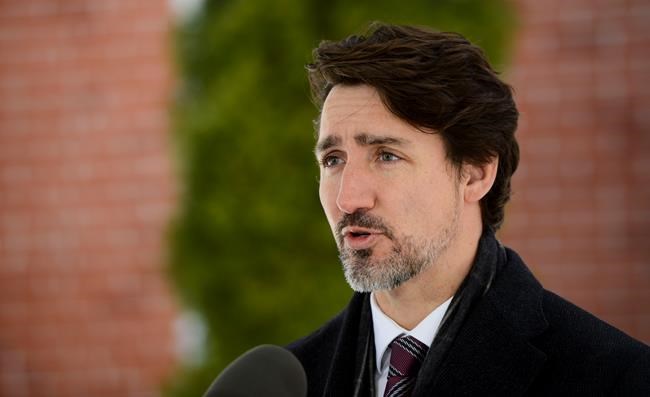
Prime Minister Justin Trudeau addresses Canadians on the COVID-19 pandemic from Rideau Cottage in Ottawa on Wednesday, April 15, 2020. THE CANADIAN PRESS/Sean Kilpatrick

“We will continue our co-ordination around principles and steps that need to be taken. But this is Canada, which means there are very different needs and very different approaches that will be in place across the country,” Trudeau said at his regular morning news conference.

The latest round of economic measures were specifically geared towards Newfoundland and Labrador and the country’s western provinces, including a $1.7 billion funding promise to clean up orphaned oil wells largely found in Alberta.

Despite the regional differences, the country’s top public health official cautioned against relaxing protective restrictions — even in regions where the pandemic seems to be under control.

Dr. Theresa Tam said the bulk of COVID-19 cases are concentrated in just two provinces, Ontario and Quebec, where new provincial numbers continue to show the most positive diagnoses. Comparatively, some provinces have reported no fresh cases for several days running and British Columbia has openly declared it has flattened its pandemic curve.

But Tam cautioned against letting the public guard down, saying physical distancing measures and economic shutdowns must stay in place to prevent the pandemic from flaring up in other areas.

“Some areas will experience the epidemic slowdown earlier than others. But no matter where we are in the country, we’ve got to remember that Canadians are highly susceptible to the virus. Unless we all remain diligent in maintaining our new habits of physical distancing and good hygiene, new outbreaks can be sparked anywhere at any time.”

The regional differences were also clear from the nature of government responses to the crisis.

Trudeau indicated members of the country’s Armed Forces would be on the ground in Quebec later Friday, particularly to help with an ongoing series of outbreaks at long-term care facilities.

Quebec reported 16,798 total COVID-19 cases in the province as of Friday, nearly 700 of which have been fatal.

In Ontario, meanwhile, the number of COVID-19 cases continued to climb, though at a consistently lower rate in recent days. The province reported its largest single-day increase on Friday, with 564 new cases and 55 new deaths.

Prince Edward Island, in contrast, reported no new cases, continuing a streak the province’s medical officer of health called encouraging. Manitoba and New Brunswick also said virus cases remained flat on Friday.

And in B.C., where provincial officials released fresh data on the impact of COVID-19, chief medical officer Dr. Bonnie Henry hailed the province’s success in coping with the outbreak relative to other jurisdictions.

“Our pandemic started earlier than other parts of Canada,” she said. “But … we have flattened that curve.”

Even in those provinces with more encouraging numbers, however, restrictions aimed at curbing the spread were expected to remain in place for some time.

And in harder-hit regions such as Ontario, a return to the pre-pandemic norm is still a distant prospect.

“The number 1 priority is health over everything,” said Premier Doug Ford. “I am zoned in on this economy … after we get through this and we get the green light.”

Regional variations are evident across Canada’s business community, Trudeau acknowledged as he announced yet another financial assistance effort initiatives.

The package targets the oil and gas sector, among others, with funding earmarked for cleaning up so-called orphaned oil wells.

The measures are unlikely to satisfy the country’s oil producers, who have been sounding alarms about the economic devastation in the sector in the lead-up to Friday’s announcement.

With western Canada’s heavy crude selling for under $5 a barrel this week — less than a tenth of the price it garnered a year ago — a letter to Canada’s natural resources minister from the Canadian Association of Petroleum Producers called for freezing the carbon tax and delaying new climate change regulations while the industry weathers the storm.

More than 31,000 Canadians have tested positive for COVID-19, which has killed more than 1,300 people across the country. About half of those killed have been residents of long-term care facilities.

This report by The Canadian Press was first published April 17, 2020.

Report Error Submit a Tip

More Stories

WRHA directs three care homes to accommodate surge of hospital patients

Malak Abas 5 minute read Preview

WRHA directs three care homes to accommodate surge of hospital patients

Malak Abas 5 minute read Friday, Aug. 14, 2026

The Winnipeg Regional Health Authority has directed three long-term care centres to make space for hospital patients, citing “exceptionally high demand for care across the health-care system.”

Read
Friday, Aug. 14, 2026

Big Loser’s latest a winning mix of country, folk

Ben Waldman 5 minute read Preview

Big Loser’s latest a winning mix of country, folk

Ben Waldman 5 minute read Yesterday at 6:00 AM CDT

The yellow trucker hat for sale on Facebook Marketplace said “Selkirk Lumber,” so Adam Wayne Brown knew he had to hammer home a deal.

Like the other millennial members of Winnipeg folk-country band Big Loser, the bassist has an affinity for the nostalgic, taking every opportunity — through music, through lyrics and through wardrobe — to recall the unique circumstances of growing up in a changing Interlake.

“I remember the matte yellow trucks driving around — the lumber trucks — and so I’ve had this strange memory of something disappearing from my youth and then persisting,” says Brown, who, like the band’s frontman Alex Paradoski, moved to Winnipeg more than a decade ago.

“I have a photo of the Lockport Bridge in my dining room,” chimes in Paradoski, whose first job as a teenager was bunning wieners and chopping fries at Skinner’s, a drive-in mainstay since 1929 along Highway 44.

Read
Yesterday at 6:00 AM CDT

A Life's Story: Woman fought for better outcomes for others amid cancer fight

Janine LeGal 7 minute read Preview

A Life's Story: Woman fought for better outcomes for others amid cancer fight

Janine LeGal 7 minute read Yesterday at 3:00 AM CDT

Catherine Mary Burke was strong and motivated in ways many of us could never imagine.

She was known for fighting the good fight, and she fought as hard as she could for as long as she could. But something set her apart. Even when it was too late for her, she insisted cancer survival rates had to be better for other women. And they are today because of her fierce determination.

Burke died on Nov. 29, 2025, at age 67 after courageously facing breast cancer for more than a decade.

“Cathy was born happy,” said her husband, Patrick Burke. “She was a glass-half-full person. What a gift this attitude was to me and the boys. She never once said ‘Why me?’ or complained. She was just so happy to be alive.

Read
Yesterday at 3:00 AM CDT

RCMP searching for missing 34-year-old woman

1 minute read Yesterday at 6:29 PM CDT

Police are asking for the public’s help locating a 34-year-old woman last heard from almost a week ago.

Tamara Stevens, who also goes by Tammy, was last heard from on Sunday last weekend and was reported missing Tuesday morning, said a Thompson RCMP news release Saturday.

RCMP and family are worried for her well-being.

Stevens is believed to be in Thompson and is described as 5'7, with a slender build and long red hair, said RCMP. She also has a piercing on her lip and was last seen wearing black T-Shirt featuring the Twilight character Jacob, pants and work boots.

Could renewed interest in strategically critical rare earth elements finally make sub-sector profitable?

Joel Schlesinger 6 minute read Preview

Could renewed interest in strategically critical rare earth elements finally make sub-sector profitable?

Joel Schlesinger 6 minute read Yesterday at 3:00 AM CDT

Rare earth elements are among the most critical of mined resources for modern economies.

They’re essential in manufacturing specialized magnets used in a host of technologies from wind turbines and electric vehicles to hard drives, smartphones, television screens, and fibre optics. Most notably, however, rare earth minerals are increasingly vital to the defence industry.

These 17 elements — closely related chemically and usually found all together in mineral deposits — have indeed been growing in geopolitical importance as the United States, Canada and other Western nations recognize their dependence on production from China.

It is the world’s largest producer and processor of rare earths, including the most in-demand elements neodymium and praseodymium used to manufacture very light and powerful magnets for an array of technologies, including the most advanced weapons of modern warfare.

Read
Yesterday at 3:00 AM CDT

Trailblazing Western Scrap Metals heavy-equipment operator relishes role at massive crane’s control

David Sanderson 7 minute read Preview

Trailblazing Western Scrap Metals heavy-equipment operator relishes role at massive crane’s control

David Sanderson 7 minute read Friday, Aug. 14, 2026

Less than five per cent of heavy-equipment operators in the country are women but that number is trending upward, according to a study conducted by trade magazine Crane & Hoist Canada.

It was reported that in Ontario roughly eight per cent of jobs in the transport and heavy-equipment field are currently held by women. Furthermore, in 2024 almost 20 per cent of graduates at an Edmonton-based heavy-equipment operator training school were female, the article stated.

That brings us to Harmony Guspodarchuk, the first female crane operator in the 70-year history of Western Scrap Metals, a family-owned business at 18 Sutherland Ave.

Three years ago, Guspodarchuk literally stepped into the driver’s seat of a 27,500-kilogram, Liebherr C 924 Heavy Lift Litronic crane. The 29-year-old hasn’t looked back much since.

Read
Friday, Aug. 14, 2026