

World Health Organization update no impact on Manitoba rules: Roussin

Advertisement
Read this article for free:
or
Already have an account? Log in here »
To continue reading, please subscribe:
Digital Subscription
One year of digital access for only $1.44 a week*
- Enjoy unlimited reading on winnipegfreepress.com
- Read the E-Edition, our digital replica newspaper
- Access News Break, our award-winning app
- Play interactive puzzles
*Billed as $5.77 plus GST every four weeks. After 52 weeks, price increases to the regular rate of $19.95 plus GST every four weeks. Offer available to new and qualified returning subscribers only. Cancel any time.
To continue reading, please subscribe:
Add Free Press access to your Brandon Sun subscription for only an additional
$1 for the first 4 weeks*
- Enjoy unlimited reading on winnipegfreepress.com
- Read the E-Edition, our digital replica newspaper
- Access News Break, our award-winning app
- Play interactive puzzles
*Your next Brandon Sun subscription payment will increase by $1.00 and you will be charged $17.95 plus GST for four weeks. After four weeks, your payment will increase to $24.95 plus GST every four weeks.
Read unlimited articles for free today:
or
Already have an account? Log in here »
Hey there, time traveller!
This article was published 04/05/2021 (2000 days ago), so information in it may no longer be current.
IN the wake of the World Health Organization acknowledging some risk of airborne transmission of COVID-19 in poorly ventilated or crowded indoor spaces, Manitoba’s top doctor emphasized the virus usually spreads via droplets.
The coronavirus can spread through the air in certain crowded, indoor settings and areas that aren’t well ventilated, the WHO stated in updated transmission guidelines April 30, because aerosols (tiny droplets carried through the air) can “remain suspended in the air or travel farther than one metre.”
The WHO still says the virus spreads mainly via droplets when people are in close contact with each other.
The organization, which is an agency of the United Nations, has previously been criticized for being slow to recognize the threat of airborne transmission of COVID-19. The Public Health Agency of Canada acknowledged the risk of airborne transmission in the fall.
Infectious diseases that are considered airborne — such as tuberculosis, chicken pox and measles — typically are transmitted in viral or bacterial particles that stay in the air a lot longer and can travel greater distances.
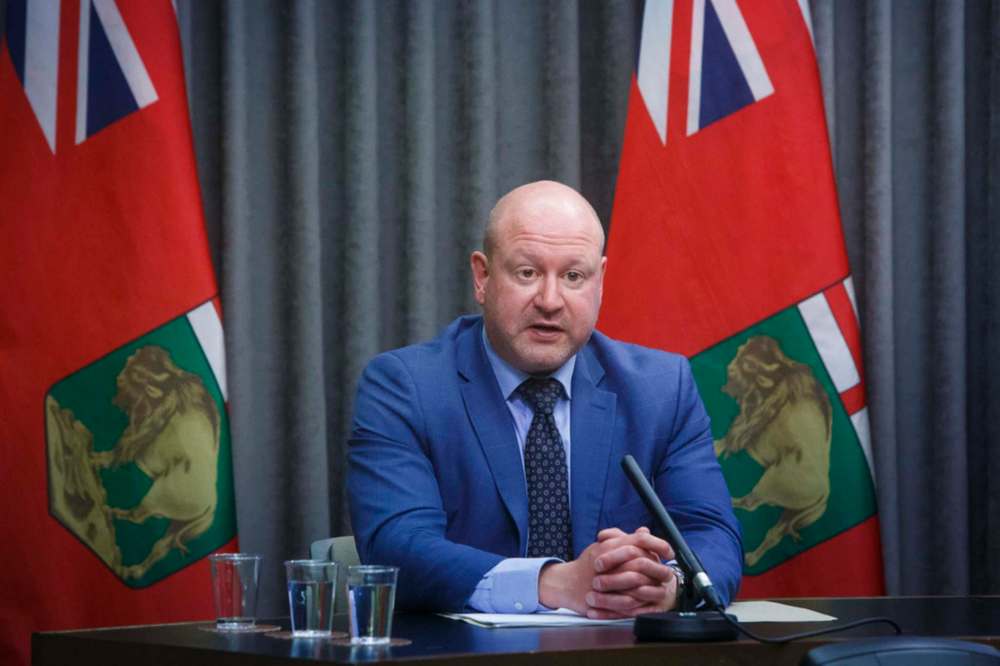
There is some evidence the COVID-19 virus can travel more than two metres, but in the majority of cases, a two-metre guideline for physical distancing, as well as mask-wearing and handwashing, is effective at stopping the spread, chief provincial public health officer Dr. Brent Roussin said Monday.
He was asked during a news conference how the updated WHO guidelines affect Manitoba schools and other spaces where people are gathered indoors.
Roussin said he still recommends appropriate ventilation and opening windows when the weather permits, along with the existing advice to stay home, limit contacts, wear masks and stay at least two metres apart from others. But for the most part, the virus still spreads via droplets, he said.

“The issue here is that transmission of virus, just like really anything in medicine, is not binary,” said Roussin.
“There is a bit of that grey area. Certainly, COVID is predominantly spread by droplet. That’s by far the transmission mechanism that this virus is spread by. In certain circumstances, there’s been reports of transmission wider than that two-metre distance,” Roussin said.
“We wouldn’t classify it necessarily as airborne.”
katie.may@freepress.mb.ca
Twitter: @thatkatiemay
Katie May is a multimedia producer for the Free Press.
Our newsroom depends on a growing audience of readers to power our journalism. If you are not a paid reader, please consider becoming a subscriber.
Our newsroom depends on its audience of readers to power our journalism. Thank you for your support.
Katie May is a multimedia producer for the Free Press.
Our newsroom depends on a growing audience of readers to power our journalism. If you are not a paid reader, please consider becoming a subscriber.
Our newsroom depends on its audience of readers to power our journalism. Thank you for your support.
Advertisement Advertise With Us
Advertisement Advertise With Us