

Worries remain about COVID shots
Vaccine mistrust higher among Manitoba evangelicals, survey shows
Advertisement
Read this article for free:
or
Already have an account? Log in here »
To continue reading, please subscribe:
Monthly Digital Subscription
$1 per week for 24 weeks*
- Enjoy unlimited reading on winnipegfreepress.com
- Read the E-Edition, our digital replica newspaper
- Access News Break, our award-winning app
- Play interactive puzzles
*Billed as $4.00 plus GST every four weeks. After 24 weeks, price increases to the regular rate of $19.95 plus GST every four weeks. Offer available to new and qualified returning subscribers only. Cancel any time.
Monthly Digital Subscription
$4.99/week*
- Enjoy unlimited reading on winnipegfreepress.com
- Read the E-Edition, our digital replica newspaper
- Access News Break, our award-winning app
- Play interactive puzzles
*Billed as $19.95 plus GST every four weeks. Cancel any time.
To continue reading, please subscribe:
Add Free Press access to your Brandon Sun subscription for only an additional
$1 for the first 4 weeks*
*Your next subscription payment will increase by $1.00 and you will be charged $16.99 plus GST for four weeks. After four weeks, your payment will increase to $23.99 plus GST every four weeks.
Read unlimited articles for free today:
or
Already have an account? Log in here »
Hey there, time traveller!
This article was published 15/11/2021 (1578 days ago), so information in it may no longer be current.
Manitoba children could qualify for COVID-19 vaccines within weeks, but evangelical parents might not let their kids roll up their sleeves.
In a recent Probe Research survey shared with the Free Press, two-thirds of evangelical Manitobans said they “worry about the long-term effects of COVID-19 vaccinations in children,” compared with 41 per cent of overall respondents.
In addition, 49 per cent of those identifying as evangelical said COVID-19 as an issue was “overblown,” compared with 28 per cent of the overall population.
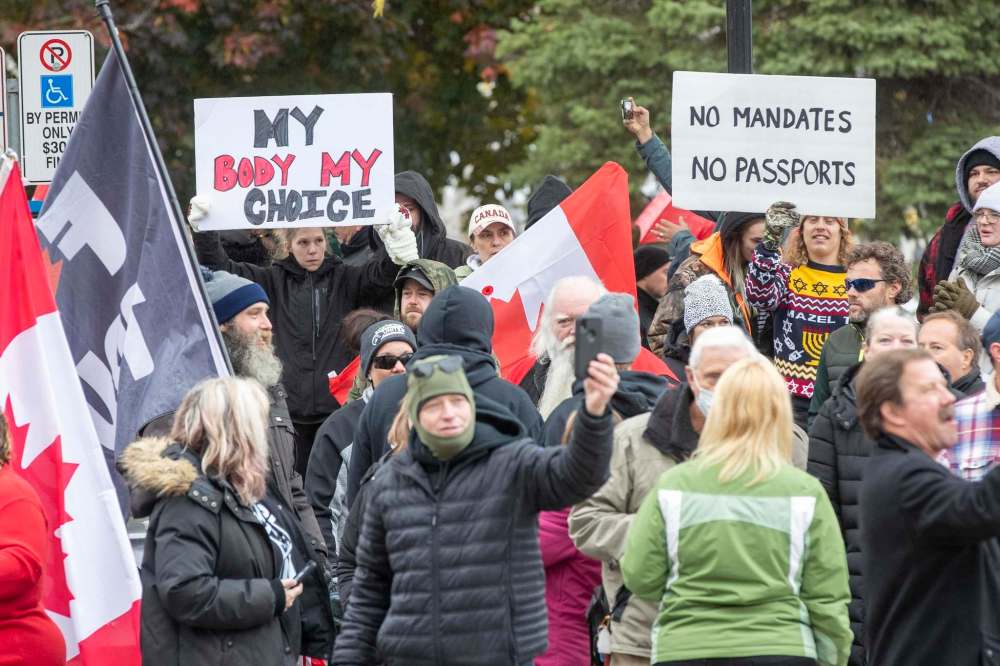
“A lack of trust and polarization have come home to roost,” said Rick Hiemstra, research director for the Evangelical Fellowship of Canada.
Probe Research polled 1,189 Manitobans for their thoughts on various aspects of COVID-19 and policy responses. The firm often asks about demographics, and sorts answers between Winnipeg and the rest of Manitoba.
But this time, Probe decided to also sort respondents by region, and ask them to indicate their religious views.
The polling suggests that while a majority of evangelicals are vaccinated, there are stark differences in how that faith community perceives COVID-19, beyond overlapping demographic and identity factors.
For example, some 22 per cent of evangelical respondents said they had no plan to get vaccinated, a sentiment held by just 10 per cent of rural Manitobans, 14 per cent of those living in the rural south, and just five per cent of the general population.
Evangelical scholar Nicholas Greco said numerous factors cause that gap, from a desire to rely on God for healing, to science clashing with creationism, to general skepticism of media and government.
“Evangelicals often are reflective of a social and political conservatism, which calls for smaller governments (and) personal autonomy, but also tends to lead to a mistrust of government,” said Greco, who is provost of Providence University College in Otterburne.
Greco, a longtime communications professor, said there’s a perception the government wants to control everyone, and that the media is overhyping the virus as part of some sort of conspiracy.
“The rhetoric I hear from many of my colleagues… is that we don’t want the government to have further control, because if they do, we will lose our freedoms,” he said.
“For too long evangelicals have been isolationist.”
That’s fuelled misinformation, originally with a disproven claim that COVID-19 vaccines contain tissues from aborted fetuses. At a recent panel, one congregant said everyone who got the vaccine is going to die within a few years, and that they’ll all go to hell.
“That doesn’t seem to fit, either scientifically or theologically,” Greco said.
He added the lack of a central evangelical authority, unlike other Christian movements, makes it harder to encourage vaccination.
Christian Scientists, for example, emphasize healing through prayer, but their central leadership in Boston spoke in favour of COVID-19 vaccinations.
Hiemstra, whose Ottawa group advocates for hundreds of evangelical churches, said officials need to try healing a rift caused by increasing polarization in Canadian society.
“It is a matter of trust and how that trust has been cultivated and stewarded, over decades but especially since the beginning of the pandemic, and it’s a question of equitable impacts,” he said.
Hiemstra noted that evangelicals used to vote Liberal roughly as much as other Canadians up until the past two decades, when mainstream politicians increasingly supported marriage equality and assisted suicide.
In that same period, surveys using what’s called the Bebbington quadrilateral show little change in the religious views held by evangelicals in Canada.
“Evangelicals as group have largely held to the beliefs you would have seen in 1996, but the rest of the population has moved in a direction that is (the) polar opposite,” he said.
Hiemstra argues authorities botched public-health communication when they referred to restrictions on “non-essential” gatherings and services, instead of using less value-loaded terminology, such as by describing events as posing a higher risk of coronavirus spread.
For example, there is a harm-reduction argument for allowing alcohol and cannabis sales even during a pandemic, as people might seek out those substances in more dangerous ways if authorities close shops, which can be operated at lower capacity.
Yet it’s jarring to many evangelicals to see buying booze deemed more essential than their worship services.
“The way that public-health restrictions were explained did not appear to be equitable, and they did not land evenly on different parts of the population,” said Hiemstra, noting evangelicals tend to have larger families, and thus might feel the impact of school closures more acutely than others.
To get higher vaccine uptake, Hiemstra suggested officials show some humility about how they’ve handled the pandemic, and work with faith leaders to acknowledge the fears people hold, even when those fears aren’t founded.

“The zero tolerance policies, I think, are counterproductive and they cement people in their fears,” he argued.
“Once they see that they are reasonably accommodated, then they may be open to a conversation, that might get them to a place where they would consider getting vaccinated.”
Evangelical groups unsuccessfully challenged public-health restrictions in court, where Manitoba officials argued they are trying to follow the evidence on how to prevent transmission. They had the same message Friday.
“We’ve always been in this together, and so we’ve never tried to target people; we’re trying to target where the virus is being transmitted,” said chief provincial public health officer Dr. Brent Roussin.
dylan.robertson@freepress.mb.ca
The Free Press is committed to covering faith in Manitoba. If you appreciate that coverage, help us do more! Your contribution of $10, $25 or more will allow us to deepen our reporting about faith in the province. Thanks! BECOME A FAITH JOURNALISM SUPPORTER
History
Updated on Monday, November 15, 2021 6:35 PM CST: Fixes typo.
The Free Press acknowledges the financial support it receives from members of the city’s faith community, which makes our coverage of religion possible.